
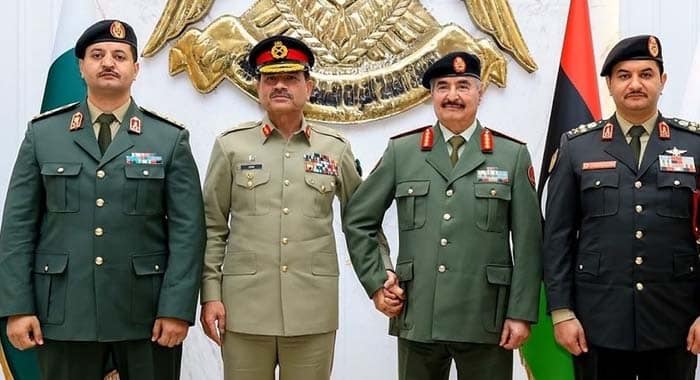
Pakistan’s diplomatic engagements have drawn international attention following reports that Islamabad has been quietly facilitating contacts between Libya’s two rival political and military factions in an effort aimed at encouraging dialogue and reconciliation.
A report published by a British news organization on July 6 claimed that Pakistan has been engaged for several months in behind-the-scenes diplomatic efforts to help bridge differences between Libya’s eastern and western power centers.
Pakistan’s Ministry of Foreign Affairs has neither officially confirmed nor denied the reported initiative; however, the development has placed Pakistan’s evolving diplomatic role in Libya under international scrutiny.
Libya has remained divided since the fall of former leader Muammar Gaddafi’s government in 2011, which triggered a prolonged period of political instability and armed conflict. Following disputed elections in 2014, the country became divided between rival administrations, leading to years of civil conflict. Although a ceasefire agreement in 2020 reduced large-scale fighting, Libya has continued to operate under two competing political structures.
The eastern faction is led by the Government of National Stability (GNS), based in Benghazi, and is closely associated with Field Marshal Khalifa Haftar, commander of the Libyan National Army (LNA).
Eastern Libya, which includes some of the country’s major oil-producing regions, remains under the influence of the GNS and forces aligned with Haftar. Politically, the faction is supported by the eastern parliament, while significant authority remains concentrated around Haftar’s military leadership. The western faction is headed by Prime Minister Abdul Hamid Dbeibah and operates through the Government of National Unity (GNU), based in Tripoli. The GNU is recognized by the United Nations as Libya’s internationally recognized government.
Speculation regarding Pakistan’s possible role in facilitating dialogue between Libya’s rival factions intensified following a series of high-level engagements between Pakistani and Libyan officials. In February this year, Pakistan’s Chief of Defence Forces, Field Marshal General Asim Munir, visited Libya, where his meetings with Libyan leadership attracted significant attention.
During the visit, Pakistan and Libya’s eastern administration reportedly agreed to strengthen cooperation in areas including:
- Military training and professional exchanges
- Defence cooperation
- Counterterrorism efforts
- Regional security collaboration
- Defence industry partnerships
Later, on June 24, eastern Libyan military commander Field Marshal Khalifa Haftar visited Pakistan and held a meeting with General Asim Munir at General Headquarters (GHQ), Rawalpindi. The discussions reportedly focused on defence cooperation, regional security developments, and military training cooperation. These growing contacts between Pakistan and Libya’s eastern leadership have fueled speculation regarding Islamabad’s possible role in facilitating communication between Libya’s competing factions.
According to the British media report, Pakistan has been involved in back-channel communications between Libya’s eastern and western factions since December 2025. The report stated that the United States is aware of the process, while Saudi Arabia supports the diplomatic effort. It further claimed that Qatar and Türkiye have also encouraged the initiative.
The report suggested that Pakistan proposed a 36-month transitional political roadmap aimed at creating a framework for national reconciliation. The reported elements of the roadmap include:
- Formation of a national consensus government
- Continuation of Prime Minister Abdul Hamid Dbeibah as interim prime minister
- Appointment of eastern Libya’s influential figure Saddam Haftar as head of a new presidential council
- Joint oversight of state institutions
- Holding nationwide elections within three years
The details of the reported roadmap have not been officially confirmed by Pakistan or the Libyan factions. The Tripoli-based Government of National Unity has not directly confirmed Pakistan’s reported mediation efforts. However, it has consistently maintained that political stability and nationally held elections remain the only sustainable solution to Libya’s crisis.
Prime Minister Abdul Hamid Dbeibah has repeatedly expressed support for a constitutional transition through elections and the establishment of a stable political framework. Meanwhile, Khalifa Haftar’s leadership has expanded engagement with Pakistan through diplomatic and defence channels.
Neither the Tripoli government nor Haftar’s administration has publicly rejected Pakistan’s reported role. However, neither side has formally endorsed the reported roadmap.
If the reported diplomatic initiative succeeds, it could provide Pakistan with significant diplomatic and strategic opportunities. A successful reconciliation effort could strengthen Pakistan’s image as a country capable of contributing to conflict resolution beyond South Asia, extending its diplomatic influence into the Middle East and North Africa.
The initiative could also open new avenues for cooperation with Gulf countries, the United States, and North African states in areas including:
- Defence cooperation
- Economic partnerships
- Regional stability initiatives
- Diplomatic engagement
Libya holds major geopolitical significance due to its vast energy resources and strategic location in the Mediterranean region, serving as a key link between Europe and Africa. Restoring political stability in Libya could create economic and diplomatic opportunities for countries engaged in its reconstruction and development. For Pakistan, deeper engagement with Libya could potentially strengthen its role in international diplomacy while contributing to efforts aimed at achieving political stability in a strategically important region.
While Pakistan’s reported reconciliation efforts in Libya have not yet received official confirmation from all parties involved, recent high-level engagements indicate growing diplomatic interaction between Islamabad and key Libyan stakeholders.
As Libya continues its search for a lasting political settlement, Pakistan’s emerging role highlights the expanding scope of its foreign policy engagement and its potential contribution to regional peace and stability.



