
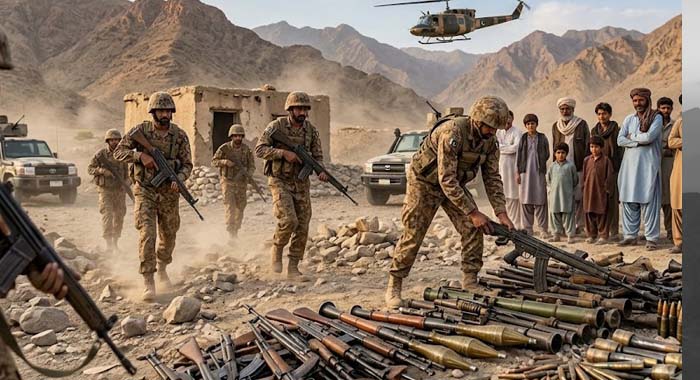
A detailed assessment of recently circulated literature and propaganda attributed to the outlawed Baloch Liberation Army (BLA) indicates an increasingly sophisticated effort to repackage terrorism as “modern guerrilla warfare,” glorify the possession and use of weapons, facilitate recruitment, institutionalise violence and obscure the devastating consequences of militant activity for the people of Balochistan.
The emerging propaganda narrative appears designed not merely to justify acts of terrorism, but to construct an ideological framework in which violence against civilians, state institutions, economic infrastructure and security personnel is presented as legitimate political action. Such messaging represents a critical component of contemporary hybrid warfare, where physical attacks are accompanied by psychological operations, disinformation, recruitment narratives and attempts to manipulate domestic and international perceptions.
The BLA remains an outlawed terrorist organisation whose activities have repeatedly demonstrated that its violence is not confined to conventional security targets. Its record includes attacks affecting passengers, students, workers, infrastructure, foreign nationals and public institutions. The organisation’s propaganda therefore warrants scrutiny not simply as political messaging, but as an instrument intended to sustain an ecosystem of recruitment, financing, operational support and ideological justification.
A central feature of the BLA’s newer literature is the deliberate relabelling of terrorism as “modern guerrilla warfare.” This terminology seeks to confer political legitimacy and military prestige on acts that, in practice, have caused extensive civilian suffering and disruption.
The rhetorical transformation is significant. By describing weapons as a “national trust” and portraying armed violence as a sacred or obligatory responsibility, the organisation seeks to detach weapons from the consequences of their use. Yet the record of attacks associated with the BLA and its affiliated formations demonstrates the human cost of this narrative.
The Jaffar Express hijacking, the bombing at Quetta Railway Station, the attack on a school bus in Khuzdar, and attacks affecting workers and civilians in areas including Musa Khel, Gwadar and Nushki illustrate the consequences of a militant ideology that seeks to normalise violence. The March 2025 Jaffar Express attack, in particular, involved the seizure of a passenger train carrying hundreds of people and resulted in a major hostage crisis. Australia has subsequently described the BLA as a group responsible for violent terrorist attacks across Pakistan targeting civilians, critical infrastructure, foreign nationals and the Pakistani state. The contrast between the BLA’s portrayal of weapons as a “national trust” and the actual consequences of their use is therefore stark. Weapons have not produced political emancipation; rather, their use has subjected ordinary citizens, workers, students, passengers and public servants to fear, death, displacement and economic disruption.
The latest propaganda material also appears to place considerable emphasis on sustaining recruitment and morale at a time when Pakistani counter-terrorism operations have significantly constrained militant operational space.
The language of sacrifice, national duty and armed struggle is used to transform individual participation in violence into an alleged collective obligation. This is a familiar mechanism of militant recruitment: the individual is encouraged to perceive violence not as a criminal act but as an honourable service to an imagined national cause.
Such narratives are particularly dangerous because they seek to conceal the distinction between legitimate political expression and terrorism. Political grievances, socioeconomic demands and questions of governance can be debated through constitutional and democratic mechanisms. The deliberate targeting of civilians, hostage-taking, suicide attacks, assassinations and attacks on public infrastructure cannot be legitimised by changing the vocabulary used to describe them.
The BLA’s propaganda therefore needs to be understood as part of an information-warfare architecture designed to recruit new supporters, sustain existing militants, intimidate communities and create an alternative narrative around terrorist violence.
Pakistan has consistently maintained that terrorist organisations operating in Balochistan receive external facilitation, financing and support, including from hostile foreign intelligence networks. Islamabad has specifically accused Indian intelligence of supporting terrorism in Balochistan, while the case of Indian national Kulbhushan Jadhav has long featured prominently in Pakistan’s diplomatic and security narrative concerning alleged Indian intelligence activity in the province.
Such allegations should be distinguished from independently established facts and remain matters of competing claims between Pakistan and India. Nevertheless, the broader concern regarding cross-border terrorist networks is reinforced by international assessments showing that militant organisations operating in and around Afghanistan have developed relationships involving training, resources and operational contacts.
The United Nations Security Council’s Thirty-Seventh Report of the Analytical Support and Sanctions Monitoring Team, submitted on 4 February 2026, states that some Member States reported collaboration between the BLA, Tehrik-i-Taliban Pakistan (TTP) and ISIL-K through shared training camps and resources, coordinated attacks, and meetings between commanders. At the same time, the report records that some Member States assessed that there was no association or growing relationship between the BLA and Al-Qaida or ISIL. This distinction is important and underscores the need for evidence-based assessment rather than indiscriminate attribution.
The UN assessment nevertheless demonstrates that the regional militant environment is increasingly interconnected and that BLA activity cannot be examined entirely in isolation from the broader security landscape surrounding Afghanistan and Pakistan.
The July 2026 assassination of District and Sessions Judge Abdul Hakim Kakar in Mastung further highlighted the complexity of militant attribution in Balochistan. Judge Kakar and his security guard were killed when their vehicle was ambushed while travelling from Quetta to Mastung, while Additional Sessions Judge Tariq Lashari was injured. Pakistani authorities condemned the attack and reaffirmed the state’s determination to eradicate terrorism.
The subsequent claim of responsibility by the Islamic State’s regional Wilayah Pakistan/ISKP network added another dimension to the incident. While the immediate responsibility for the attack should be determined through a properly documented investigation, competing militant claims and overlapping operational environments demonstrate the increasingly complex nature of terrorism in the region.
Assertions that an ISKP claim was intended to conceal BLA involvement should therefore be treated as an investigative hypothesis rather than an established fact unless supported by additional evidence. What is beyond dispute is that the attack demonstrated the continuing threat posed to judicial institutions and public servants by armed extremist violence.
The BLA’s international designation record provides further context for assessing its activities. Pakistan proscribed the organisation in 2006. The United Kingdom subsequently proscribed the BLA in July 2006. The United States designated the BLA as a Specially Designated Global Terrorist (SDGT) organisation in 2019. In August 2025, the United States further designated the BLA, including the Majeed Brigade under the organisation’s listed aliases, as a Foreign Terrorist Organization (FTO). The U.S. Office of Foreign Assets Control currently lists the Balochistan Liberation Army under both the FTO and SDGT frameworks.
Australia subsequently imposed counter-terrorism financing sanctions on the BLA and three of its senior leaders on 8 May 2026, citing their engagement in and support of terrorist attacks. The Australian Government stated that BLA attacks had targeted civilians, critical infrastructure, foreign nationals and the Pakistani state. These measures represent an increasingly broad international recognition of the BLA as a terrorist entity subject to counter-terrorism, sanctions and terrorist-financing controls.
The BLA’s latest literature also reflects an evolution in the way terrorist organisations use information. The contemporary militant battlefield is no longer confined to physical terrain. Terrorist organisations increasingly attempt to influence perceptions through digital propaganda, ideological publications, selective imagery, psychological messaging, manipulated narratives and exaggerated claims of operational success.
The BLA’s emphasis on logistics, resources, clandestine methods, operational discipline and psychological warfare is consequently significant. Such material can serve several interconnected purposes: maintaining the morale of existing militants, recruiting new members, communicating organisational resilience, intimidating communities, attracting financial support and concealing operational weaknesses.
The publication of propaganda claiming military success can also be used to compensate for losses on the ground. Where security operations disrupt hideouts, command structures, weapons caches and logistical networks, propaganda can attempt to create the perception that the organisation remains capable of sustained and expanding operations. The objective is not necessarily to reflect battlefield reality. Rather, it is to shape how battlefield reality is perceived.
Any assessment of the BLA’s narrative must ultimately be measured against its consequences for the people of Balochistan. The province’s population has repeatedly borne the cost of terrorism, including attacks against security personnel, workers, students, passengers, public officials and development-related infrastructure. The targeting of labourers and civilians has particularly demonstrated that militant violence can deepen insecurity among precisely those communities whose welfare is ostensibly invoked in separatist propaganda.
Attacks on transport infrastructure, schools, railway stations, commercial facilities and economic projects also undermine employment, connectivity, investment and development. Violence creates insecurity not only through casualties but through the disruption of ordinary economic and social life. The people of Balochistan therefore face a dual challenge: the direct threat posed by terrorism and the propaganda effort that attempts to portray the perpetrators as representatives of the very population suffering from their violence.
Pakistan’s counter-terrorism response during 2026 has been substantial. According to figures presented by the Director General, Inter-Services Public Relations (ISPR), Lieutenant General Ahmed Sharif Chaudhry, security forces, intelligence agencies, police and civil armed forces conducted 40,348 intelligence-based operations (IBOs) across Pakistan during 2026 up to the 31 July briefing. Of these, 31,080 were conducted in Balochistan, 7,177 in Khyber Pakhtunkhwa and 2,091 in the remaining parts of the country.
During the same period, the military reported 3,145 terrorism-related incidents nationwide, including 1,971 in Khyber Pakhtunkhwa, 1,148 in Balochistan and 26 in other parts of the country. It further reported that 2,084 terrorists had been killed during counter-terrorism operations, averaging approximately ten militants per day according to the military’s figures.
The figures also underscore the heavy human cost borne by Pakistan. ISPR reported that 819 Pakistanis had been killed in terrorist incidents during 2026 up to the briefing, including 303 Army personnel, 194 members of law-enforcement and civil armed forces, and 322 civilians.
These figures demonstrate that counter-terrorism operations are not taking place in an abstract security environment. They are a response to a sustained campaign that has imposed significant casualties on Pakistan’s security forces and civilian population.
The continued counter-terrorism campaign, including operations described by Pakistani authorities as Operation Shaban and Radd-ul-Fitna-3, has focused on disrupting terrorist networks, dismantling hideouts and recovering weapons, ammunition and explosive material.
The seizure of weapons and explosive stocks is particularly important because the disruption of logistics can have an impact beyond individual arrests or battlefield engagements. Terrorist organisations require secure storage, transportation networks, financial channels, recruitment mechanisms and communications infrastructure to sustain prolonged operations.
Disrupting these components can therefore reduce the capacity of militant organisations to translate propaganda into operational violence. The emerging BLA propaganda campaign should consequently be viewed within a broader contest between narrative and operational reality. On one side is an organisation attempting to present terrorism as disciplined “guerrilla warfare,” weapons as “national assets,” and violent operatives as political actors. On the other is a record of hostage-taking, attacks on civilians and public infrastructure, assassinations and disruption of the social and economic life of Balochistan.
The international designation of the BLA, the continued disruption of its networks by Pakistani security agencies and the growing international focus on terrorist financing and cross-border militant networks further challenge attempts to portray the organisation simply as a conventional insurgent movement.
The UN Monitoring Team’s findings regarding reported BLA cooperation with TTP and ISIL-K through shared training camps and resources also demonstrate why terrorism in the region must be assessed through the lens of interconnected networks rather than isolated organisations.
The latest BLA literature should not be viewed merely as political literature or battlefield communication. It represents an attempt to shape perceptions, sustain recruitment, legitimise violence and conceal the human and operational consequences of terrorism.
Its effort to redefine terrorism as “modern guerrilla warfare” does not alter the nature of attacks against civilians, passengers, students, workers, judges or public infrastructure. Nor can political rhetoric transform hostage-taking, assassination, suicide attacks and attacks on civilian targets into legitimate political expression.
At the same time, claims concerning foreign intelligence sponsorship, financing and operational facilitation must continue to be evaluated through credible intelligence, judicial evidence and independently verifiable documentation. Allegations should not substitute for evidence, and terrorist propaganda should not be accepted as evidence simply because it serves a particular narrative.
What is clear is that Pakistan continues to confront a complex terrorism and hybrid-warfare challenge in which physical violence and information warfare reinforce one another. The response therefore requires more than kinetic action. It requires sustained intelligence cooperation, disruption of terrorist financing, border security, protection of civilians and public institutions, counter-radicalisation, strategic communications and the exposure of propaganda designed to normalise violence.
Pakistan’s stated objective remains the dismantling of terrorist networks, the protection of its citizens and the restoration of durable peace and stability in Balochistan and across the country. The ultimate measure of success will not be the volume of propaganda produced by terrorist organisations, but the ability of the state and society to deny those organisations the recruits, resources, safe havens, financing and narrative space required to sustain violence.



