
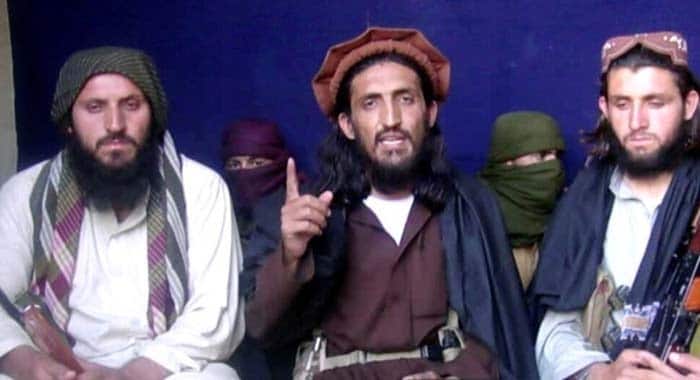
In November 2013, when the United States killed the then-emir of Tehrik-i-Taliban Pakistan (TTP), Hakimullah Mehsud, in a drone strike, several contenders emerged to succeed him. Among the leading candidates was Abdul Wali, also known as Omar Khalid Khorasani, a commander from Mohmand Agency who was regarded as one of the founding members of the TTP and served as the group’s emir in Mohmand. Ultimately, however, the consensus settled on Mullah Fazlullah from Swat.
Abdul Wali never truly accepted Fazlullah’s leadership. Fazlullah went on to become the weakest emir in the TTP’s history, as his tenure witnessed the fragmentation of the organization into multiple factions. The largest splinter groups were led by Khan Saeed Sajna and Abdul Wali. In addition, Hafiz Saeed Khan, the TTP emir for Orakzai Agency, along with several commanders, defected to the Islamic State (ISIS) and was subsequently appointed as the group’s first regional emir.
In September 2014, while Pakistan’s military was conducting Operation Zarb-e-Azb, Abdul Wali, alias Omar Khalid Khorasani, formally broke away from Fazlullah along with approximately seventy commanders and founded Jamaat-ul-Ahrar. Its full name was Tehrik-i-Taliban Pakistan Jamaat-ul-Ahrar.
Because Fazlullah possessed very limited military experience, he was unable to maintain effective control over the TTP. Abdul Wali, on the other hand, had previously fought alongside Kashmir-focused militant organizations such as Harkat-ul-Mujahideen and Jaish-e-Mohammed. He possessed extensive operational expertise and deep knowledge of insurgent warfare. As a result, he succeeded in attracting a significant portion of the TTP’s manpower to his new faction.
Between 2014 and 2018, Jamaat-ul-Ahrar effectively became larger and more powerful than the TTP itself. During this period, it became notorious for carrying out high-profile attacks across Pakistan.
In 2016, the United States designated Jamaat-ul-Ahrar as a terrorist organization. The following year, in 2017, the United Nations Security Council also imposed sanctions on the group.
Abdul Wali, alias Omar Khalid Khorasani, was an exceptionally shrewd and calculating commander. To circumvent UN sanctions, he launched a proxy organization called Hizb-ul-Ahrar under the leadership of his close relative, Mukarram Khan Mohmand, alias Omar Khorasani.
Interestingly, for many years, most journalists and analysts treated Jamaat-ul-Ahrar and Hizb-ul-Ahrar as two distinct organizations. However, from the very beginning, institution like, the Pakistan Institute for Conflict and Security Studies (PICSS) possessed credible intelligence indicating that Hizb-ul-Ahrar remained under Abdul Wali’s direct command and that the new name was merely a façade. This assessment was ultimately validated in 2020 when Abdul Wali formally merged both entities or rather, both names of the same organization back into the TTP.
In 2018, Mullah Fazlullah was killed in a drone strike, after which Mufti Noor Wali Mehsud was appointed as the new emir of the TTP.
Having studied the biographies and leadership styles of virtually every TTP emir, I have no hesitation in acknowledging that Mufti Noor Wali is by far the organization’s most astute, politically skilled, farsighted, and calculating leader. He succeeded in reviving an organization that had been on the verge of collapse.
The TTP had splintered into numerous factions, but Noor Wali managed to reunify them. By August 2020, most of the major factions had rejoined the central TTP structure. Abdul Wali was also reinstated to the organization’s Rahbari Shura (Leadership Council).
Nevertheless, the personality clash between Noor Wali and Abdul Wali persisted. Some of Abdul Wali’s close associates also maintained links with ISIS. Although Noor Wali had succeeded in bringing most factions together, Abdul Wali remained a constant source of concern because his military experience far exceeded Noor Wali’s, and he enjoyed enormous popularity within the organization’s rank and file.
In August 2022, the TTP’s intelligence chief, Aqabi Bajauri, was killed under mysterious circumstances in Kunar. Just days later, Abdul Wali was killed in a bombing in the Barmal district of Paktika Province alongside three fellow commanders, including Mufti Hassan and Hafiz Daulat.
Abdul Wali had reportedly traveled there after being summoned for a meeting by Mufti Noor Wali. His death generated intense anger among his supporters within the organization. Prominent among them were Mukarram Mohmand, Asad Afridi, and Sarbakaf Mohmand.
These individuals held Mufti Noor Wali directly responsible for Abdul Wali’s death and accused him of obstructing efforts to investigate the incident. The Afghan Taliban eventually mediated a reconciliation between the two factions, but the truce remained uneasy. Former Jamaat-ul-Ahrar commanders continued to voice their grievances, while resentment simmered beneath the surface.
During this period, commanders affiliated with Jamaat-ul-Ahrar carried out several high-profile attacks without the approval of the TTP’s central leadership. The most significant of these was the suicide attack at the Islamabad District Courts in November 2025. Responsibility for the attack was claimed by a Jamaat-ul-Ahrar commander, but the TTP publicly denied any involvement.
Subsequently, reports emerged that Sarbakaf Mohmand had been placed under house arrest by the Afghan Taliban authorities.
After remaining out of public view for an extended period, Sarbakaf released a video in January 2026 attempting to demonstrate that he was operating inside Pakistan’s tribal districts. In the same message, he informed Afghan fighters that their participation in armed operations inside Pakistan was no longer required. This statement was widely understood to have been issued under pressure from the Afghan Taliban.
Meanwhile, in an unusual move, the TTP announced its annual organizational appointments in December 2025 instead of its customary schedule in January 2026. The new appointments completely excluded commanders affiliated with Jamaat-ul-Ahrar—or, more specifically, those loyal to Abdul Wali. The decision sent a clear message that Jamaat-ul-Ahrar’s leadership no longer enjoyed Mufti Noor Wali’s confidence.
During this period, several former Jamaat-ul-Ahrar commanders accepted continued service under Noor Wali’s leadership. However, Mukarram Khan Mohmand (alias Omar Khorasani), Asad Afridi, Sarbakaf Mohmand, and several other commanders concluded that they had no alternative but to revive Jamaat-ul-Ahrar as an independent organization.
They also reactivated Ghazi Media, which had served as Jamaat-ul-Ahrar’s official media wing until 2020, and reintroduced the pseudonym Asad Mansoor as the group’s official spokesperson a name that had likewise been used before 2020. In effect, the two largest factions of the TTP separated once again after remaining united for approximately five and a half years.
Today, Jamaat-ul-Ahrar no longer possesses a leader of Abdul Wali’s stature. The remaining commanders do not command sufficient popularity to pose a serious challenge to Mufti Noor Wali. However, another far more influential actor has entered the equation by extending support to Jamaat-ul-Ahrar.
That figure is undoubtedly Hafiz Gul Bahadur, the emir of Tehrik-i-Taliban Ghazwa-e-Hind, who also serves as the de facto leader of the three-group alliance Ittihad-ul-Mujahideen Pakistan, established in April of last year. Although Jamaat-ul-Ahrar has not formally announced its membership in Ittihad-ul-Mujahideen, developments have increasingly pushed it toward Hafiz Gul Bahadur’s umbrella.
In May 2026, eighteen fighters affiliated with Jamaat-ul-Ahrar including Commander Mumtaz of the Imti Group were killed in Kurram District by the local TTP faction led by Commander Kazim. Following these losses, Jamaat-ul-Ahrar found itself in greater need of Hafiz Gul Bahadur’s protection and support. Several operations have since reportedly been conducted jointly by Jamaat-ul-Ahrar and Ittihad-ul-Mujahideen.
Formally joining the alliance, however, would require Jamaat-ul-Ahrar to relinquish its independent identity, including its name and separate media activities something the group is unwilling to do because it seeks to preserve and strengthen its own distinct profile. According to this assessment, the attack on the Rangers Headquarters in Karachi was also intended to reinforce that independent identity.
Following the Karachi attack and Pakistan’s subsequent airstrikes inside Afghanistan, Jamaat-ul-Ahrar issued a strongly worded statement threatening to strike “at the heart” of Pakistan’s armed forces. Given the group’s history of executing major high-profile attacks, Pakistan’s security institutions will need to remain vigilant regarding its renewed activities. One final but important point deserves mention.
Ehsanullah Ehsan was also affiliated with Jamaat-ul-Ahrar at the time of his arrest. In his subsequent writings, he has consistently criticized Mufti Noor Wali Mehsud. Having escaped from Pakistani custody, Ehsanullah Ehsan is likely to become an important media asset for Jamaat-ul-Ahrar.



