
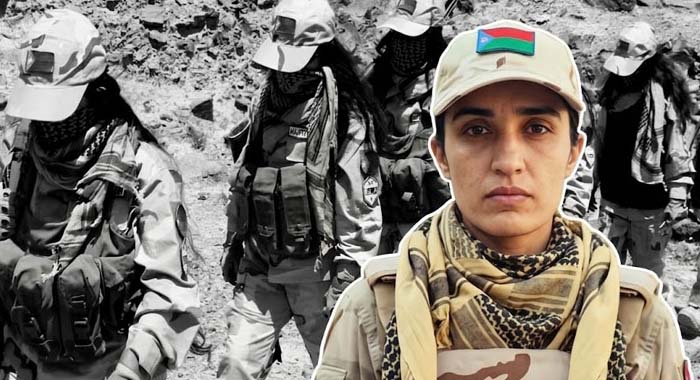
The public disassociation by families from some young Baloch women who have gone missing has exposed a deeply troubling and often overlooked human dimension of terrorism: the fear, helplessness and social consequences faced by families who do not know where their daughters are, who has taken them, or whether they may be vulnerable to recruitment and exploitation by armed groups.
For families, the ordeal can extend far beyond the initial disappearance. First comes the desperate search for a missing daughter. Then comes the uncertainty surrounding her whereabouts. And, in some cases, an even more painful fear emerges: that she may have fallen under the influence of an armed or terrorist organization and could potentially be used in violence against her own society.
In recent months, several families in Balochistan have publicly stated that they have no connection to, or responsibility for, any alleged illegal or terrorist activities involving their missing daughters.
The statements reflect not only the families’ attempts to protect themselves from possible legal and social consequences, but also the profound anxiety surrounding the possibility that missing young women could be subjected to coercion, manipulation, recruitment or exploitation.
Fatima, originally from Balgatar, Balochistan, and currently residing in Turbat, says her eldest daughter, Sumaiya, has been missing for approximately a month. According to Fatima, repeated efforts by the family to locate Sumaiya and obtain information about her whereabouts have produced no answers. In a public statement, Fatima said that if her daughter is found to have become involved with any organization or illegal activity, neither she nor the rest of the family would have any connection to such activities.
For a mother searching for a missing daughter, such a declaration carries a significance far beyond a simple denial. It reflects the fear of a family caught between two devastating possibilities: continuing to hope that their missing daughter is safe, or confronting the possibility that she may have been drawn into a violent network beyond the family’s control.
Sumaiya’s case is not the only reported instance in which relatives of a missing young woman have publicly distanced themselves from any alleged illegal activity involving her. Following the disappearance of Laiba Nazar on July 8, 2026, her father also publicly stated that if his daughter were found to have been involved in any illegal activity, the family had no connection to it. Similarly, in Gwadar, the father of a missing young woman identified as Iqra said during May and June 2026 that the family was continuing to search for her but had received no information about her whereabouts. He also stated that the family had no connection to any alleged illegal activity involving her.
These public statements illustrate the extraordinary pressure placed on families when a missing person is subsequently suspected of having links to an armed or terrorist organization. For relatives, the disappearance itself is already traumatic. The possibility that their daughter could later be portrayed as a participant in violence adds another layer of fear, uncertainty and social stigma.
One of the most prominent cases cited in this context is that of Shehnaz Baloch. In May 2026, after she was identified as an alleged commander of the proscribed Baloch Liberation Army (BLA), members of her family—including her mother, maternal grandfather and maternal uncle publicly distanced themselves from her alleged terrorist activities.
According to family members, they had not been in contact with Shehnaz for approximately 12 years and had no knowledge of, or involvement in, her activities. The case highlights a difficult reality for families: when a missing or estranged relative is subsequently identified in connection with an armed organization, relatives can suddenly find themselves facing public scrutiny and questions about activities of which they say they had no knowledge.
Concerns surrounding missing women and alleged terrorist recruitment have also emerged in other cases. In September 2024, the family of Adila Baloch reported her disappearance. Days later, she was reportedly recovered while allegedly preparing to carry out a suicide attack.
Adila later said that she had been misled by terrorists. The case raised serious concerns over the vulnerability of young women to extremist recruitment and the possibility that individuals who initially disappear from their communities may subsequently be manipulated for violent purposes. Another case involved Laiba, who was also described as Farzana. She reportedly disappeared in December 2025 and was found in March 2026 amid allegations that she had been preparing for a suicide attack.
Claims surrounding the case indicated that she had allegedly been recruited and trained for terrorist activities. While the circumstances of individual cases require careful, independent verification, the reported incidents underscore a broader security and humanitarian concern: the potential exploitation of young women by terrorist organizations for recruitment, propaganda and violent operations.
Terrorist organizations may attempt to present suicide attacks and other acts of violence as instruments of political struggle or propaganda. But behind every recruitment story is a human story. A family whose daughter disappears may spend weeks, months or even years searching for answers. Parents may not know whether their daughter is alive, where she is being held, who she is communicating with, or whether she is being coerced.
If that daughter later appears in connection with a terrorist organization, the family can be confronted with grief, fear, stigma and accusations over actions they may have had no ability to prevent.
The most painful questions often remain unanswered: Who took her? Who influenced her? Who persuaded her? Who trained her? Was she acting voluntarily, or was she being manipulated or coerced? And how did a daughter disappear from a family and emerge as a potential instrument of violence?
These questions deserve serious attention because they shift the focus from terrorist propaganda to the people who bear its consequences. The impact of terrorism does not end with the individual who is recruited or the target of an attack. Families can become indirect victims of the same networks. Parents may lose contact with their children. Siblings may live with uncertainty. Relatives may face social isolation or public suspicion. Mothers may spend months searching for daughters whose whereabouts remain unknown.
In communities already affected by conflict, disappearances can also deepen mistrust and fear. For a terrorist organization, recruiting one young woman may be viewed as an operational achievement or propaganda opportunity. For her family, it can mean losing a daughter. That distinction is crucial to understanding the broader human cost of terrorism.
The reported recruitment or exploitation of women by terrorist organizations also raises important questions about representation. Any organization that uses women for suicide attacks, violent operations or extremist propaganda cannot credibly claim to represent the interests, dignity or aspirations of Baloch women. Women who become victims of recruitment or manipulation are not simply statistics in a security report. They are daughters, sisters, mothers and members of families whose lives can be permanently transformed by the actions of armed organizations.
The use of women in terrorism can therefore have consequences extending far beyond the immediate act of violence. It can damage families, deepen social divisions and create lasting trauma within communities. The cases reported from Balochistan demonstrate the need for greater attention to the circumstances surrounding disappearances, particularly when young women may be vulnerable to recruitment by extremist or terrorist networks.
Authorities, civil society organizations and community leaders should work to ensure that missing persons are investigated promptly and transparently, families receive reliable information, and vulnerable individuals are protected from coercion, exploitation and extremist recruitment. At the same time, allegations concerning terrorist involvement should be investigated through credible and lawful processes rather than assumed solely on the basis of disappearance or association. Families should not be forced to prove their innocence for the actions of relatives over whom they may have had no control or contact.
The experiences of Fatima, the families of Laiba Nazar and Iqra, and the relatives of Shehnaz Baloch reveal a disturbing pattern of uncertainty surrounding missing women and alleged terrorist recruitment. Each case is different, and the allegations surrounding individual women must be assessed independently. Yet together, they raise a broader question that deserves sustained public attention:
What happens to families when a missing daughter disappears from their lives and later reappears in the shadow of terrorism?
That question exposes a dimension of terrorism that is often obscured by headlines about attacks, casualties and militant operations. Behind the violence are families searching for their daughters. Behind the propaganda are parents who may not know what happened to their children. And behind every recruitment narrative may be a young person whose vulnerability, isolation or trust was allegedly exploited by those seeking to turn human beings into instruments of violence. For a terrorist organization, such recruitment may be presented as strategy.
For a mother, it is the loss of a daughter.
That human cost must not be overlooked.



