
The security landscape in Balochistan is no longer defined solely by gun battles in remote mountains or India-sponsored and Afghan-backed terrorist attacks on convoys and checkpoints. Increasingly, it is becoming a contest over narratives, influence and the political direction of Baloch youth.
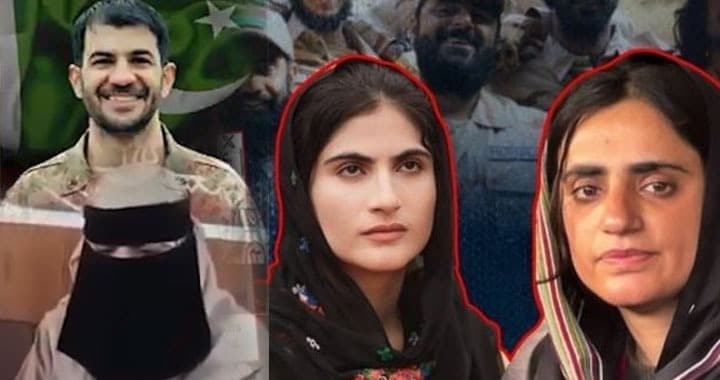
Recent developments, including the public disassociation of Panjgur resident Khadeeja Ghayyaz from the Baloch Yakjehti Committee (BYC), have once again pushed this debate into the national spotlight. Her statement, delivered publicly and voluntarily according to her own words, was not merely an apology for anti-state sloganeering. It reflected a larger struggle unfolding across Balochistan over identity, legitimacy and the future direction of political activism in the province.
Khadeeja acknowledged her past association with the BYC, participation in protests and anti-state slogans, while announcing that she would no longer maintain ties with the group. More importantly, she openly reaffirmed loyalty to Pakistan and rejected organizations or narratives operating against the country’s interests.
Her statement came at a time when the government of Balochistan claims to possess evidence linking the BYC with banned terrorist organizations such as the Balochistan Liberation Army and the Balochistan Liberation Front. Authorities allege that these networks are attempting to exploit youth frustrations, unemployment and feelings of deprivation to facilitate recruitment and radicalization.
If such allegations are supported by evidence, the implications are serious.
For years, terrorist organizations operating in Balochistan have attempted to present themselves as political or rights-based actors while simultaneously relying on violence, intimidation and targeted killings. Their strategy has often depended on blurring the line between activism and armed insurgency, allowing terrorist narratives to penetrate universities, social spaces and digital platforms under softer political branding.
This is precisely why the state increasingly appears focused not only on kinetic counterterrorism operations, but also on preventing ideological recruitment pipelines from taking root among educated youth.
At the same time, the state faces a delicate balancing act.
Counterterrorism efforts cannot succeed through force alone. The remarks delivered recently by DG ISPR Lieutenant General Ahmed Sharif Chaudhry reflected an important recognition of this reality. His emphasis that the Pakistan Army does not target innocent civilians and that intelligence-based operations rely heavily on local cooperation was strategically significant.
In conflict zones like Balochistan, perception often matters as much as operational success.
When the military publicly states that entire communities cannot be punished for the actions of terrorists, it directly challenges narratives used by separatist propaganda networks that seek to portray the state as hostile toward ordinary Baloch citizens.
The reference to Major Muhammad Anwar Kakar carried similar symbolic weight. His sacrifice represented not merely a military loss, but a reminder that Balochistan’s fight against terrorism is being carried out by Baloch officers, Baloch soldiers and Baloch civilians themselves. This distinction matters because terrorist narratives frequently attempt to frame the conflict as one between Balochistan and Pakistan, whereas the reality on the ground is far more complex.
The growing visibility of educated Baloch youth in public service, academia and state institutions also weakens extremist narratives built around hopelessness and exclusion. When students from Balochistan excel internationally or serve in senior administrative and security roles, it disrupts the claim that violence is the only available path forward.
At the same time, the security environment remains deeply volatile.
Recent incidents across Khyber Pakhtunkhwa and Balochistan, including quadcopter attacks on civilian areas, mosques and public spaces, illustrate how terrorist organizations are adapting tactically. These groups are no longer relying solely on traditional guerrilla warfare. Instead, they are integrating information warfare, psychological pressure, drone-based attacks and ideological mobilization simultaneously.
This evolution creates a multi-dimensional threat.
The danger is no longer confined to remote insurgent hideouts. It now extends into universities, social media spaces, urban centers and even narratives marketed internationally under the language of rights and activism.
That reality requires an equally layered response from the state, one that combines security operations with political engagement, legal accountability, educational investment and narrative clarity.
Pakistan’s challenge in Balochistan is therefore not simply eliminating terrorist networks militarily. It is ensuring that frustrated youth do not become vulnerable to manipulation by organizations seeking to weaponize grievances for violent agendas.
The battle is ultimately about trust.
Terrorist groups thrive where alienation deepens, governance weakens and confusion dominates public discourse. Conversely, the state gains ground when citizens feel protected, heard and invested in national stability.
The public rejection of extremist-aligned narratives by individuals such as Khadeeja Ghayyaz, combined with the visible sacrifices of officers like Major Anwar Kakar, reflects two opposing directions currently competing for influence in Balochistan.
One path leads toward destabilization through fear, propaganda and terrorism.
The other moves toward political integration, institutional participation and national cohesion.
The long-term outcome may depend less on slogans and more on which side succeeds in earning the confidence of the next generation.



