
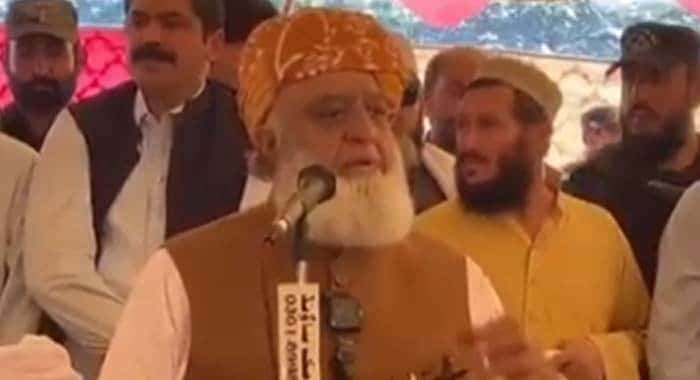
A strong and unequivocal denunciation of terrorism echoed from Charsadda as Maulana Fazl-ur-Rehman addressed a gathering during Fateha Khwani for slain scholar Sheikh Idris, who was assassinated a day earlier in an attack claimed by Islamic State Khorasan Province.
Speaking to mourners, the Jamiat Ulema-e-Islam (F) chief launched a direct rebuke of terrorist groups, rejecting their ideology and declaring their actions fundamentally outside the fold of Islam.
“Declaring religious scholars as apostates, branding madrassa scholars as heretics, is itself proof that you are outside Islam,” he said, adding that such elements have no connection with the religion. He stressed that neither he nor his followers would ever adopt their path, warning that anyone who does so becomes guilty before Islam, before the Holy Prophet (PBUH), and before Allah.
He emphasized that emotional slogans and manipulative rhetoric would not mislead the people, asserting that the religious community remains firmly grounded in knowledge and responsibility.
Maulana Fazl-ur-Rehman underscored his party’s commitment to Pakistan, stating that they love the country deeply and aspire to see it as a cradle of Islam, peace, and stability. He called for dialogue and differences of opinion, saying disagreements are natural and should be addressed through discussion, not violence.
“What kind of religion is it,” he asked, “where disagreement leads to killing, where someone is killed simply for expressing a different opinion?”
He further clarified that any action contributing positively to Pakistan’s image would be acknowledged, regardless of political differences. However, he termed killing over disagreement as the height of ignorance, stating that nothing could surpass such ignorance.
Referring to a broad religious consensus, he said scholars from all schools of thought across the country, from Karachi to Gilgit-Baltistan, have unanimously declared that taking up arms within Pakistan is un-Islamic. He described this as a documented, collective ruling agreed upon by the nation’s religious leadership.
Raising a pointed question, he challenged terrorist narratives, asking whether millions of scholars across Pakistan fail to understand Islam while a handful of fugitives claim exclusive authority over religion.
“You call yourselves Mujahid but have you no shame?” he said. “If you assassinate scholars like Maulana Sami ul Haq, Maulana Hassan Jan, and now Sheikh Idrees, should we call you Mujahid (freedom fighter)?”
He asserted that scholars are educated individuals connected to the Quran and Hadith, unlike those spreading violence in the name of religion.
Addressing the youth, particularly madrassa students, he urged them not to fall for emotional slogans, emphasizing that Islam teaches dignity, seriousness, and ethics. He paid tribute to Sheikh Idrees, recalling his eloquence and grace in teaching Hadith, describing him as a scholar whose words flowed with clarity and depth.’
In an emotional reflection, he said the nation has already carried the funerals of scholars like Hassan Jan and now Sheikh Idrees, highlighting a painful pattern of targeted killings.
Concluding with a stark warning to terrorist elements, he said: “We may endure today, but when the tide turns, you will not be able to endure.”



