
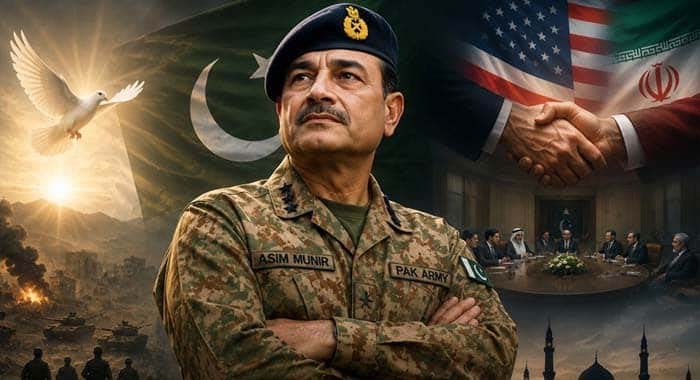
Against the backdrop of intensifying tensions between the United States and Iran, Pakistan has stepped up its diplomatic efforts to facilitate dialogue, de-escalation, and a negotiated resolution to the ongoing conflict.
The diplomatic initiative gained renewed significance following Field Marshal Syed Asim Munir, Chief of Defence Forces of Pakistan,’s visit to Tehran on August 24, where he held a series of high-level meetings with Iran’s political, diplomatic, parliamentary, and national-security leadership.
The visit came at a particularly sensitive juncture. On the same day, the United States announced “Operation Economic Outcast,” a sweeping campaign aimed at intensifying economic pressure on Iran and restricting the country’s remaining international financial and commercial lifelines. The US Treasury said the campaign would target key sectors and networks associated with Iran’s economy, including digital assets, technology, gold, aviation and shipping.
Against this backdrop, Pakistan’s engagement with Tehran assumes wider regional and international significance, particularly as Islamabad seeks to bridge the widening trust deficit between Washington and Tehran and create space for renewed negotiations.
During his visit, Field Marshal Syed Asim Munir met Iranian President Masoud Pezeshkian, Parliament Speaker Mohammad Bagher Ghalibaf, Secretary of the Supreme National Security Council Mohsen Rezaei, Foreign Minister Abbas Araghchi and other senior Iranian officials. According to Pakistan’s military, the discussions focused comprehensively on preventing further escalation, reopening the Strait of Hormuz, expediting an end to the conflict, and exploring a sustainable negotiated settlement. Iranian leadership also appreciated Pakistan’s constructive role and its efforts aimed at promoting peace and regional stability.
Pakistan’s Interior Minister Mohsin Naqvi, who accompanied Field Marshal Asim Munir, subsequently described the discussions as highly positive and productive, stating that significant progress had been made. He also indicated that the two sides discussed steps required to revive the Islamabad Memorandum of Understanding, an interim framework associated with Pakistan’s mediation efforts.
The importance attached to the visit was further underscored by a statement from Seyed Mehdi Tabatabaei, Deputy for Communications and Information at the Iranian President’s Office. Responding to what he described as inaccurate media speculation, Tabatabaei said Field Marshal Asim Munir’s visit had been “highly productive” and marked by significant diplomatic achievements, adding that important diplomatic results would become visible soon.
The statement indicates that Tehran viewed Pakistan’s engagement as more than a routine diplomatic interaction and that the discussions may have opened avenues for further diplomatic movement.
Pakistan’s diplomatic significance stems from its ability to maintain communication with both sides at a time when direct trust between Washington and Tehran remains severely constrained. Islamabad is therefore seeking to use its relations with both countries to facilitate communication, reduce misunderstandings, and encourage the parties to return to a diplomatic track. The timing of Field Marshal Asim Munir’s visit was particularly noteworthy amid reports that he had spoken with US President Donald Trump before travelling to Tehran. International reporting indicated that Washington had sought Pakistan’s assistance in using its influence with Iran to encourage a return to negotiations.
This places Pakistan in a potentially important intermediary position not as a party to the conflict, but as a regional actor capable of carrying messages and facilitating confidence-building measures between the two sides. The Strait of Hormuz has emerged as one of the most consequential issues in the US-Iran confrontation. The strategically vital waterway is a major artery for global energy supplies, and disruption to navigation has created significant economic and geopolitical repercussions.
Pakistan’s discussions with Iranian leadership reportedly placed particular emphasis on the reopening of the Strait and on mechanisms that could reduce tensions surrounding maritime movement. A credible diplomatic understanding on freedom of navigation could potentially become one of the first confidence-building measures between the opposing sides. For Pakistan, the objective would be to help create a framework in which Iran receives credible assurances regarding security concerns while the United States obtains verifiable commitments concerning maritime security and the broader negotiating process.
The diplomatic initiative is unfolding as Iran faces intensified economic pressure. On August 24, US Treasury Secretary Scott Bessent announced Operation Economic Outcast, describing an expanded campaign designed to cut off Iran’s financial lifelines and pressure Tehran into making strategic concessions. The measures include sanctions targeting individuals, entities and vessels connected to Iran and increased pressure on sectors considered important to Tehran’s ability to generate revenue. Washington has also warned countries and commercial entities that continued economic engagement with Iran could expose them to sanctions. At the same time, US officials have maintained that Iran has a choice between continued isolation and a return to a negotiated path.
The intensified economic pressure adds another layer of urgency to ongoing diplomatic efforts, increasing the potential value of a credible channel through which Tehran and Washington can explore mutually acceptable arrangements.
While the latest developments have generated cautious optimism, it would be premature to conclude that the fundamental differences between the United States and Iran have been resolved. The central challenge remains the deep lack of trust between Washington and Tehran, compounded by military confrontation, economic sanctions, disputes over maritime security, and disagreements over the terms and sequencing of any future negotiations.
Pakistan’s role is therefore likely to be incremental and confidence-building rather than immediately transformative. A possible diplomatic pathway could involve a series of phased measures: verifiable arrangements concerning navigation through the Strait of Hormuz; reciprocal reductions in military activity; carefully calibrated economic relief; confidence-building steps by both sides; and, ultimately, a return to indirect and then direct negotiations.
Pakistan’s engagement carries a distinctive dimension because its security and defence leadership maintains channels of communication that extend beyond conventional diplomatic structures. Analysts have noted that Field Marshal Asim Munir’s access to Iran’s political and security establishment gives Pakistan an additional channel through which sensitive security-related messages can be conveyed. His meetings in Tehran included senior figures from both the political and national-security spheres, including Mohsen Rezaei, who occupies a significant position within Iran’s security architecture. This combination of political and security-level engagement could prove valuable in addressing issues that conventional diplomacy alone may find difficult to resolve.
Pakistan’s diplomatic initiative reflects its longstanding position that regional conflicts should ultimately be addressed through dialogue, diplomacy, de-escalation and negotiated arrangements, rather than prolonged military confrontation. Islamabad’s current efforts are aimed at helping create conditions in which both Washington and Tehran can return to the negotiating table without either side being required to abandon its core interests at the outset.
The immediate objective is not to impose a settlement, but to open diplomatic space, reduce the risk of further escalation, restore communication, and establish confidence-building measures that can eventually lead to substantive negotiations.
The coming days will be critical in determining whether the diplomatic momentum generated by Pakistan’s engagement can be translated into concrete steps. The Iranian leadership’s positive assessment of Field Marshal Asim Munir’s visit, Pakistan’s claim of significant progress, and Washington’s apparent interest in Islamabad’s engagement collectively indicate that a potential diplomatic opening exists.
However, translating this opening into a durable agreement will require sustained engagement, reciprocal confidence-building measures and political will from both Washington and Tehran. For Pakistan, the immediate priority remains clear: prevent further escalation, facilitate communication between the parties, support the restoration of safe navigation through the Strait of Hormuz, and encourage a negotiated end to the conflict.
If Islamabad succeeds in helping Washington and Tehran move even incrementally back toward negotiations, its diplomatic initiative could emerge as one of the most consequential regional peace efforts of the current crisis. Pakistan remains committed to playing a constructive and responsible role in promoting regional peace, stability and dialogue, while supporting diplomatic efforts aimed at preventing further escalation and achieving a sustainable political settlement.



