
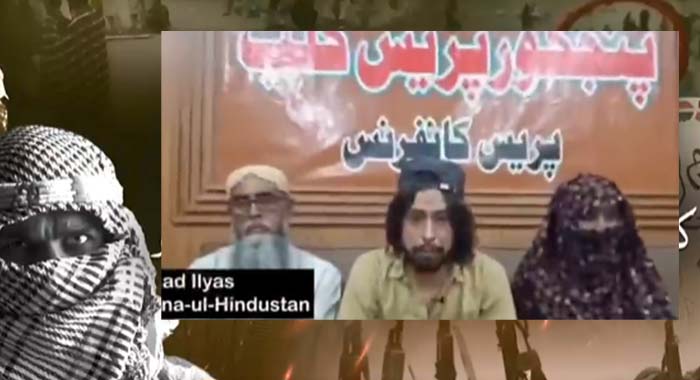
A confessional statement by Muhammad Ilyas, identified as an operative of the Baloch Yakjehti Committee (BYC), has brought to light significant details concerning his involvement with Fitna al-Hindustan, identified in the statement as the Baloch Liberation Army (BLA), as well as his role in social media propaganda and public mobilization activities.
In his statement, Muhammad Ilyas said that he had remained associated with both Fitna al-Hindustan and the BYC. He further acknowledged playing an active role in promoting terrorist propaganda and advancing the negative narrative of Fitanah al-Hindustan through social media platforms.
According to his confession, Ilyas used videos, photographs and other digital material to influence public opinion and mislead members of the public.
The statement provides an insight into the increasingly important role of information warfare in the activities of terrorist organizations, where digital platforms can be exploited to spread propaganda, manipulate perceptions, recruit sympathizers and create public support for terrorist narratives.
Muhammad Ilyas acknowledged that he actively participated in social media campaigns designed to promote the narrative of Fitna al-Hindustan. He stated that videos and photographs were used to selectively portray events and influence public sentiment.
The disclosure highlights how terrorist organizations increasingly combine physical attacks with coordinated propaganda and information campaigns. Social media platforms provide terrorist networks with a powerful mechanism for reaching large audiences, disseminating propaganda, influencing vulnerable individuals and attempting to undermine public confidence in state institutions.
The rapid circulation of emotionally charged photographs and videos can allow terrorist narratives to gain traction, particularly when material is distributed without context or independent verification.
In his confessional statement, Ilyas also acknowledged participating in BYC rallies and gatherings. He stated that he took part in activities where anti-state slogans were raised and speeches were delivered. The disclosure has brought renewed attention to the relationship between public mobilization, propaganda networks and terrorist organizations operating in and around Balochistan.
Security authorities have repeatedly warned that terrorist organizations seek to exploit political and social grievances to advance their objectives, influence public opinion and facilitate recruitment and propaganda activities.
One of the most significant claims contained in the statement is that the BYC has been functioning as a “soft face” for Fitna al-Hindustan. The statement points toward what security authorities describe as a broader strategy in which terrorist organizations seek to benefit from civilian-facing platforms while distancing themselves from direct acts of violence.
The issue has assumed particular significance amid the continuing terrorist threat in Balochistan.
According to the information contained in the statement, several individuals identified by security authorities as terrorists were also included in BYC lists concerning missing persons. The names cited include Burhan Baloch, Hafeez Baloch, Abdul Hameed, Rashid Baloch, Sohaib Langoo and Kareem Jan.
The reported overlap has become a significant element in the security narrative concerning connections between terrorist elements and public-facing campaigns. Another important point raised in the statement concerns BYC’s response to terrorist attacks. The statement asserts that the organization has not condemned terrorist incidents attributed to Fitna al-Hindustan. The issue raises broader questions about the distinction between legitimate political advocacy and activities that may provide terrorist organizations with political, social or narrative space.
A clear and unequivocal rejection of terrorism is an important benchmark for organizations claiming to represent the interests and rights of local communities.
The disclosures attributed to Muhammad Ilyas also highlight the expanding information-warfare dimension of terrorism. Modern terrorist organizations increasingly operate across multiple domains, combining armed attacks with propaganda, social media campaigns, psychological operations and narrative-building.
Unlike traditional propaganda, digital campaigns can reach large audiences almost instantly and can be replicated across multiple platforms. Photographs, videos, slogans and emotionally charged narratives can be repeatedly circulated to shape public perceptions and influence audiences. This environment makes responsible journalism, digital literacy, independent verification and fact-based public communication increasingly important.
The activities described in the confession demonstrate how terrorist networks can seek influence far beyond conventional attacks. While terrorist organizations use violence and intimidation to achieve tactical objectives, their propaganda arms seek to influence public opinion, generate sympathy, undermine state institutions and create social divisions.
The convergence of terrorism and information warfare has consequently emerged as one of the major security challenges of the digital age. For counterterrorism institutions, confronting terrorism therefore increasingly requires addressing both physical terrorist infrastructure and the digital ecosystems through which terrorist narratives are promoted.
The disclosures contained in Muhammad Ilyas’s statement have renewed attention on the reported intersection between Fitna al-Hindustan, BYC activities and coordinated propaganda efforts. The security concern extends beyond individual participation in rallies or social media activity. The central issue is whether terrorist organizations can exploit public-facing platforms to advance their narratives, obscure their networks and influence audiences while maintaining distance from their violent activities.
Such tactics can make it more difficult for the public to distinguish between legitimate civic advocacy and messaging that serves the objectives of terrorist organizations.
The reported confession underscores the importance of continued vigilance against terrorism, terrorist propaganda and information warfare. Counterterrorism efforts increasingly require coordination among intelligence agencies, law-enforcement institutions, digital platforms, civil society and responsible media organizations.
At the same time, counterterrorism measures must remain grounded in credible evidence, due process and transparent investigation. Legitimate political expression and peaceful civic activity should not be automatically conflated with terrorism.
The objective must remain clear: terrorist organizations, their violent activities and demonstrable support for terrorism must be confronted firmly, while genuine grievances and lawful civic concerns should be addressed through legitimate democratic and legal channels.



