
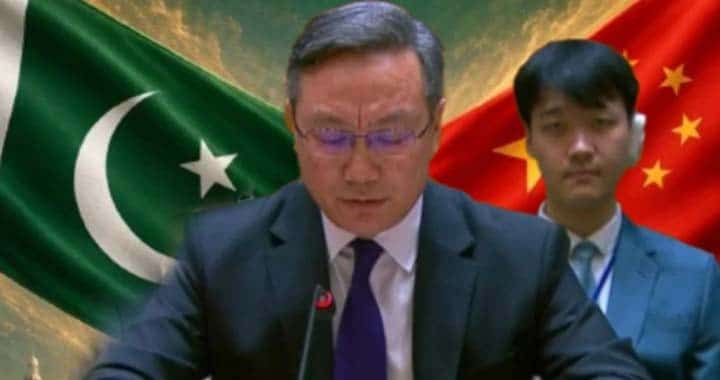
China has once again delivered a strong and unequivocal diplomatic message at the United Nations Security Council (UNSC), calling for the immediate inclusion of the banned Balochistan Liberation Army (BLA) and its suicide attack wing, the Majeed Brigade, on the United Nations’ international sanctions list. Beijing’s renewed demand represents a significant expression of diplomatic support for Pakistan’s longstanding efforts to secure international action against the two designated terrorist organisations.
The demand was raised during the 10,276th meeting of the United Nations Security Council, where China urged the 1267 Sanctions Committee to move forward with the listing of both organisations, stressing the importance of an objective, impartial, and evidence-based approach to counterterrorism measures.
Representing China, Ambassador Sun Lei, Acting Permanent Representative and Chargé d’Affaires ad interim of China to the United Nations, reiterated Beijing’s position and called upon all members of the committee to set aside political considerations and build consensus without further delay.
In his address, Ambassador Sun Lei emphasized that the 1267 Committee must uphold the principles of objectivity, impartiality, and professionalism in dealing with sanctions-related matters, ensuring that decisions are grounded in credible evidence and broad international consensus.
The Chinese envoy stated:
“China once again calls on the 1267 Committee to place the Balochistan Liberation Army (BLA) and its Majeed Brigade on the sanctions list, and hopes that all members will discard political considerations and form consensus as soon as possible.”
This firm reiteration of China’s position carries considerable diplomatic significance, reinforcing Pakistan’s efforts to bring international attention to the security threats posed by the BLA and its Majeed Brigade and to ensure that terrorist organisations cannot exploit political divisions or diplomatic manoeuvring to evade international accountability.
Pakistan was represented at the meeting by its newly appointed Permanent Representative to the United Nations, Ambassador Syed Haider Shah.
The 10,276th Security Council meeting, chaired by Latvia, also included briefings by the chairs of three Security Council subsidiary bodies responsible for counterterrorism, the ISIL (Da’esh) and Al-Qaeda sanctions regime, and the prevention of the proliferation of weapons of mass destruction.
China’s renewed call sends a clear diplomatic message: international counterterrorism efforts must be guided by consistency, credible evidence, and collective responsibility rather than selective political considerations. The threat posed by designated terrorist organisations requires a coordinated international response, and the United Nations must ensure that its sanctions mechanisms are applied effectively and without discrimination.
For Pakistan, China’s position represents an important diplomatic endorsement of its efforts to strengthen international cooperation against terrorism and pursue the global designation of organisations responsible for terrorist violence. It also highlights the importance of denying such groups the space to operate, mobilise support, or pursue their activities without international scrutiny.
The international community must not allow political considerations to undermine the global fight against terrorism. Terrorist organisations must face accountability, and international sanctions mechanisms must serve their intended purpose of strengthening collective security and preventing terrorist activities.
China’s latest statement further underscores the importance of Pakistan-China diplomatic coordination at the United Nations and the shared commitment to strengthening international counterterrorism cooperation.



