
Bannu is no longer simply another troubled district on Khyber Pakhtunkhwa’s security map. It has increasingly become a frontline test of whether Pakistan can stay ahead of a terrorist threat that is becoming more adaptive, technologically enabled and locally embedded.
The pattern visible in Bannu is particularly significant because terrorists are combining methods that were once employed separately. Vehicle-borne explosives, suicide attacks, assaults on police positions, surveillance through drones, attacks on security vehicles and attempts to place explosives near public institutions now form part of a broader operational toolkit.
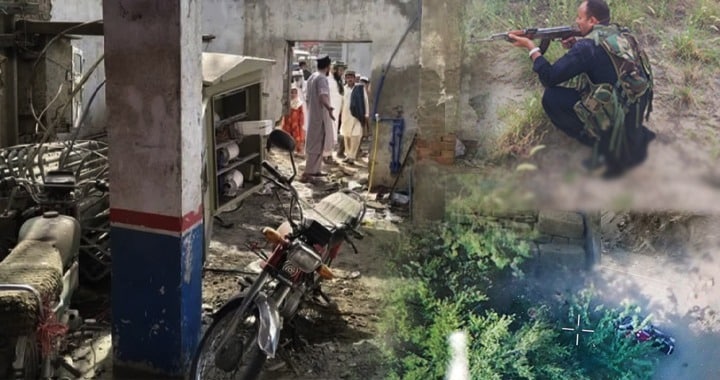
The failed suicide attack in Mali Khel illustrates this evolution. An explosive-laden rickshaw was reportedly used in an attempt to reach a security target, but security personnel detected and engaged the vehicle before it could reach its intended destination. The suicide bomber and another terrorist were subsequently eliminated.
The significance of such an incident lies not merely in the fact that an attack failed. It lies in what the attempted attack tells us about terrorist planning. A vehicle can carry a substantial explosive payload, blend into civilian surroundings and approach a target without immediately revealing its purpose. Preventing such attacks therefore depends increasingly on intelligence, surveillance, rapid decision-making and the ability of frontline personnel to respond within seconds.
The subsequent responsibility claim by Majlis-e-Askari Karwan adds another dimension. The group’s reported claim showed that the attack was not simply an isolated act of violence, but part of an organized terrorist ecosystem. The reported presence of its leadership in Afghanistan further reinforces the wider concern over terrorist networks operating across the Pakistan-Afghanistan frontier.
The broader security picture is equally revealing.
Bannu has witnessed repeated terrorist attacks and counterterrorism operations in recent months. Following a surge in attacks, extensive intelligence-based operations resulted in the elimination of 24 Khwarij in Bannu and adjoining areas in July. Weapons and ammunition were also recovered, while operations continued against terrorist support infrastructure.
This points to an important shift in counterterrorism strategy. The objective cannot simply be to protect a police station after terrorists attack it. The more effective approach is to identify terrorist networks before they assemble the manpower, explosives and reconnaissance required for an assault.
That is precisely where intelligence becomes the decisive battlefield.
Bannu’s police and security forces have increasingly incorporated modern surveillance technology into their operations. Earlier this year, Bannu Police received thermal weapon sights, night-vision devices, quadcopters, an advanced surveillance quadcopter and anti-drone guns.
This development also exposes an important nuance in the debate over police preparedness. The question is no longer simply whether equipment exists. The real questions are whether enough equipment is available, whether it reaches the units that need it most, whether personnel are properly trained to use it, and whether maintenance, communications and intelligence systems allow the technology to produce an operational advantage.
A thermal sight is useful only when an officer has the training, intelligence and communications necessary to act on what it reveals. A surveillance drone becomes strategically valuable when its information reaches a decision-maker quickly enough to prevent an attack. An anti-drone system matters when it forms part of a wider counter-UAS architecture rather than functioning as an isolated piece of equipment.
The terrorist threat is also becoming more difficult because local knowledge gives attackers advantages that technology alone cannot eliminate.
Terrorists familiar with villages, roads, compounds and movement patterns can identify vulnerabilities that an outside attacker would struggle to understand. They can observe police routines, identify sympathetic or hostile communities and exploit the physical complexity of southern Khyber Pakhtunkhwa.
That makes community cooperation an indispensable component of counterterrorism.
A population that trusts the police is more likely to report suspicious movement, identify unfamiliar individuals, reject terrorist intimidation and cooperate with investigations. Conversely, every gap between citizens and security institutions creates an opportunity for terrorists to operate in the shadows.
This is why the response to terrorism in Bannu cannot be measured only by the number of terrorists eliminated. Operational success matters, but so does the ability to prevent recruitment, detect reconnaissance, protect vulnerable communities and ensure that terrorist networks cannot regenerate after losing their operatives.
The experience of Bannu also demonstrates why large-scale operations should not be treated as the only answer. Residents who have experienced displacement and disruption understand the price of prolonged conflict. What communities want is security that allows ordinary life to resume, not a permanent state of emergency.
The ideal counterterrorism model therefore combines targeted intelligence-based operations with stronger policing, modern surveillance, community engagement and continuous disruption of terrorist financing and logistics.
The central lesson from Bannu is straightforward: terrorists are adapting, so the state must adapt faster.
A terrorist organization needs only one successful attack to create fear, damage public confidence and disrupt economic activity. The state, by contrast, must succeed repeatedly, every day, across thousands of possible targets.
That is why prevention matters more than reaction.
Bannu is demonstrating that Pakistan’s frontline counterterrorism personnel are capable of thwarting sophisticated attacks. The strategic challenge now is to ensure that this frontline advantage becomes a permanent institutional capability rather than a series of isolated successes.
The battle for Bannu is therefore not simply a contest between armed personnel and terrorists. It is a contest between a state trying to anticipate violence and terrorist networks trying to remain one step ahead.
The side that controls the information, the initiative and the speed of response will ultimately control the battlefield.



