
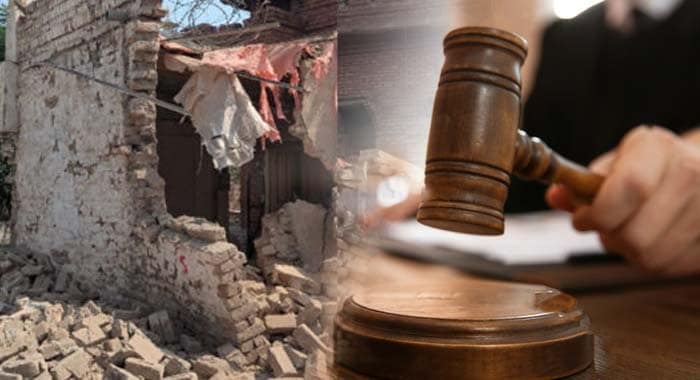
A bomb blast near the Frontier Road Police Check post in Peshawar’s Sra Khawra area injured a police officer and damaged part of the boundary wall of the police facility.
The physical damage may be repaired. The injured officer may recover. But the more important question raised by the attack extends beyond the blast itself: what happens to those who planned, facilitated and carried it out?
The banned Tehreek-e-Taliban Pakistan (TTP), referred to by the Pakistani state and government as Fitna al-Khwarij, has claimed responsibility for the attack. Such claims can provide investigators with information to examine, but a terrorist organization’s statement is not, by itself, proof of the entire chain of responsibility behind an attack.
That distinction is important because a bomb does not appear beside a police post by accident.
Someone has to identify the target.
Someone has to obtain or prepare the explosive.
Someone has to transport it.
Someone has to determine where and when it should be placed.
And someone has to facilitate the operation while attempting to keep those involved beyond the reach of law-enforcement agencies.
The person who plants the device may therefore be only one part of a much larger network.
The Blast Is Only the Visible Part
Terrorist attacks are often judged by their immediate consequences: deaths, injuries and physical destruction.
But counterterrorism investigations have to look beyond those visible consequences.
A relatively small explosion can expose a much wider chain of terrorist activity. The person who physically plants an explosive may have received instructions from another individual. Materials may have been supplied by a facilitator. Transport may have been arranged through another contact. Information about the target may have been collected beforehand.
Breaking that chain is essential.
If investigators identify only the person who carried out the final act while the wider support network remains intact, another attack can eventually be planned and executed.
That is why accountability has to extend beyond the individual who physically carried the bomb.
A Responsibility Claim Is Not the End of the Investigation
The TTP’s claim of responsibility is another piece of information surrounding the attack, but it should not be confused with a completed investigation.
Terrorist organizations have an obvious interest in claiming attacks and presenting them as evidence of their operational reach. Their claims therefore require scrutiny alongside physical evidence, intelligence and other investigative findings.
The real objective is not simply to establish which organization claims an attack.
It is to determine who was actually involved.
Who planned it?
Who provided the explosives?
Who identified the target?
Who facilitated the movement of the attackers or material?
Who financed the operation?
And who remains connected to the network capable of organizing another attack?
Those questions turn a responsibility claim into something far more consequential: a potential pathway toward dismantling the network behind the attack.
Police Posts Are Not Just Buildings
The targeting of a police facility also carries a significance beyond the physical structure that was damaged.
Police checkpoints and posts are part of the state’s local security presence. Personnel stationed there monitor movement, respond to incidents and provide security in areas where terrorists may attempt to exploit gaps.
Targeting such a facility can therefore serve multiple purposes for a terrorist organization.
It can injure or intimidate law-enforcement personnel.
It can expose vulnerabilities.
It can create fear among residents.
And it can generate propaganda even when the physical damage is limited.
That is precisely why the response cannot end with repairing a wall and restoring the facility.
The security system has to learn from the attack while investigators pursue those responsible.
Accountability Has a Wider Meaning
Bringing the perpetrators to justice is not merely a matter of punishment after an attack.
It is also part of preventing the next one.
Every successful investigation that identifies a facilitator, financier, weapons supplier or recruiter can potentially remove another link from the terrorist chain.
Every terrorist network disrupted before it can launch another attack reduces the opportunity for future violence.
And every perpetrator brought before the law sends a message that responsibility for an attack does not disappear simply because those involved attempt to hide behind an organization’s claim or operate from outside the immediate area.
This is particularly important in a terrorist environment in which attackers can rely on remote facilitators, clandestine communications and networks that cross geographic boundaries.
The visible perpetrator may be standing beside the target.
The network behind him may be somewhere else entirely.
The Injured Policeman Is Not a Statistic
There is also a human dimension that can disappear behind the language of counterterrorism.
One police officer was injured in the Sra Khawra blast.
That officer was not merely a casualty figure in a security report. A person went to work at a police facility and ended up injured because terrorists chose that location as a target.
For police personnel serving at checkpoints and other vulnerable installations, every such attack carries a personal risk.
That makes accountability important not only for the state but also for the people expected to stand on the frontline of the security response.
They need to know that an attack against them will trigger more than a temporary security alert.
It must trigger an effort to identify those responsible and dismantle the network that enabled them.
Justice Must Reach Beyond the Bomb
The perpetrators of the Sra Khawra blast may not all be the people who eventually appear in the headlines.
The individual who planted the bomb could be only the final link in the chain.
The more significant counterterrorism achievement would be to follow that chain wherever the evidence leads: from the attacker to the facilitator, from the facilitator to the planner, and from the planner to the wider network.
That is how an individual terrorist attack can become an opportunity to disrupt a broader terrorist infrastructure.
The blast itself has already happened.
The damage has been done.
The investigation, however, has a larger purpose.
Whoever planted the bomb must eventually face justice. So must those who planned, financed, facilitated or enabled the attack if evidence establishes their involvement.
A damaged wall can be rebuilt.
A security post can be reinforced.
But lasting security requires something more: ensuring that those responsible cannot simply disappear after the smoke clears.



