
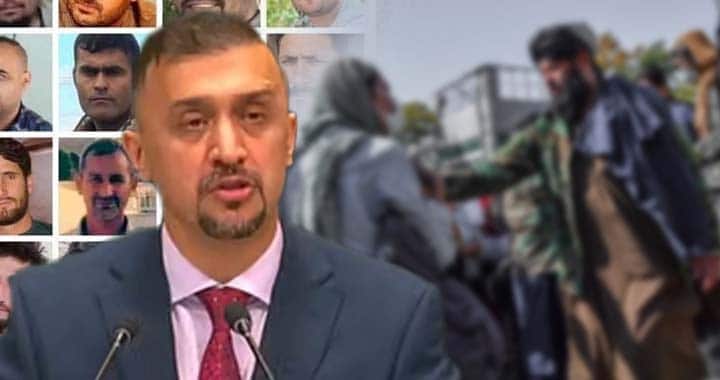
Afghanistan’s representative to the United Nations, Nasir Ahmad Faiq, has called for the immediate activation of an independent UN investigative mechanism to document human rights violations under Taliban rule, urging the international community to make accountability and measurable human rights progress conditions for engagement with the group.
Addressing the UN General Assembly during a discussion on the Human Rights Council’s report, Faiq said that five years after the Taliban’s return to power, Afghan women and girls remained deprived of basic rights, including education, employment and participation in public life.
He described the restrictions imposed on women and girls as constituting crimes against humanity and warned that repression under Taliban rule extended far beyond gender-based restrictions.
According to Faiq, Hazaras, Shias and other religious and ethnic minorities, journalists, human rights defenders and former Afghan security personnel have also faced arbitrary detention, torture, enforced disappearances and extrajudicial killings.
He welcomed the extension of the mandate of Richard Bennett, the UN Special Rapporteur on the situation of human rights in Afghanistan, and called for guarantees of safe and unrestricted access to the country so that human rights conditions could be independently monitored.
Faiq pressed the United Nations to immediately operationalize its independent investigative mechanism, providing it with sufficient financial resources and personnel to investigate violations, preserve evidence and support accountability efforts.
He also backed international legal proceedings aimed at holding the Taliban leadership accountable, including action through the International Criminal Court and the continued pursuit of Afghanistan’s case under the Convention on the Elimination of All Forms of Discrimination against Women.
Warning against normalizing relations with the Taliban without meaningful improvements, Faiq said international engagement must be guided by clear benchmarks and verifiable progress. Diplomatic contacts, he stressed, should not come at the expense of Afghan women’s and girls’ fundamental rights.
He further called for humanitarian assistance to Afghanistan to continue, emphasizing that women must be included in the distribution of aid to ensure that vulnerable sections of society are not excluded. He also urged countries to uphold the principle of non-refoulement, which prohibits the forced return of refugees to places where they face serious risks.
On the political future of Afghanistan, Faiq said the human rights crisis could only be addressed through an Afghan-led political process facilitated by the United Nations. Such a process, he argued, should lead to an inclusive and accountable government representing women, young people, minorities and civil society.
He concluded that the effectiveness of international human rights efforts should be judged by tangible improvements in the lives of Afghans, particularly the restoration of girls’ access to education, employment opportunities for women and their meaningful participation in public life.
The appeal adds to international pressure over the Taliban’s restrictions and treatment of vulnerable communities, while highlighting the growing demand for concrete accountability measures rather than diplomatic engagement without conditions.



