
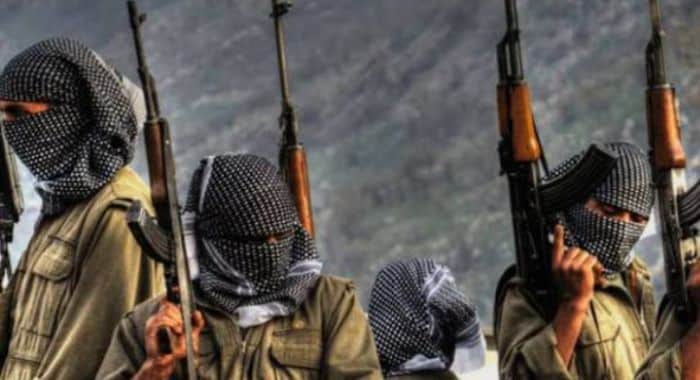
Security analysts are increasingly raising concerns over the emergence of militant factions in Pakistan and Afghanistan openly promoting anti-China narratives and signaling potential threats to Chinese interests, particularly projects linked to the China-Pakistan Economic Corridor (CPEC).
Recent assessments highlight the growing visibility of Inquilab-e-Islami Pakistan (IIP), an Al-Qaeda-aligned militant group that surfaced publicly in April last year and has since attracted attention due to its ideological messaging, operational rhetoric, and alignment with broader jihadist networks operating in the region.
The concerns intensified following the circulation of a recently released video message attributed to the group’s late commander, Ustad Abdullah Saeed, in which he focused heavily on allegations regarding the treatment of Muslims in Xinjiang and referenced the concept of “East Turkistan.” In the video, the commander framed the issue as part of a broader ideological struggle, signaling a potential shift toward explicitly anti-China narratives among certain extremist factions active in Pakistan.
Security observers note that while militant organizations such as Tehreek-e-Taliban Pakistan (TTP) and allied factions have generally avoided publicly claiming direct attacks against Chinese nationals or projects, IIP appears to be openly articulating ideological justification for targeting Chinese interests.
Analysts believe this development could represent a dangerous evolution in the regional threat landscape, particularly as militant narratives increasingly intersect with geopolitical tensions involving China’s western region of Xinjiang and strategic infrastructure investments under CPEC.
According to security assessments, IIP has formally aligned itself with Ittihad ul Mujahideen Pakistan (IMP), an umbrella alliance that seeks to consolidate multiple militant factions under a coordinated operational framework. Sources monitoring militant activity further indicate that Jamaat-ul-Ahrar (JuA) is also expected to formally integrate into the alliance in the near future.
Security experts warn that JuA’s inclusion could significantly expand the alliance’s operational reach due to the group’s previously established networks across various regions of Pakistan. Analysts suggest that the consolidation of such factions under IMP could potentially create a more decentralized and geographically dispersed threat structure.
Observers further point to an emerging pattern in recent militant activity, noting that a significant portion of terrorist incidents in Pakistan has occurred in areas linked to CPEC routes, strategic infrastructure, and regions hosting Chinese-funded development projects.
Regional analysts argue that the evolving security environment mirrors broader trends already visible across neighboring countries. ISIS-Khorasan (ISIS-K) has previously claimed attacks targeting Chinese interests in Afghanistan, while the banned Balochistan Liberation Army (BLA) has conducted multiple high-profile attacks against Chinese nationals, engineers, and infrastructure projects in Balochistan.
The convergence of jihadist groups, separatist narratives, and anti-China rhetoric is increasingly being viewed by security observers as a potentially destabilizing development capable of complicating regional security calculations and Pakistan-China strategic cooperation.
Security officials maintain that Pakistan’s counterterrorism apparatus remains fully alert to emerging threats against Chinese nationals, diplomatic assets, and CPEC-related infrastructure. Authorities continue to conduct intelligence-based operations aimed at dismantling militant networks and preventing attacks against strategic interests.
Analysts note that the death of IIP commander Ustad Abdullah Saeed during a recent security forces operation in Bannu in late May 2026 represents a significant operational setback for the group. However, they caution that the ideological messaging and evolving alliances among extremist factions continue to warrant close monitoring.
Experts further emphasize that the security of Chinese investments and personnel in Pakistan has become increasingly intertwined with the broader regional counterterrorism environment, requiring sustained intelligence coordination, strategic vigilance, and proactive security measures.
As militant alliances evolve and ideological narratives increasingly incorporate geopolitical themes, regional observers warn that the intersection of extremism and anti-China sentiment could emerge as a major security challenge for Pakistan and the wider region in the coming years.



