
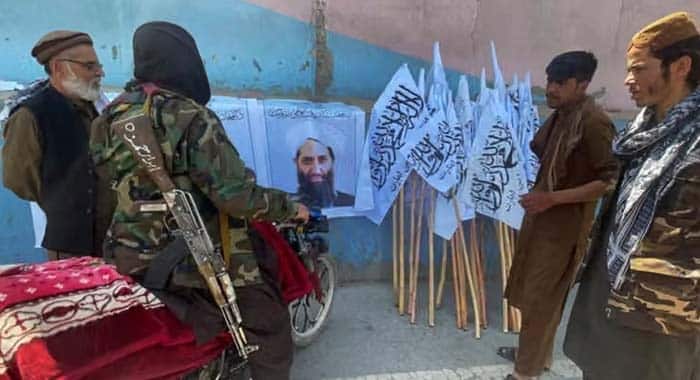
Taliban supreme leader Hibatullah Akhundzada’s rare visit to Kabul to contain growing divisions within the group has exposed the widening cracks in a leadership structure increasingly strained by his concentration of power, unilateral decrees and insistence on unquestioned obedience.
Akhundzada, who exercises supreme authority from Kandahar through a close circle of loyal religious figures, has reportedly held meetings with several senior Taliban officials, including Deputy Defense Minister Qayyum Zakir, and is expected to meet Interior Minister Sirajuddin Haqqani in an attempt to narrow differences within the group’s leadership.
The irony of the visit is difficult to overlook. The man whose increasingly centralized rule has become a major source of friction is now attempting to contain the very divisions generated by his own decisions. Rather than addressing the grievances behind the internal discord, his approach appears focused on securing greater compliance with his authority.
The growing divide between the Kandahar-based leadership and influential Kabul-based officials reflects a deeper struggle over decision-making, governance and the concentration of power. While Akhundzada and his inner circle retain control over major policy decisions, several senior officials have increasingly voiced reservations about the consequences of allowing one individual to determine the direction of the entire administration.
The differences became particularly visible after Haqqani, speaking at Kabul University on Monday, questioned the wisdom of making an entire governing system dependent on the personal views of one individual. He said many people disagreed with Akhundzada’s policies and urged Taliban members to concentrate on their responsibilities rather than praising and glorifying their leader.
Haqqani’s remarks amounted to a rare public challenge to the personality-centered authority cultivated around Akhundzada. His criticism also exposed the growing discomfort among influential Taliban figures with a system in which loyalty to the supreme leader appears to take precedence over institutional responsibilities and collective decision-making.
Akhundzada’s response the following day offered little indication that he intended to reconsider this concentration of authority. Addressing a gathering at Kabul University, he repeatedly warned against internal discord, declaring that obedience to the emir was mandatory and that opposition to leadership decisions could weaken the administration.
He also insisted that the decrees enforced under his leadership were derived from Islamic jurisprudence rather than his personal opinions. Yet this defense does little to address the fundamental question at the heart of the dispute: why should the entire governing structure, including senior ministers and officials, remain answerable to the preferences of one individual?
His repeated warnings against divisions appear increasingly contradictory when viewed alongside his insistence on absolute personal authority. A leadership that demands unquestioning obedience while leaving little room for consultation, disagreement or institutional accountability cannot simply blame dissenting voices for the resulting fractures.
The underlying problem is not merely a disagreement between two groups of Taliban officials. It is a power structure that has placed the country’s major political and administrative decisions in the hands of Akhundzada and his inner circle in Kandahar, leaving Kabul-based officials with limited room to exercise independent authority.
The restrictions on girls’ education and women’s employment have been among the most prominent sources of disagreement. The group’s approach to governance, relations with the outside world and the role of senior officials in policymaking have further exposed differences between the factions.
A previous United Nations assessment also identified the divide between the Kandahar faction, dominated by Akhundzada’s religious allies, and the Kabul-based faction, which includes the influential Haqqani network and other senior officials. The division is therefore not a sudden development triggered by recent speeches but a longstanding structural problem within the Taliban leadership.
Akhundzada’s apparent concern about losing internal cohesion also raises questions about his repeated rejection of personal ambition as a motive for exercising authority. His insistence that the leadership must be obeyed, coupled with his resistance to challenges against his decrees, has reinforced perceptions that preserving his personal grip on power has become inseparable from preserving the Taliban administration itself.
His declaration that he does not intend to turn Muslims against one another to retain power may sound reassuring, but statements alone cannot resolve the contradictions within a system built around one man’s authority.
Ultimately, the Taliban leadership cannot manufacture unity through speeches, religious gatherings or demands for renewed allegiance. Nor can Akhundzada expect senior officials to accept responsibility for governing while denying them meaningful participation in decisions that shape the administration.
The divisions he is now trying to contain are rooted in the very governing model he has imposed. Unless the underlying concentration of power is addressed, attempts to silence disagreement in the name of unity are more likely to suppress the symptoms than resolve the crisis.



