
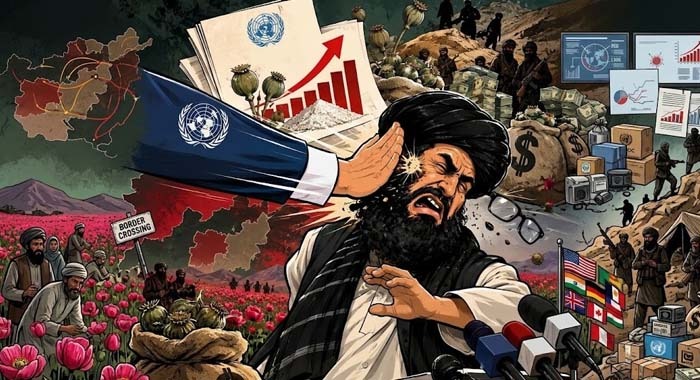
Taliban Foreign Minister Amir Khan Muttaqi stood before the world and blamed Afghanistan’s neighbours for the region’s drug problem. He pointed fingers, played the victim and insisted his regime had crushed the opium trade. The United Nations Office on Drugs and Crime has now answered him, and its 2026 survey lands like a slap.
The numbers Muttaqi cannot hide According to the UNODC’s 2026 report, opium cultivation in Afghanistan surged from 10,200 to 43,300 hectares. Production jumped from 296 to 1,466 tonnes, a fivefold increase. Cultivation spread across sixteen provinces, five more than last year.
Badakhshan alone recorded 29,482 hectares, with the UN noting that outside financiers, including actors from the old southwestern growing heartland, were renting and buying land to plant poppy. In Helmand, the share of concealed fields jumped from 6 percent to over 50 percent, as growers hid plots among cereal crops and behind compound walls. Opium now sells at USD 500 per kilogram, still far above pre-ban levels of under USD 100.
Kabul’s response has been predictable. The Taliban interior ministry rejected the report, claiming it contradicts official data. But the regime that once claimed credit for UN figures showing a decline cannot now dismiss the same agency when its numbers turn inconvenient.
A ban that was dust in the world’s eyes The so-called ban was dust thrown in the world’s eyes. The Taliban regime is a narco-state, and opium is only part of the story.
Afghanistan’s methamphetamine trade is bleeding across its borders and poisoning every region it touches. More than 5,000 synthetic-drug laboratories operate under the Taliban’s watch. Pakistan sees the consequences first-hand, most recently when its Anti-Narcotics Force and the US DEA seized 463 kg of Afghan-origin crystal meth bound for Sri Lanka.
The UNODC’s findings leave little room for denial. A regime that claims to have eliminated poppy cultivation while presiding over a fivefold rise in production, a spread to sixteen provinces and a thriving synthetic-drug industry cannot credibly cast itself as a victim of its neighbours. Rather than deflecting blame, Kabul should accept independent verification, act against the networks profiting from the trade, and engage seriously with regional partners who bear the cost of Afghanistan’s drug exports. Until then, Muttaqi’s offer of cooperation will remain a statement of intent unsupported by evidence on the ground.



