
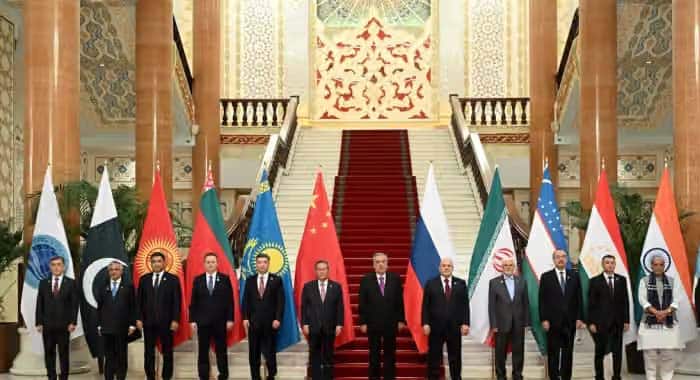
Tajik President Emomali Rahmon has called for stronger regional cooperation against terrorism, extremism, drug trafficking and transnational organised crime, placing security challenges at the centre of discussions with delegations attending the 25th meeting of the Shanghai Cooperation Organisation (SCO) Council of Heads of Government in Dushanbe.
The high-level meeting brings together senior representatives from SCO member states and participating countries to discuss regional security, economic cooperation, trade, investment and shared development priorities. Notably, no representative of the Taliban administration appears among the official participants identified in the meeting information, underscoring Afghanistan’s continued absence from high-level SCO government deliberations since the Taliban returned to power in August 2021.
During his meeting with the heads of delegations, President Rahmon emphasised the importance of preserving peace and stability across the region and resolving disputes through peaceful means. He also reaffirmed Tajikistan’s support for strengthening the central role of the United Nations in addressing international and regional challenges.
A key focus of his remarks was the need for more effective cooperation among participating countries against terrorism, extremism, cyber threats, drug trafficking and cross-border organised crime.
These challenges remain significant concerns for countries across Central and South Asia, where instability, illicit trafficking and the movement of extremist networks can have consequences beyond national borders. Rahmon’s call for coordinated action reflects the importance of intelligence cooperation, stronger border management and collective efforts to prevent criminal and extremist networks from exploiting regional vulnerabilities.
The emphasis on counterterrorism and narcotics trafficking is particularly relevant to Afghanistan’s regional neighbourhood, where governments have repeatedly raised concerns about militant activity, illicit drug flows and the wider security implications of instability.
Despite Afghanistan’s geographical importance to regional connectivity and security, no Taliban representative was listed among the official participants at the Dushanbe meeting, according to the information provided.
Afghanistan has held observer status in the Shanghai Cooperation Organisation since 2012. However, the Taliban administration has not been represented at recent SCO government-level meetings following its return to power in 2021.
Taliban officials have repeatedly called for greater participation in regional forums, arguing that discussions concerning Afghanistan and the wider region should include the authorities currently governing the country. Nevertheless, the absence of a Taliban delegation from the Dushanbe gathering means that Afghanistan’s security and economic challenges are being discussed without direct representation from its current administration.
At previous meetings, SCO member states have also emphasised the importance of an inclusive government in Afghanistan. The question of Afghanistan’s political representation therefore remains closely connected to broader regional discussions about stability, counterterrorism and diplomatic engagement.
The absence of Taliban representatives should not, in itself, be interpreted as evidence of a new formal decision by the organisation. However, it highlights the continuing gap between the Taliban administration’s calls for regional participation and its actual presence in high-level SCO deliberations.
Images released from the meeting show representatives of participating countries alongside President Rahmon, including officials from Pakistan, China, Russia, Iran, Kazakhstan, Kyrgyzstan, Belarus and Uzbekistan. The gathering reflects the SCO’s role as a platform for dialogue among countries with diverse political systems and economic interests, but shared concerns about regional security, connectivity and development.
The organisation was established in 2001, while Afghanistan received observer status in 2012. Since then, developments in Afghanistan have remained relevant to the SCO’s security agenda, particularly in relation to counterterrorism, extremism and narcotics trafficking.
The meeting in Dushanbe provides member states with another opportunity to coordinate their positions on these issues and identify areas where collective action could strengthen regional stability.



