
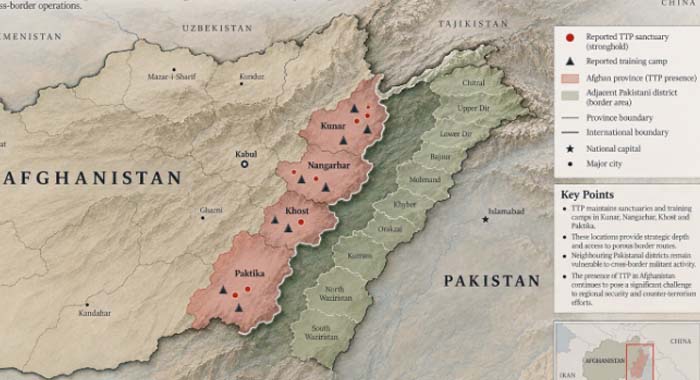
The longstanding relationship between the Afghan Taliban and Tehreek-e-Taliban Pakistan (TTP) remains a central obstacle to resolving the security dispute between Islamabad and Kabul, as ideological loyalties, shared battlefield history and concerns over internal dissent complicate efforts to secure decisive action against the group.
Security analysts argue that the relationship extends beyond political convenience, reflecting decades of ideological affinity, personal connections and cooperation during the war against US-led forces in Afghanistan. These links, they suggest, may help explain why the Afghan Taliban leadership faces a difficult choice between addressing Pakistan’s security concerns and preserving cohesion within its own movement.
At the heart of the dispute is Pakistan’s demand that the Afghan Taliban prevent the TTP from using Afghan territory to plan, organise or support attacks against Pakistani security personnel and civilians. Islamabad maintains that meaningful progress requires concrete action against the group’s leadership and operational networks, rather than assurances that cannot be independently verified.
The Taliban authorities have rejected allegations that they deliberately facilitate anti-Pakistan terrorism. Nevertheless, the continued dispute over the TTP’s presence and activities has deepened mistrust between the two neighbours and placed the relationship between the Taliban leadership and the TTP under increasing scrutiny.
Hassan Khan, a senior commentator on Afghanistan, shared with The Express Tribune that the Taliban leadership’s reluctance to fully acknowledge the extent of the TTP’s presence in Afghanistan may reflect the political and organisational consequences of confronting a group with deep connections to the wider Taliban movement.
According to Khan, acknowledging the TTP’s presence would increase pressure on Kabul to take decisive action against an organisation whose members share longstanding ideological, religious and personal ties with sections of the Afghan Taliban.
The challenge, he suggested, is not merely a question of security policy. It also concerns the internal dynamics of a movement whose members have developed relationships through years of conflict, shared religious beliefs and cooperation on the battlefield.
For the Taliban leadership, decisive action against the TTP could therefore carry consequences beyond its relationship with Pakistan. It could also test the loyalty of commanders and fighters who regard the group as an ideological ally or former wartime partner.
Khan pointed particularly to the influence of second- and third-tier Taliban commanders who may have fought alongside TTP members during the two-decade war against US-led forces. These connections could make efforts to dismantle the TTP’s networks politically sensitive, particularly if sections of the Taliban movement view such action as a betrayal of former comrades. A direct confrontation could generate resistance within parts of the Taliban’s own ranks, potentially complicating the leadership’s efforts to maintain unity and discipline.
This creates a strategic dilemma for Kabul. On one side is the need to maintain workable relations with Pakistan, a neighbouring country with significant geographic, economic and diplomatic influence. On the other is the potential cost of confronting an organisation whose ideological and personal connections extend into sections of the Taliban movement. The extent to which these considerations determine Taliban policy remains a matter of analysis. However, they offer one possible explanation for the persistent gap between Pakistan’s demands and the practical outcomes of diplomatic engagement.
Former Pakistani ambassador to Afghanistan Mansoor Ali Khan told The Express Tribune that the Afghan Taliban and the TTP share deep ideological connections and a history of fighting alongside one another. These historical ties, he argued, help explain why the Taliban leadership may find it difficult to treat the TTP as an entirely separate organisation whose activities can be curtailed without affecting relationships within the wider movement.
The relationship is also shaped by overlapping religious networks, personal connections, battlefield experience and organisational affiliations. Together, these factors can complicate efforts to distinguish between the two movements and establish effective cooperation against the TTP. Another significant element is the TTP’s recognition of Afghan Taliban supreme leader Mullah Haibatullah Akhundzada as its ameer, or leader. This reinforces the ideological dimension of the relationship and adds further complexity to Pakistan’s efforts to persuade Kabul to take action against the group. However, shared ideology and historical connections do not, by themselves, establish that the Afghan Taliban leadership directs every TTP operation or endorses every action carried out by the organisation. The nature and extent of any operational support must be assessed through specific evidence.
For Islamabad, the central issue is whether the Taliban authorities will take verifiable measures to prevent the TTP from operating from Afghan territory. Pakistan has repeatedly called for action against the group’s leadership, recruitment networks and operational infrastructure, arguing that the continued threat to its security personnel and civilians cannot be resolved through public denials or verbal assurances alone. The Taliban authorities, meanwhile, have rejected allegations that they deliberately facilitate attacks against Pakistan, leaving the two sides divided over both the nature of the threat and the appropriate response. The result is a persistent trust deficit in which historical loyalties and internal political considerations are increasingly relevant to the wider security dispute.
The Afghan Taliban’s relationship with the TTP presents a challenge that extends beyond bilateral diplomacy. If ideological affinity and internal loyalties constrain the Taliban leadership’s willingness to act, efforts to secure lasting counterterrorism cooperation could remain difficult.
For Pakistan, the priority is to reduce terrorist violence through practical measures that can be independently assessed. For the Taliban authorities, the challenge is to demonstrate that their security policies can address the concerns of neighbouring countries without creating further instability within Afghanistan.
A sustainable resolution would require concrete commitments, credible verification and consistent engagement between the two sides. It would also require distinguishing between ideological affinity, political sympathy and demonstrable operational assistance, rather than treating them as interchangeable.
Ultimately, the future of Pakistan-Afghanistan security relations will depend in part on whether the Taliban leadership can reconcile its longstanding connections with the TTP with its responsibility to prevent threats against a neighbouring country. Until that question is addressed through verifiable action, the relationship between the two movements is likely to remain a major source of mistrust and a significant obstacle to regional stability.



