
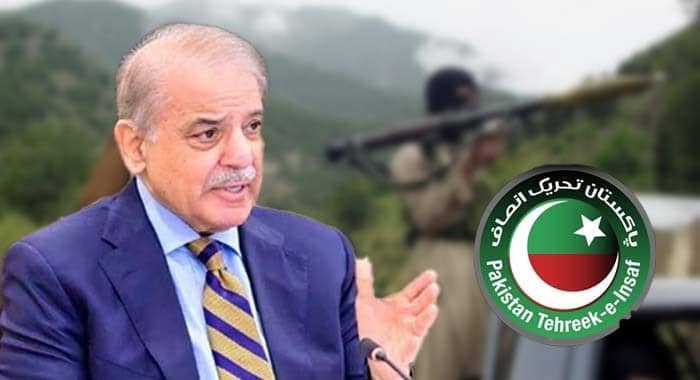
Prime Minister Muhammad Shehbaz Sharif has said that the federal government made every possible effort to work collaboratively with the Khyber Pakhtunkhwa (KP) provincial government to address the province’s security challenges and restore stability, but repeated attempts to secure cooperation did not produce the desired results.
Addressing a parliamentary party meeting of the Pakistan Muslim League-Nawaz (PML-N), the prime minister expressed concern over the deteriorating security situation in Khyber Pakhtunkhwa, accusing the Pakistan Tehreek-e-Insaf (PTI) provincial government of failing to demonstrate the necessary commitment to tackling terrorism and advancing the province’s development.
The prime minister said the federal government had repeatedly offered cooperation to the provincial leadership, including Chief Minister Sohail Afridi and former Chief Minister Ali Amin Gandapur. According to him, meetings were held with the provincial leadership, during which the centre assured them of its full support in addressing the province’s pressing challenges.
However, he maintained that these efforts failed to achieve the level of coordination required to confront the growing threat of terrorism. Prime Minister Shehbaz Sharif said Pakistan had made substantial progress in combating terrorism, adding that the security situation had deteriorated following the return of terrorist elements to parts of the country during the PTI government’s tenure.
Referring to developments in Swat, he alleged that the return of terrorists began during the PTI government, despite significant progress in eliminating terrorism by 2018.
The prime minister argued that the consequences of those decisions were now being felt across the country, particularly in Khyber Pakhtunkhwa, where security personnel and civilians continue to lose their lives in terrorist attacks. He expressed concern that provincial government representatives had not demonstrated the level of public condemnation and practical action against terrorist groups that the circumstances demanded. The prime minister stressed that protecting citizens and supporting security forces must remain a national priority, requiring effective coordination between federal and provincial authorities.
The prime minister said the federal government had sought to resolve differences with the Khyber Pakhtunkhwa government through dialogue and consultation rather than confrontation. According to Shehbaz Sharif, negotiations involved repeated discussions over a proposed draft, but changes were made to the document on multiple occasions, preventing the process from reaching the desired consensus.
He said the federal cabinet subsequently decided, following mutual consultation, to proceed with constitutional measures under Articles 232 and 234 of the Constitution of Pakistan. The prime minister maintained that the decision followed efforts to achieve agreement through dialogue and was taken against the backdrop of growing concerns over the province’s security situation. He also referred to the establishment of an 11-member council comprising technical experts to assist and advise the Governor of Khyber Pakhtunkhwa. The council, he said, was intended to provide professional input and support efforts to address the province’s administrative and governance challenges.
During his address, the prime minister also criticized PTI’s political approach, referring to its past protests in Islamabad and alleging that the party had repeatedly prioritized political confrontation over constructive engagement. He specifically recalled the 2014 sit-in at Islamabad’s D-Chowk, making critical remarks about the protest activities carried out at the time. Shehbaz Sharif contrasted those political activities with what he described as the urgent need for responsible governance, institutional cooperation and practical measures to address terrorism and economic difficulties.
He said the federal government had sought to work with the provincial administration despite political differences, but maintained that meaningful cooperation was essential to resolving the challenges confronting Khyber Pakhtunkhwa.
The prime minister emphasized that terrorism continues to impose a heavy human cost on the country, with members of the security forces and ordinary citizens being killed in attacks. He said the situation required coordinated action, effective governance and a clear commitment to protecting the lives and property of the public.
Shehbaz Sharif reiterated that the federal government wanted terrorism and unemployment to be eliminated from Khyber Pakhtunkhwa, enabling the province to participate fully in the country’s economic and development progress. He described it as unfortunate that any province should remain behind in Pakistan’s overall development journey, stressing that national progress depended on improving security, strengthening public institutions and creating opportunities for citizens across the country.
The prime minister also accused the PTI government of facilitating the return of terrorists to Pakistan and allowing them greater freedom of movement, arguing that the country was now facing the consequences of those decisions. He said the resurgence of terrorism underscored the importance of consistent security policies and effective implementation of counterterrorism measures.
The prime minister maintained that the fight against terrorism could not be addressed through political rhetoric alone and required sustained action, institutional coordination and a shared commitment from all levels of government.
Concluding his remarks, Prime Minister Shehbaz Sharif reiterated that the federal government’s objective was to restore peace, eliminate terrorism, reduce unemployment and ensure that Khyber Pakhtunkhwa was not left behind in Pakistan’s development process.
He emphasized the importance of cooperation between federal and provincial institutions, stating that national security and public welfare must take precedence over political differences. The prime minister’s remarks underscore the continuing political disagreement between the federal government and the PTI-led provincial administration over responsibility for the deterioration in security and the constitutional measures adopted in Khyber Pakhtunkhwa.
The federal government has reiterated that its stated priorities remain the restoration of peace, the protection of citizens and security personnel, and the creation of conditions for sustainable development across Khyber Pakhtunkhwa.



