
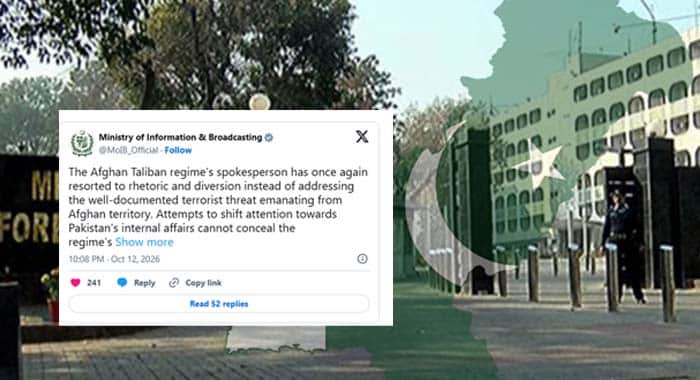
Pakistan’s Ministry of Information and Broadcasting has urged the Afghan Taliban government to respond to concrete evidence concerning terrorist activities originating from Afghan territory, emphasizing that statements and rhetoric cannot replace practical measures to eliminate terrorist threats. The Ministry stressed that the presence of terrorist groups in Afghanistan and the use of Afghan soil for attacks against Pakistan remain serious security concerns that require a credible, measurable, and sustained response.
According to the Ministry, terrorist attacks originating from Afghanistan reflect a failure by the Afghan Taliban government to effectively address the threat posed by armed groups operating from its territory. The Ministry maintained that attempts to deny the existence of these threats or divert attention through public statements cannot obscure the security challenges confronting the region.
Pakistan reiterated that the Afghan Taliban government must demonstrate its commitment to counterterrorism through concrete action, rather than assurances alone. The protection of regional peace and stability, the Ministry emphasized, requires decisive measures against terrorist networks, their support structures, and the sanctuaries from which attacks are planned and facilitated.
The Ministry of Information and Broadcasting referred to a report of the United Nations Security Council that, according to the Ministry, documents the presence of approximately 6,000 members of the banned Tehreek-e-Taliban Pakistan (TTP) in Afghanistan and addresses the Afghan Taliban’s alleged support for the organization.
The Ministry described these findings as a significant indication of the continuing threat posed by terrorist groups operating from Afghan territory. It stressed that concerns documented in international reporting require serious attention and a substantive response from the Afghan Taliban government.
Pakistan called upon the Afghan authorities to address these concerns transparently and take verifiable action against terrorist organizations operating within Afghanistan. Such measures, the Ministry emphasized, are essential to preventing cross-border attacks, strengthening mutual confidence, and ensuring that Afghan territory is not used to threaten the security of neighbouring countries.
The Ministry further underscored that counterterrorism commitments must be assessed on the basis of demonstrable results, including effective action against terrorist sanctuaries, operational networks, and the infrastructure supporting militant activities.
Pakistan has stressed that denying the presence of terrorist groups is not a substitute for addressing the threat they pose. The Ministry called on the Afghan Taliban government to move beyond public declarations and undertake credible, verifiable operations against organizations responsible for threatening Pakistan’s security.
The Ministry emphasized the importance of dismantling terrorist networks, preventing their access to logistical and operational support, and ensuring that individuals and groups involved in planning or facilitating attacks cannot continue to operate with impunity.
Pakistan maintains that the responsibility to prevent its territory and population from being targeted by cross-border terrorism requires practical cooperation and sustained commitment from the authorities exercising control over Afghan territory.
The Ministry reiterated that effective counterterrorism efforts are indispensable to protecting civilian lives, maintaining regional stability, and preventing further deterioration in relations between Pakistan and Afghanistan. The Ministry also criticized the Afghan Taliban government’s restrictions on girls’ education and the broader curtailment of fundamental human rights in Afghanistan.
According to the Ministry, these policies contradict the Afghan Taliban’s public claims and raise serious concerns about the rights, opportunities, and future prospects of the Afghan population, particularly women and girls.
Pakistan underscored the importance of respecting fundamental rights and ensuring access to education without discrimination. Restrictions on girls’ education deprive millions of opportunities for personal development and contribute to wider social and economic challenges.
The Ministry’s statement placed these concerns within the broader context of the Afghan Taliban government’s domestic and international responsibilities, emphasizing the importance of consistency between public commitments and actions on the ground.
Despite the continuing security concerns, Pakistan reaffirmed its commitment to dialogue and diplomatic engagement with Afghanistan. The Ministry emphasized, however, that meaningful progress in bilateral relations depends on the Afghan Taliban government’s willingness to fulfil its counterterrorism commitments through concrete and verifiable measures.
Pakistan maintains that constructive engagement must be accompanied by practical action to address the concerns that have repeatedly undermined bilateral trust. Without credible progress against terrorist groups operating from Afghan territory, efforts to establish lasting confidence and sustainable cooperation will remain severely constrained.
The Ministry stressed that dialogue should produce tangible outcomes, particularly in matters directly affecting the security of Pakistani citizens and the stability of the wider region.
Pakistan’s position, as outlined by the Ministry, is that diplomatic engagement and effective counterterrorism measures are complementary rather than mutually exclusive. Progress on both fronts is necessary to establish a more stable, secure, and cooperative relationship between the two neighbouring countries.
The Ministry reiterated that the Afghan Taliban government bears responsibility for preventing Afghan territory from being used to launch attacks against Pakistan. Pakistan has consistently emphasized that the security of its citizens is a fundamental national priority and that the threat posed by cross-border terrorism requires serious, sustained, and effective action.
The Ministry stated that Pakistan will continue to take all necessary measures to protect its citizens and defend its national security. It also stressed that preventing terrorist attacks requires a credible response to the networks, sanctuaries, and support structures that enable such violence.
The statement made clear that Pakistan’s security concerns cannot be resolved through rhetoric or denials. They require demonstrable action that addresses the underlying threat and helps prevent further attacks.



