
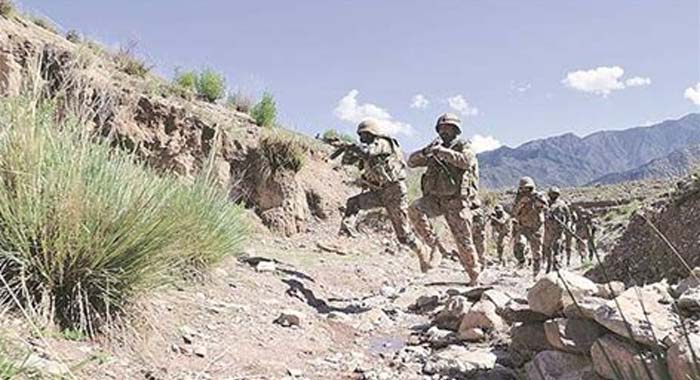
Pakistan has reached a decisive moment in its long-running struggle against terrorism, particularly in Khyber Pakhtunkhwa, where communities have endured years of violence, displacement, economic disruption and the loss of civilians and security personnel.
The central question confronting the country is no longer whether Pakistan can afford to continue its fight against terrorism. The question is whether Pakistan can afford not to finish it. For years, Pakistan’s security forces and civilian population have paid an enormous price in the fight against militant violence. Yet despite repeated operations, sacrifices and counterterrorism campaigns, the threat has continued to evolve.
The time has therefore come for a comprehensive national approach one that places Pakistan’s sovereignty, territorial integrity and the safety of its citizens above political considerations, temporary arrangements and competing narratives. At the heart of the current debate is the fundamental disagreement over the nature of terrorism confronting Pakistan and the policies required to defeat it.
The Pakistan Tehreek-e-Insaf (PTI) has historically argued that Pakistan’s participation in the war against terrorism was externally imposed and driven primarily by financial incentives. That narrative has shaped much of the party’s political positioning on terrorism and Afghanistan. Critics argue that this approach has frequently placed PTI’s political messaging at odds with the state’s counterterrorism objectives, particularly where policies or political positions have been perceived as accommodating the Tehreek-e-Taliban Pakistan (TTP) and the authorities in Kabul.
The issue is not merely political rhetoric. It concerns a fundamental question of national security: Can Pakistan defeat terrorism while simultaneously maintaining political ambiguity about the forces responsible for terrorist violence against Pakistani citizens? A successful counterterrorism strategy requires clarity. The state cannot effectively confront militant organisations if political discourse continuously blurs the distinction between negotiation and accommodation, between political engagement and strategic appeasement, or between legitimate Afghan interests and organisations attacking Pakistan from Afghan territory.
Pakistan has made enormous sacrifices in its fight against terrorism. Thousands of civilians and members of the armed forces and law-enforcement agencies have lost their lives. Entire communities in the tribal districts and elsewhere in Khyber Pakhtunkhwa have experienced the consequences of militant violence. Yet the persistence of the threat raises an unavoidable question: Why, after so many sacrifices, has terrorism not been decisively defeated? One explanation offered by critics of the existing political approach is that Pakistan has repeatedly struggled to maintain a unified national policy toward the TTP and its associated militant networks.
Military operations alone cannot permanently eliminate a threat if political, administrative and ideological conditions continue to provide space for militant organisations to reorganise. The country therefore requires consistency between its political leadership, security institutions and counterterrorism policy. There can be no effective national security strategy when political actors send contradictory signals about organisations that the state itself identifies as security threats.
One of the recurring political arguments in Pakistan is that if security forces are deployed along the country’s western border, how can militants continue to enter Pakistan or carry out attacks? The answer requires a more sophisticated understanding of modern terrorism. A border can be strengthened, monitored and heavily secured and yet the threat can persist through established networks, local facilitators, clandestine routes, sympathetic infrastructure, criminal networks and cross-border militant sanctuaries. Border security is essential.
But it is not sufficient by itself. Pakistan must simultaneously address the networks that enable terrorism to operate inside the country. That requires intelligence cooperation, policing, financial disruption, prosecution, political coordination, border management and sustained pressure against militant infrastructure.
A central political argument emerging from the current debate is that Pakistan’s political leadership particularly in Khyber Pakhtunkhwa must look toward Islamabad and Peshawar when developing solutions to Pakistan’s internal security challenges rather than treating Kabul as the primary source of answers. Afghanistan is an important neighbour and Pakistan has legitimate reasons to maintain diplomatic engagement with Kabul. But diplomacy cannot replace national security policy.
Pakistan’s interests must be determined in Pakistan. The security concerns of citizens in Peshawar, Charsadda, Bannu, North and South Waziristan, Khyber and other affected districts cannot be subordinated to political calculations connected to developments across the border. The fundamental responsibility of every government is to protect its own citizens.
For decades, the people of Khyber Pakhtunkhwa have lived on the front lines of regional conflict. The province has endured terrorism, military operations, displacement, attacks on schools and public institutions, economic disruption and the destruction of ordinary community life. Its people deserve more than another cycle of violence followed by temporary political arrangements.
They deserve lasting security. The argument now being advanced by critics of accommodation with militant organisations is straightforward: The future of Khyber Pakhtunkhwa must be determined by the interests of its people—not by the priorities of militant organisations operating across the border. The province must look toward its own cities, districts and institutions—to Peshawar, Charsadda, Bannu, Waziristan and the rest of Khyber Pakhtunkhwa—and toward Islamabad as the centre of Pakistan’s constitutional state. Afghanistan remains an important neighbour. But militant sanctuaries, trafficking networks and cross-border criminal activity cannot be allowed to define Pakistan’s relationship with Afghanistan.
Pakistan’s relationship with Afghanistan is complex and cannot be reduced to a single issue. The two countries share history, geography, ethnic and cultural connections and a long border. At the same time, Pakistan has legitimate security concerns regarding militant groups operating from Afghan territory. TTP attacks and cross-border militancy have transformed Afghanistan from a purely diplomatic issue into a direct national-security challenge.
The answer is not permanent confrontation with the Afghan people. Nor is it hostility toward Afghanistan as a nation. The answer is a clear distinction between the Afghan people and militant organisations that use Afghan territory to plan or facilitate attacks against Pakistan. Pakistan must maintain diplomatic channels with Kabul while simultaneously demanding that Afghan territory not be used against Pakistan. Diplomacy and counterterrorism are not mutually exclusive. Indeed, effective diplomacy requires clarity about national interests.
The people of Pakistan particularly the people of Khyber Pakhtunkhwa—have experienced the consequences of militant violence for far too long. There is growing public fatigue with the idea that Pakistani communities should simply coexist indefinitely with organisations responsible for violence, intimidation and attacks against the state. Citizens want schools that remain open. They want markets where businesses can operate without fear. They want roads and public spaces where families can travel safely.
They want police officers, soldiers, teachers, journalists and community leaders to be able to perform their duties without becoming targets. Above all, they want the state to establish a permanent security environment in which militant organisations cannot dictate the terms of daily life. The fight against terrorism must therefore be understood not merely as a military campaign but as a demand arising from ordinary citizens for the restoration of normal life.
The political leadership of Khyber Pakhtunkhwa now faces a historic responsibility. After years of PTI-led governance in the province, critics argue that militant networks and their sympathisers have been allowed too much political and social space. Whether one agrees with that assessment in full or not, the underlying challenge is undeniable: terrorism remains a serious threat to the province.
The next phase requires leaders who are prepared to stand shoulder to shoulder with the people and the institutions responsible for protecting them. Khyber Pakhtunkhwa needs political leadership that treats counterterrorism as a provincial and national priority rather than as an issue to be used primarily for political confrontation. It needs leaders who can work with the federal government, security institutions, police, intelligence agencies, local administrations and communities to build a unified response. Most importantly, it needs leadership that places the interests of Pakistan and Khyber Pakhtunkhwa above partisan considerations.
The country cannot afford endless ambiguity over the TTP. There must be a clear distinction between legitimate political dialogue and concessions that strengthen militant organisations. There must be a distinction between reconciliation and surrendering state authority. And there must be a distinction between diplomacy with Afghanistan and dependence on Afghan authorities to resolve Pakistan’s internal security challenges. Pakistan’s policy must be based on one principle: No organisation can be permitted to use violence against Pakistani citizens or challenge the authority of the Pakistani state.
Any political settlement must operate within the Constitution and the law. Any engagement with neighbouring governments must protect Pakistan’s sovereignty and security. And any counterterrorism strategy must ultimately be judged by one standard: whether it makes Pakistani citizens safer.
Pakistan now requires a renewed national consensus against terrorism. Such a consensus should bring together the federal government, provincial governments, political parties, parliament, security institutions, religious scholars, civil society, business communities and, above all, the people directly affected by violence. The objective should not be political victory over one party or another.
The objective should be the defeat of terrorism. Political differences will continue to exist in a democratic society. Governments will change. Parties will rise and fall. But the state’s fundamental responsibility to protect its citizens cannot change with every political cycle. Terrorism must remain a red line.
Pakistan has fought terrorism for years. The sacrifices are already written into the country’s history. The question now is whether those sacrifices will ultimately produce lasting peace or whether Pakistan will remain trapped in a cycle in which militants regroup, political debates reopen old questions and another generation is forced to confront the same threat. The moment has arrived for a decisive shift.
Pakistan must strengthen its borders. It must dismantle militant networks. It must disrupt terrorist financing. It must strengthen intelligence and law enforcement. It must demand effective action against militant sanctuaries across the border. It must support communities that have suffered from terrorism. And it must ensure that political considerations never become a substitute for national security.
The message emerging from Khyber Pakhtunkhwa should be unmistakable: The people of Pakistan want peace, but peace cannot mean permanent accommodation with terrorism. The people want dialogue, but dialogue cannot mean surrendering the state’s authority. The people want regional stability, but stability cannot be built on the continued existence of organisations attacking Pakistani citizens.
And the people want Afghanistan to be a peaceful neighbour not a source of militant violence, criminal networks and instability. Pakistan’s future cannot be held hostage by terrorism.
The time has come for a unified national policy in which there is no ambiguity about the enemy, no political space for terrorism and no compromise over the security of Pakistani citizens. The next chapter of Pakistan’s counterterrorism struggle must be defined by coordination, resolve and the rule of law.
This is not a war against a people, a province or a neighbouring country. It is a fight against terrorism and those who use violence to undermine the Pakistani state and endanger its citizens. And after years of sacrifice, the objective must finally be clear: A secure Pakistan. A peaceful Khyber Pakhtunkhwa. And a state that will no longer compromise on the right of its people to live without fear.



