
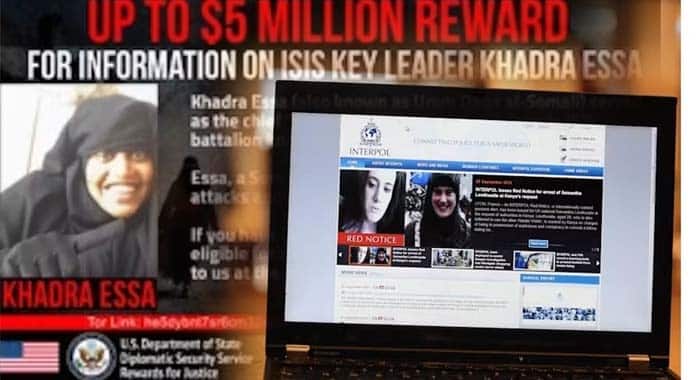
The United States has renewed its public offer of up to US$5 million for information leading to the whereabouts of Khadra Essa, a Somali-born Dutch citizen accused of holding a senior role within the Islamic State’s female military structures in Syria.
Essa, who allegedly operated under the name Umm Qaqa al-Somali, was again the subject of a U.S. State Department reward notice on September 14, 2026. The United States had initially announced a reward for information concerning her in April 2025. According to the U.S. State Department, Essa served as the chief sharia instructor of Khatiba Nusaybah, an all-female Islamic State combat battalion formed in Raqqa, Syria, in 2016. The unit was reportedly established to recruit, organize and train female members of the Islamic State.
The case has drawn particular attention because it illustrates a broader evolution in the organizational roles assigned to women within jihadi movements — extending beyond traditional support functions to include recruitment, ideological instruction, training, discipline and, in some cases, operational leadership.
The U.S. government is offering up to $5 million for information that can assist authorities in locating Essa. The reward notice identifies her as a senior ideological figure associated with Khatiba Nusaybah and alleges that she received formal instruction in weapons, explosives and suicide operations.
U.S. authorities further allege that Essa taught Islamic State ideology used to justify suicide operations and attacks against civilians, recruited members, issued orders that resulted in assaults and killings, and led a group involved in enforcing the organization’s interpretation of sharia law against women. These allegations form the basis of the U.S. government’s public identification of Essa and its continuing effort to obtain information concerning her location.
Khatiba Nusaybah represented a significant development in the Islamic State’s use of female personnel. Unlike women whose participation in jihadi organizations was historically concentrated in support activities or, increasingly, suicide attacks, the formation of an all-female military battalion provided a more formal organizational framework for women to receive weapons training, ideological instruction and military preparation.
The battalion was reportedly established in late 2016, as the Islamic State sought to expand and formalize the role of women within its organizational structure. Essa’s alleged position as chief sharia instructor placed her within the ideological and training architecture of the organization, according to the U.S. State Department.
The case of Essa also forms part of a broader development identified by terrorism researchers studying the organizational evolution of jihadi movements. Women have participated in armed movements for decades, including as fighters, suicide attackers, recruiters, financiers, couriers and intelligence operatives. However, researchers have increasingly documented cases in which women have assumed defined organizational responsibilities involving authority over other members and critical organizational functions.
Historically, many jihadi organizations publicly emphasized highly restrictive gender roles, portraying women primarily as wives, mothers and supporters of male fighters. Over time, operational requirements and changing battlefield circumstances contributed to a gradual expansion of those roles. The emergence of female recruitment networks, enforcement units, training structures and specialized technical functions demonstrated that women could become important components of organizational infrastructure even where ideological doctrine continued to emphasize traditional gender roles.
The Islamic State’s al-Khansaa Brigade, established in Syria in 2014, represented an earlier stage in this evolution. The all-female unit was initially associated with security and enforcement functions, including searching women at checkpoints and policing women in Islamic State-controlled territory. Its responsibilities reportedly expanded to include intelligence gathering, recruitment and enforcement.
The establishment of Khatiba Nusaybah subsequently represented another step, placing women within a more explicitly military structure. The distinction is significant: while al-Khansaa operated primarily as an enforcement and security formation, Khatiba Nusaybah was organized as a female military battalion.
According to the U.S. Justice Department, Allison Fluke-Ekren, a U.S.-born woman who became a senior Islamic State figure, organized and led Khatiba Nusaybah and trained more than 100 women and girls in the use of automatic rifles, grenades and suicide belts. Fluke-Ekren was eventually transferred to FBI custody in January 2022, pleaded guilty in June of that year, and was sentenced in federal court in Virginia to 20 years in prison. The cases of Fluke-Ekren and Essa demonstrate how women could occupy distinct and increasingly formalized positions within Islamic State structures.
The evolution did not stop with military roles. Women have also become involved in specialized functions that are essential to the survival and functioning of extremist organizations. One example cited in the supplied research is Sarah Jamal Muhammad al-Sayyid, an Egyptian national designated by the U.S. Treasury Department in January 2024 for allegedly supporting the Islamic State through its Electronic Horizons Foundation.
According to the U.S. Treasury Department, al-Sayyid was involved in activities including recruitment, procurement of web servers, logistical management and cryptocurrency-related support. Such cases demonstrate that women’s involvement in extremist organizations can extend across multiple layers of the organizational ecosystem from ideological instruction and recruitment to logistics, communications, financing and technical support.
The development of formal female authority within jihadi organizations should also be viewed against the longer history of women’s participation in political violence. Female combatants and attackers have existed across ideological movements for decades.
Examples include the Syrian Social Nationalist Party’s use of Sana’a Mehaidli in a 1985 suicide attack in Lebanon, the Liberation Tigers of Tamil Eelam’s deployment of female operatives, and the use of female suicide bombers by Palestinian militant organizations. By the early 2000s, female suicide attackers had become an established tactic among a number of militant and terrorist organizations.
Boko Haram subsequently expanded the tactic on an unprecedented scale. Research cited in the supplied material identified hundreds of suicide bombers associated with the group between 2011 and 2017, with women constituting a substantial proportion of those attackers.
In these cases, however, women’s roles were often concentrated at the operational end of attacks: carrying explosives, reaching designated targets and carrying out suicide missions. The cases emerging from Islamic State structures illustrate a different dimension women participating in the selection, preparation, ideological conditioning, training and management of other members.
The expansion of women’s roles occurred alongside an evolution in extremist propaganda. Islamic State messaging initially maintained a strongly restrictive view of women’s participation in armed jihad. A 2015 manifesto, for example, permitted women to fight only under exceptional circumstances. As the organization’s territorial control came under increasing military pressure, its messaging increasingly invoked historical and religious precedents to justify expanded female participation. One such precedent was Nusaybah bint Ka’ab, also known as Umm Umara, a woman associated with the early Islamic period who participated in the Battle of Uhud.
The Islamic State invoked such historical figures in its propaganda to construct a religious justification for women’s participation in armed activity. This evolution illustrates the tension between ideological doctrine and organizational necessity: as circumstances changed, the organization adapted its propaganda to accommodate functions it increasingly required women to perform.
The U.S. government has also issued a separate notice seeking information concerning two American children allegedly taken by Essa following the death of their mother in 2019. The children’s case adds a humanitarian dimension to the broader investigation surrounding Essa and demonstrates the range of allegations associated with her activities and movements in the region.
The renewed U.S. reward for Khadra Essa highlights more than the search for an individual alleged to have held a senior position within an Islamic State women’s unit. It also draws attention to a broader transformation in how extremist organizations have utilized women. Women who once appeared predominantly in propaganda as supporters, wives, mothers or suicide attackers have increasingly been documented in roles involving recruitment, ideological indoctrination, training, enforcement, financing, technical support and organizational management.
The cases of Essa, Fluke-Ekren and al-Sayyid illustrate different manifestations of this evolution. The development does not necessarily represent a uniform ideological transformation across all jihadi organizations. Rather, it reflects how extremist groups have adapted their organizational structures to exploit available personnel and capabilities while attempting to maintain ideological legitimacy.
The U.S. government’s decision to renew its $5 million reward offer keeps Khadra Essa among the individuals publicly sought by American authorities for alleged involvement with the Islamic State. The reward is intended to encourage individuals with credible information concerning her whereabouts to come forward.
The case also provides terrorism researchers and security agencies with an important example of the increasingly complex roles women can occupy within extremist organizations from the battlefield and recruitment networks to ideological, logistical and organizational functions.
As counterterrorism agencies continue to monitor the evolution of extremist networks, the Essa case underscores the importance of examining not only who carries out attacks, but also who recruits, trains, indoctrinates, disciplines and sustains the organizations behind them.



