
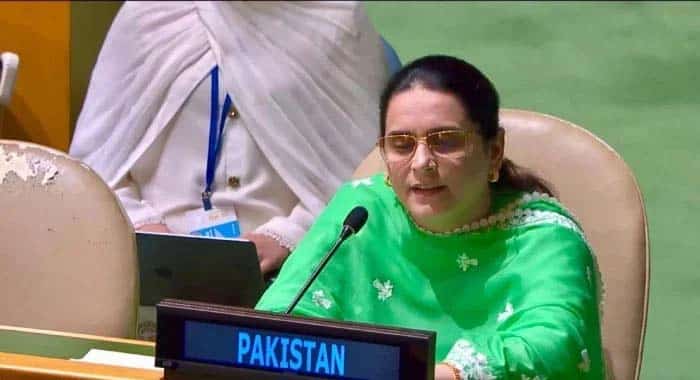
Pakistan has delivered a forceful rebuttal to India at the United Nations General Assembly, accusing New Delhi of exporting terrorism and political violence beyond the region while simultaneously portraying itself as a victim of terrorism.
Exercising its Right of Reply during the General Debate of the 81st Session of the United Nations General Assembly, Pakistan’s Counsellor Saima Saleem rejected the allegations made by the Indian representative against Pakistan and presented Islamabad’s concerns over India’s alleged involvement in terrorist activities, assassination plots, and violence both within the region and abroad.
In a strongly worded intervention, Saima Saleem stated that India had elevated what Pakistan described as propaganda and disinformation into instruments of state policy, while allegedly using terrorism as a tool of its foreign policy.
Pakistan specifically drew the attention of the international community to cases involving Indian nationals accused or convicted in connection with alleged assassination plots abroad. Saima Saleem cited the case of Kulbhushan Jadhav, a serving Indian naval officer whom Pakistan convicted on terrorism and espionage charges, as well as Nikhil Gupta, who pleaded guilty in the United States in connection with a plot to assassinate a Sikh separatist leader.
She also referred to cases in Canada involving alleged Indian links to assassination operations, arguing that such cases demonstrate that the issue extends beyond the traditional boundaries of the India-Pakistan conflict. Pakistan maintained that while New Delhi attempts to portray itself as a victim of terrorism, Islamabad believes the international record raises serious questions regarding India’s alleged use of violence and covert operations abroad.
Saima Saleem stated that Pakistan has endured enormous human and economic losses from what Islamabad describes as India-sponsored terrorism. According to the Pakistani representative, nearly 100,000 Pakistanis have lost their lives as a result of terrorism attributed to India, leaving a lasting impact on successive generations and imposing billions of dollars in economic losses. She emphasized that Pakistan’s counterterrorism campaign has involved substantial sacrifices by civilians and security personnel and said the country’s efforts against terrorism have received international recognition.
Pakistan also reiterated that it has previously shared what it considers extensive evidence concerning Indian financing, facilitation, and support for militant organizations targeting Pakistani civilians and security personnel.
The Pakistani diplomat questioned India’s credibility in lecturing other countries on terrorism while, according to Islamabad, failing to unequivocally condemn terrorist attacks that claim the lives of Pakistani civilians. She stressed that Pakistan expects the same international standards to be applied to all states and called attention to what Islamabad considers evidence of Indian involvement in activities that threaten Pakistan’s national security.
The longstanding Jammu and Kashmir dispute also featured prominently in Pakistan’s response. Saima Saleem reiterated Pakistan’s position that Jammu and Kashmir remains an internationally disputed territory and rejected India’s claim that the territory is an integral part of the country. She alleged that the people of Indian-administered Jammu and Kashmir have endured decades of occupation, repression, and restrictions on fundamental rights and freedoms.
Contrasting the situation with Azad Jammu and Kashmir, she stated that residents there participate in political processes and public life and have avenues to express their views. Pakistan maintained that the aspirations and rights of the Kashmiri people remain central to any lasting resolution of the dispute.
Pakistan also used the UN platform to raise concerns regarding the treatment of religious and social minorities in India. Saima Saleem accused the RSS-BJP establishment of embedding Hindutva ideology within state policy and alleged systematic discrimination against Muslims, Christians, Dalits, and Sikhs. She referred to communal violence in Gujarat and Delhi, inflammatory political rhetoric, calls targeting Muslims, and discriminatory citizenship measures as examples of what Pakistan described as an expanding pattern of intolerance.
Pakistan argued that these issues warrant international attention and scrutiny alongside the allegations New Delhi has levelled against Islamabad.
The Pakistani representative also strongly criticized India’s approach to the Indus Waters Treaty, accusing New Delhi of attempting to use water as a political instrument. She emphasized the critical importance of the Indus river system to Pakistan, describing water as a lifeline for approximately 240 million Pakistanis. Pakistan maintained that attempts to undermine or manipulate the water-sharing framework could have serious consequences for the country’s population, agriculture, and economy.
Turning to the military confrontation between the two countries in May 2025, Saima Saleem rejected what she described as India’s narrative surrounding the conflict. She referred to the confrontation as Marka-e-Haq and asserted that India suffered a significant setback, arguing that the episode had broader implications for New Delhi’s international credibility. Pakistan maintained that India’s attempts to shape the international narrative could not obscure what Islamabad considers the facts surrounding the May 2025 confrontation.
Pakistan’s intervention at the UN General Assembly represented a comprehensive response to India’s allegations, placing terrorism, assassination plots abroad, Jammu and Kashmir, minority rights, the Indus Waters Treaty, and the May 2025 military confrontation at the centre of Islamabad’s rebuttal.
Through its Right of Reply, Pakistan rejected what it characterized as India’s attempt to portray itself solely as a victim of terrorism and instead called upon the international community to examine allegations concerning terrorism and political violence on the basis of evidence and consistent international standards. The Pakistani delegation reiterated that Islamabad remains committed to exposing what it considers threats to its sovereignty and national security and to presenting its position before international forums.



