
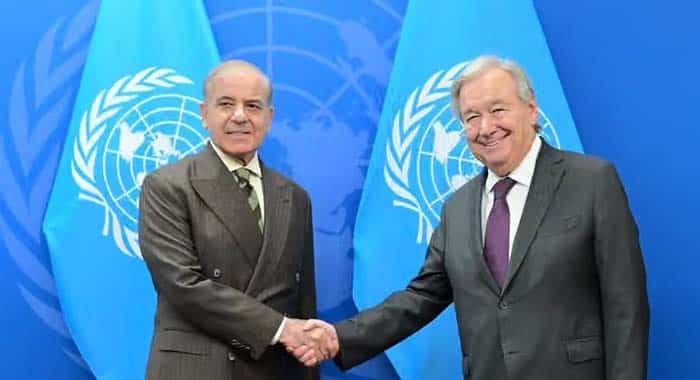
Prime Minister Shehbaz Sharif has raised Pakistan’s concerns over what he described as a growing threat of terrorism emanating from Afghan territory during a meeting with United Nations Secretary-General António Guterres on the sidelines of the 81st session of the United Nations General Assembly.
According to the Prime Minister, the security situation along Pakistan’s western border and the alleged presence of armed groups operating from Afghan territory were among the key issues discussed during the meeting.
Prime Minister Sharif reiterated Pakistan’s position that terrorism remains a serious regional and international security challenge and stressed the need for the international community to address threats that cross borders and undermine regional stability.
Despite the escalating tensions with Afghanistan, Prime Minister Sharif reaffirmed Pakistan’s support for dialogue and diplomacy as mechanisms for resolving conflicts. The Prime Minister’s remarks come at a time of heightened tensions between Pakistan and the Taliban authorities following a series of deadly attacks and subsequent military exchanges along the two countries’ border.
Sharif’s emphasis on diplomacy signals Islamabad’s stated preference for addressing outstanding disputes through engagement while maintaining that Pakistan has the right to protect its citizens and territory from terrorist attacks.
The latest escalation followed a deadly attack on a mosque near a police headquarters in Kohat, Khyber Pakhtunkhwa, which killed at least 31 people and wounded around 80 others. Following the attack, Pakistan again accused the Taliban authorities of providing sanctuary to armed groups opposed to Pakistan. The Taliban has rejected the allegation. The dispute has further strained already difficult relations between Islamabad and Kabul, with both sides exchanging accusations over cross-border terrorism and military activity.
During his meeting with Secretary-General Guterres, Prime Minister Sharif also raised Pakistan’s concerns regarding the growing phenomenon of Islamophobia. The issue remains part of Pakistan’s broader diplomatic agenda at the United Nations, where Islamabad has repeatedly called for greater international efforts to counter discrimination and hostility directed against Muslims.
Sharif also reiterated Pakistan’s support for the Palestinian people’s right to self-determination and the establishment of an independent Palestinian state.
The meeting between Prime Minister Sharif and Secretary-General Guterres comes at a particularly sensitive moment for relations between Pakistan and Afghanistan. The recent sequence of events from the deadly Kohat attack and accusations of terrorist sanctuaries to Pakistani airstrikes, Taliban attacks on Pakistani positions and diplomatic protests has demonstrated how quickly a security dispute can develop into a broader confrontation.
For Pakistan, the central issue remains the alleged presence and operation of terrorist groups from Afghan territory.



