
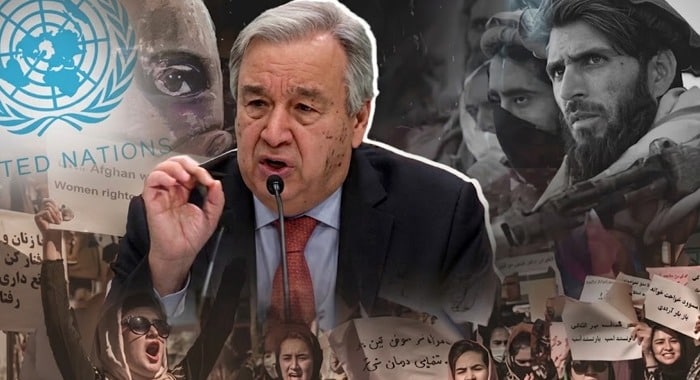
The continued erosion of women’s rights, freedom of expression, and fundamental human freedoms in Afghanistan under the Taliban regime remains a matter of profound international concern, as restrictive policies continue to affect Afghan women across virtually every sphere of public and private life.
United Nations Secretary-General António Guterres has called for the immediate reversal of discriminatory restrictions and injustices imposed on women in Afghanistan, expressing deep concern over policies that continue to limit the rights, opportunities, and participation of Afghan women in society.
The UN Secretary-General’s concerns underscore the widening gap between Afghanistan’s obligations toward fundamental human rights and the restrictions being imposed by the Taliban authorities.
Under the Taliban regime, Afghan women and girls continue to face extensive restrictions affecting their education, employment, public participation, freedom of movement, access to opportunities, and ability to contribute fully to their communities and country.
These restrictions are not isolated administrative measures. Their cumulative impact reaches into virtually every aspect of women’s lives, limiting their ability to pursue education, earn livelihoods, participate in public institutions, contribute to economic activity, and exercise fundamental freedoms.
The continued implementation of discriminatory policies has created an environment in which millions of Afghan women are being progressively excluded from social, economic, and public life.
Such exclusion carries consequences not only for individual women but for Afghanistan as a whole. A society cannot achieve sustainable stability or meaningful development while a substantial portion of its population is systematically prevented from participating in the country’s economic, social, educational, and institutional life.
The call from UN Secretary-General António Guterres reflects the growing international concern over the treatment of Afghan women under Taliban rule. The demand is clear: discriminatory restrictions against Afghan women must end, and women must be allowed to exercise their fundamental rights without discrimination.
The international community has repeatedly emphasized that women’s rights are not optional privileges that can be granted or withdrawn according to political circumstances. They form an essential component of universal human rights and are fundamental to the dignity, equality, and development of every society. The continued restrictions therefore represent a serious human rights challenge with consequences extending far beyond Afghanistan’s borders.
Afghanistan’s social and economic recovery is closely connected to the ability of its entire population to participate in national life. When women are prevented from working, studying, participating in institutions, or contributing to economic activity, the country loses an enormous portion of its human capital. Women are educators, healthcare professionals, entrepreneurs, civil servants, researchers, humanitarian workers, and community leaders. Preventing them from contributing to these fields deprives families, communities, and the wider Afghan economy of skills and expertise that are essential for recovery.
Discrimination against women can consequently deepen economic hardship, weaken social resilience, and restrict Afghanistan’s ability to integrate with the international community.



