
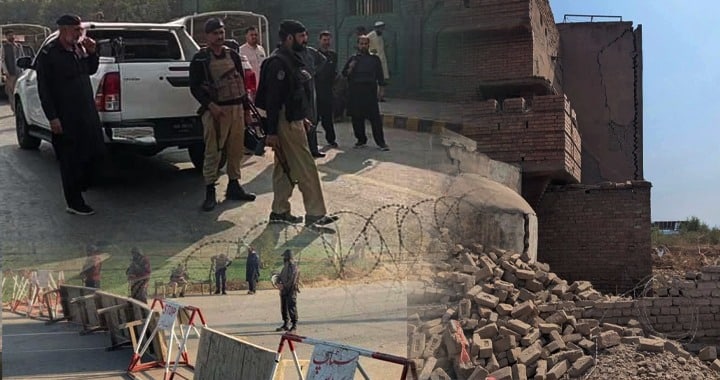
The bomb blast near the Frontier Road Police Checkpost in Peshawar’s Sra Khawra area may have caused limited physical damage, but the incident carries a significance that extends well beyond the damaged boundary wall and the police officer injured in the explosion.
The attack once again places police installations in Peshawar under scrutiny at a time when law-enforcement personnel across Khyber Pakhtunkhwa continue to face a persistent terrorist threat. The fact that an explosive device could be planted near a police facility is itself a security concern, regardless of the eventual extent of the damage.
Sra Khawra is not unfamiliar with attacks on police infrastructure. Police installations in the area were among several Peshawar facilities targeted earlier this year, when attacks left police personnel and civilians injured. Police subsequently reviewed security arrangements at the affected installations and other vulnerable points.
That history makes the latest blast more than an isolated incident. Small police posts and checkpoints may not possess the same defensive infrastructure as major security installations, yet they remain important components of the security network. They provide local policing, monitor movement and serve as visible points of state presence in areas where terrorists seek to exploit vulnerabilities.
Recent attacks elsewhere in Khyber Pakhtunkhwa have demonstrated the risks faced by personnel stationed at such facilities. In July, a major assault on a police post in Hangu resulted in heavy police casualties, while other checkpoints have also come under attack in recent months.
The challenge, therefore, is not simply to repair a damaged wall or reinforce a particular checkpoint after an explosion. It is to prevent terrorists from turning vulnerable police positions into recurring targets.
For Peshawar, that requires sustained attention to intelligence, surveillance, physical security and rapid response capabilities. It also requires the police and other law-enforcement agencies to continually reassess installations that terrorists may regard as comparatively easier targets.
The latest blast also demonstrates why accountability cannot end with a responsibility claim issued by a terrorist organization. Such claims may provide investigators with information to examine, but they do not by themselves establish the full chain of responsibility behind an attack. The people who planned, facilitated, financed, supplied or carried out the bombing remain the subject of the law-enforcement and judicial process.
That distinction matters. Terrorist organizations can claim attacks from a distance, but accountability requires identifying the individuals who actually enabled the violence and bringing them before the law.
For the injured police officer, the blast is not an abstract security statistic. For the personnel serving at the check post, neither is it. Every such attack carries the possibility of greater casualties if the next device is larger, the target more crowded or the response delayed.
Peshawar has repeatedly confronted terrorist violence, and its police have remained a frontline component of the city’s security architecture. The latest attack is another reminder that even apparently limited incidents can expose vulnerabilities that terrorists may seek to exploit again.
The immediate damage from the Sra Khawra blast may be repaired. The more important task is ensuring that those who planned and executed the attack are identified and brought to justice, while the vulnerabilities exposed by the incident are addressed before terrorists can exploit them again.



