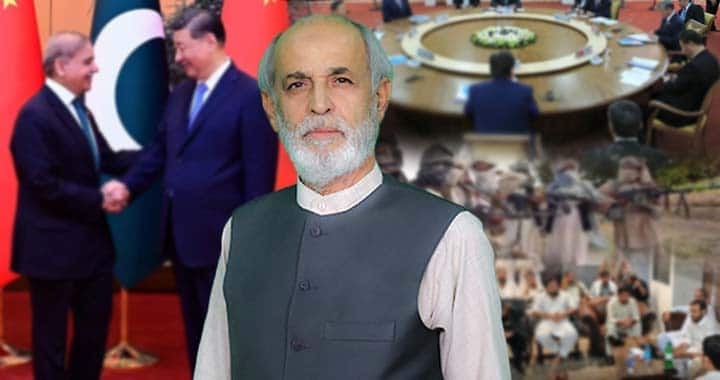
The latest regional messaging on Afghanistan carries a significance that the Taliban leadership can no longer afford to dismiss. The Shanghai Cooperation Organization’s concerns over Afghanistan, particularly its call for a more inclusive political process and a reconsideration of policies affecting education, employment, health and security, point to a broader problem: growing unease over the direction in which the Taliban are taking the country.
For Pakistan, however, the most pressing concern remains security.
The issue is no longer simply whether the Taliban want international recognition or whether they believe their policies are acceptable. The real question is whether Afghanistan’s territory is being prevented from becoming a sanctuary for organizations threatening neighboring countries.
Pakistan has repeatedly maintained that the banned TTP, or Fitna al-Khwarij, is operating from Afghan soil. China faces its own security concerns regarding the East Turkestan Islamic Movement, or ETIM, while both countries have increasingly recognized that terrorism emanating from Afghanistan cannot be treated as an isolated Afghan problem.
This explains the growing importance of China-Pakistan cooperation against TTP and ETIM.
The two organizations have different geographical and political targets, but the security concern is increasingly shared: armed groups can exploit Afghanistan’s territory, difficult terrain, porous borders and the absence of effective action against them to plan, organize and sustain terrorist activity.
The Taliban cannot reasonably expect these concerns to disappear merely because they issue assurances.
Words Are No Longer Enough
The central weakness in the Taliban’s position is the widening gap between assurances and observable developments.
Taliban representatives continue to insist that Afghan territory will not be used against Pakistan. Such statements are welcome in themselves. Dialogue and diplomatic engagement should always be preferred over confrontation. But assurances acquire credibility only when they are followed by verifiable action.
That is precisely where the problem lies.
Reports of continued contacts between Taliban figures and TTP leadership, including allegations surrounding the provision of drones to the group, have raised fresh questions about whether the Taliban are genuinely prepared to dismantle the infrastructure of groups operating against Pakistan. The Taliban have not confirmed those allegations, but neither can Islamabad simply disregard intelligence and security concerns because Kabul offers verbal assurances.
There is also a historical dimension that cannot be ignored. Afghan Taliban and Pakistani Taliban networks have maintained ideological, personal and organizational links for decades. These relationships have survived political upheavals, military operations and changes in the regional security environment.
Consequently, expecting Pakistan to accept declarations at face value while terrorist attacks and cross-border threats continue would be unrealistic.
The SCO’s emphasis on Afghanistan’s security and governance concerns therefore deserves attention. Afghanistan’s stability is not merely an Afghan domestic matter. Instability there directly affects Pakistan, Central Asia, China and the wider region. Reconstruction, refugee rehabilitation and humanitarian assistance are important, but lasting stability cannot be separated from counterterrorism.
Afghanistan needs an environment in which no armed organization can operate with impunity against another country.
For Pakistan, this is not an ideological argument. It is a matter of national security.
The Threat Is Also Playing Out Inside KP
While the regional debate over Afghanistan continues, the security situation inside Khyber Pakhtunkhwa demonstrates why Pakistan cannot afford to treat the threat as merely a diplomatic dispute.
Recent intelligence-based counterterrorism operations are a reminder that terrorist networks remain active on the ground. In Shakas, Jamrud tehsil of Khyber district, the Counter Terrorism Department eliminated four terrorists in an intelligence-based operation. Three of those killed were locals, while one was an Afghan national. The terrorists were reported to have been foreign-sponsored and affiliated with the banned TTP.
The operation was not an isolated development. Intelligence-based and targeted operations have continued in different parts of KP, including Kulachi, as security agencies attempt to disrupt terrorist networks before they can translate their plans into attacks.
At the same time, the situation in Bannu and Lakki Marwat has shown signs of improvement. Terrorist attacks have declined, intelligence-based operations are continuing, and contact among the government, local population and police peace committees has helped create a more stable environment.
But improvement should not be confused with elimination of the threat.
Terrorism remains alive in parts of KP, and there are still individuals and networks attempting to sustain it. This is precisely why the security apparatus must remain alert even when the number of attacks begins to fall. Counterterrorism is most effective when pressure is maintained before terrorist networks can regroup.
The role of local communities is equally important. Police peace committees and local stakeholders can provide valuable information and help maintain contact between the population and security institutions. Their engagement can strengthen intelligence gathering and reinforce public confidence in counterterrorism efforts.
Yet this also requires clarity about institutional responsibility.
Federal and Provincial Responsibility Must Meet
Security cannot become a political football between Islamabad and Peshawar.
The federal government cannot be ignored because terrorism is a national security issue and the federal authorities have a central role in confronting threats that cross provincial and international boundaries. But the provincial government cannot be ignored either, because maintaining law and order is fundamentally a provincial responsibility.
Both are stakeholders.
The answer, therefore, is coordination rather than exclusion. The federal and provincial governments must work together, particularly in areas where terrorist networks exploit administrative or institutional gaps.
This is especially important in KP, where the security challenge has both a domestic and a cross-border dimension. Intelligence-based operations can disrupt terrorist cells, but long-term stability also depends on effective policing, local cooperation, political engagement and coordination between the institutions responsible for security.
The same principle applies to Afghanistan.
Diplomacy and Counterterrorism Must Move Together
The situation makes direct Pakistan-Afghanistan engagement increasingly important. Almost eleven months of confrontation, military action and diplomatic efforts have failed to produce a durable solution. Qatar, Türkiye, Iran, Saudi Arabia and China have all attempted, in different ways, to help resolve the crisis, while China continues to have an important role.
Direct talks should therefore not be viewed as a concession by either side. They are a necessity.
The address by the Afghan Taliban’s representative at the National Defence University in Islamabad, in which he stated that Afghan territory would not be used against Pakistan, was a positive development. Such statements can help reduce tensions if they become part of a sustained process of engagement.
But diplomacy will ultimately be judged by results.
Pakistan needs a mechanism through which its security concerns can be presented directly to the Taliban and through which Kabul can provide verifiable assurances regarding terrorist organizations operating from Afghan territory. A joint committee or another mutually agreed mechanism could help address these concerns and prevent every new security incident from pushing the two countries back toward confrontation.
For the Taliban, the choice should also be clear.
If they genuinely want better relations with Pakistan, they must demonstrate through action that Afghan territory will not be used by the TTP against Pakistan. If they want greater regional acceptance, they must also address the wider concerns reflected in the SCO’s recent position.
For Pakistan, meanwhile, engagement with Afghanistan cannot mean suspending counterterrorism operations at home.
The two tracks must continue simultaneously.
Diplomacy can reduce tensions between states, while intelligence-based operations can protect communities from terrorists. Local peace committees can strengthen cooperation with security institutions, while federal and provincial governments can coordinate their responsibilities. Regional cooperation can add pressure on terrorist networks, while direct Pakistan-Afghanistan talks can create a channel for resolving disputes.
That is the realistic path forward.
The ultimate objective should not simply be fewer terrorist attacks for a few months. It should be an environment in which terrorist organizations lose the space, support and infrastructure they require to survive, whether that infrastructure exists inside Pakistan or across the border.
The Taliban may continue to say that Afghan soil will not be used against Pakistan. Pakistan, however, has every right to ask for something more fundamental than another assurance: action that makes the assurance credible.