
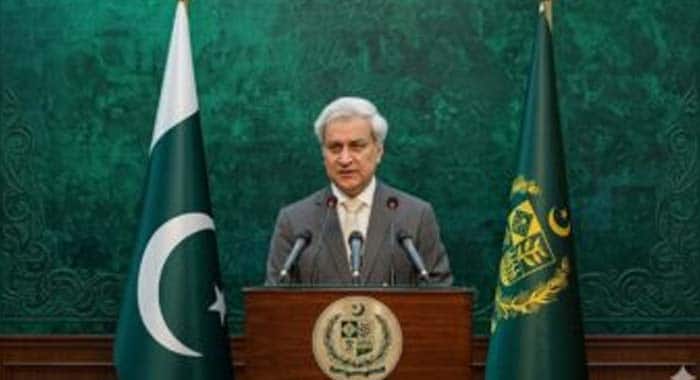
Foreign Office Spokesperson Tahira Hussain Andrabi has reiterated Pakistan’s commitment to pursuing diplomacy, dialogue and peaceful resolution of regional disputes, while firmly safeguarding the country’s national security interests.
During the Foreign Office’s weekly media briefing, the spokesperson addressed a wide range of regional and international issues, including Pakistan’s upcoming leadership role in the Shanghai Cooperation Organisation (SCO), diplomatic efforts to reduce tensions between the United States and Iran, engagement with Afghanistan, Pakistan’s strategic assets, trade with Iran, the situation surrounding the Strait of Hormuz, and developments concerning India and Palestine.
The Foreign Office spokesperson announced that Pakistan will host the next SCO Heads of State Summit and will assume the organisation’s chairmanship for a one-year term. Pakistan’s chairmanship will formally commence at the forthcoming SCO summit. The spokesperson also confirmed that the Prime Minister of Pakistan will travel to Bishkek to participate in the SCO Heads of State Summit.
Pakistan’s upcoming leadership of the SCO provides Islamabad with an important platform to contribute to regional cooperation, economic connectivity, security dialogue and collective efforts to address emerging challenges confronting the region.
Addressing the ongoing tensions between the United States and Iran, the Foreign Office spokesperson said that Field Marshal Syed Asim Munir’s visit to Iran was part of Pakistan’s broader peace efforts, aimed at helping reduce tensions between the two sides. The spokesperson categorically rejected the impression that the Field Marshal travelled to Tehran as an envoy or emissary of US President Donald Trump, emphasizing that the visit formed part of Pakistan’s independent diplomatic efforts to promote de-escalation and dialogue.
Pakistan, she said, continues to undertake diplomatic initiatives aimed at reducing tensions and breaking the military deadlock between Washington and Tehran. Islamabad has been working in coordination with friendly countries to promote negotiations and diplomacy as the most viable means of achieving sustainable peace and stability in the region.
The Foreign Office spokesperson highlighted Pakistan’s extensive diplomatic engagement in recent weeks. Deputy Prime Minister and Foreign Minister Ishaq Dar visited Tehran on August 14, where discussions focused on reducing regional tensions, ending the military impasse and exploring a negotiated solution to the conflict. He also held three telephone conversations with the Turkish Foreign Minister on August 17, 19 and 25, during which the two sides discussed the evolving regional situation and the importance of advancing dialogue and diplomatic efforts.
The Deputy Prime Minister has also remained engaged with his Kuwaiti counterpart on the regional situation. During his current visit to London, the Foreign Minister has held discussions with the head of International Maritime Security and also met the Secretary-General of the Commonwealth, further reflecting Pakistan’s sustained diplomatic engagement on regional and international security matters.
Pakistan, the spokesperson emphasized, will continue its efforts to reduce tensions and promote peaceful settlement of disputes, as durable solutions to the region’s current challenges can only be achieved through dialogue and diplomacy. On Pakistan-Afghanistan relations, the Foreign Office spokesperson said that Pakistan remains ready for state-level dialogue with Afghanistan. However, she made clear that dialogue must be accompanied by meaningful and verifiable action.
Pakistan does not seek to close the door to engagement with Afghanistan, but merely issuing assurances regarding terrorism is not sufficient. The Afghan interim authorities, she said, must provide concrete evidence that effective action is being taken against terrorism emanating from Afghan territory. Pakistan’s position remains that practical steps and verifiable results are essential for rebuilding confidence and creating conditions conducive to meaningful bilateral engagement.
Responding to remarks by India’s Chief of Defence Staff concerning the Karana Hills attack, the Foreign Office spokesperson categorically stated that Pakistan’s strategic assets remain fully secure. She stressed that Pakistan’s strategic assets are completely protected and that no compromise whatsoever can be made on their security. Rejecting recent statements by Indian officials, the spokesperson described them as lacking credibility and dismissed what she termed “Bollywood-style statements” as having no substantive value.
She questioned the rationale behind making such statements 16 to 18 months after the alleged events, asking why such claims were being raised at this stage. Pakistan, she emphasized, remains fully determined to safeguard its strategic assets and will not compromise on matters relating to their security and protection.
Despite the sanctions imposed by the United States on Iran, Pakistan intends to continue and further expand bilateral trade with Iran, the Foreign Office spokesperson said. She reiterated Pakistan’s longstanding position against unilateral sanctions imposed outside the framework of the United Nations, emphasizing that Islamabad has consistently opposed such measures.
Pakistan remains hopeful that negotiations between the United States and Iran will eventually address economic issues as well as other outstanding matters. Islamabad’s approach, therefore, remains focused on preserving legitimate economic engagement while simultaneously encouraging diplomatic efforts aimed at resolving the broader US-Iran dispute.
Responding to a question regarding the Diplomatic Enclave, the spokesperson said that Pakistan had directed all diplomatic missions to remove obstacles and encroachments. The directive applied to all embassies, including the Indian High Commission. However, she noted that structures located outside the Pakistani diplomatic mission in India were removed by Indian authorities without prior notification to Pakistan. The matter reflects the importance of maintaining established diplomatic protocols and ensuring that issues affecting diplomatic missions are handled through appropriate channels.
The Foreign Office spokesperson said that efforts to facilitate the reopening of the Strait of Hormuz are continuing, emphasizing that the situation surrounding the strategically important waterway has consequences for the entire region and beyond. Pakistan remains hopeful that a way forward can be found, while acknowledging that the final decision rests with the parties directly concerned. Given the Strait’s significance to regional and global trade and energy flows, Pakistan continues to support diplomatic efforts aimed at reducing tensions and restoring safe and normal maritime movement.
Asked about comments by former Foreign Secretary Asif Durrani regarding the Taliban being described as a proxy, the spokesperson said that if the Afghan Taliban are promoting terrorism in Pakistan at the direction of another neighbouring country, then such a relationship would constitute proxy activity. Pakistan has consistently maintained that terrorism emanating from Afghan territory remains a serious security concern and that Afghanistan’s authorities must ensure their territory is not used against neighbouring countries.
Responding to a question regarding the planned visit of RSS chief Mohan Bhagwat to the United States, the spokesperson declined to comment specifically on the visit. However, she strongly condemned the hatred against Muslims propagated through the RSS, expressing hope that the issue would also be raised during Bhagwat’s visit to the United States. Pakistan continues to highlight concerns regarding the treatment of minorities and the broader implications of hate-based political narratives for regional peace and stability.
Commenting on developments in the occupied Palestinian territories, the Foreign Office spokesperson reiterated Pakistan’s position that Israeli settlement activity in the West Bank is illegal and without legal basis. Pakistan remains committed to supporting international law and the legitimate rights of the Palestinian people and continues to oppose measures that undermine prospects for a just and lasting resolution of the Palestine issue.
The Foreign Office spokesperson also addressed a question regarding whether Pakistan celebrated its 79th or 80th Independence Day this year. She described the matter as open to interpretation, explaining that the calculation depends on the starting point used. If Independence Day celebrations are counted from 1948, the current anniversary would be the 79th Independence Day. However, if the calculation is made from 1947, it would amount to 80 years since independence. The clarification followed questions concerning different references, with the President’s Office referring to the 79th Independence Day, while the Foreign Office had referred to the 80th.
The Foreign Office briefing underscored Pakistan’s broader approach to the rapidly evolving regional environment: dialogue over confrontation, diplomacy over escalation, and verifiable action over assurances. From its engagement on the US-Iran crisis and the Strait of Hormuz to its readiness for state-level dialogue with Afghanistan, Pakistan continues to position itself as a proponent of peaceful conflict resolution while maintaining firm red lines concerning national security.
Pakistan’s diplomatic outreach reflects its determination to work with regional and international partners to reduce tensions, prevent further escalation and create conditions for sustainable peace. At the same time, Islamabad has made clear that diplomatic engagement cannot come at the expense of national security. Whether concerning terrorism emanating from neighbouring territory, the protection of strategic assets, or the security of critical maritime routes, Pakistan remains committed to safeguarding its national interests while pursuing peaceful solutions.
Pakistan will continue to support dialogue, diplomacy and regional cooperation, with the objective of promoting peace, stability, security and sustainable economic development across the region.



