
Afghanistan’s Drone Gamble
The Afghan Taliban’s increasingly provocative conduct toward Pakistan has acquired a new and troubling dimension: the use of drones launched from territory under their control to intrude into Pakistani airspace. What makes the development particularly significant is not merely the technology involved. It is the message behind it.
After years of allegations that terrorist organizations hostile to Pakistan continue to operate from Afghan territory, the appearance of Afghan-launched drones over Pakistani territory points toward a broader security challenge in which the Afghan Taliban’s actions are no longer confined to political rhetoric or the alleged facilitation of terrorist networks.
Pakistan is now confronting aerial incursions from the western side of the border.
Yet the incidents also demonstrate something equally important: Pakistan’s airspace is being watched, its air-defence systems are alert, and attempts to exploit the skies have been neutralized.
Khyber: The First Warning Was Not Ignored
On June 19, Pakistan rejected claims by the Afghan Taliban that they had conducted drone strikes against alleged Daesh hideouts in border areas of Khyber Pakhtunkhwa and Balochistan.
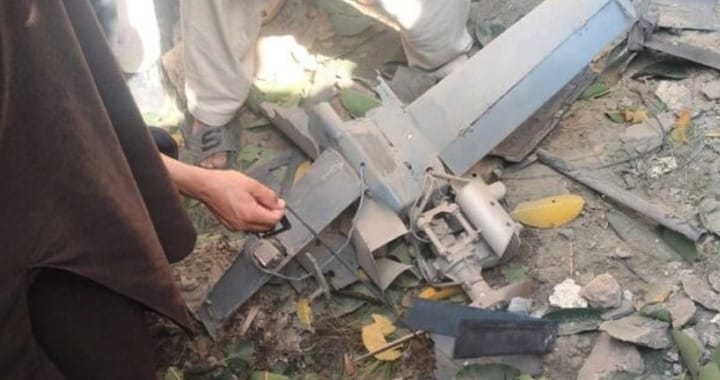
Pakistan’s Information Ministry said the claims were false and pointed instead to a rudimentary drone belonging to the Afghan Taliban that had entered Pakistani airspace near Shinko in Khyber district. The drone was immediately identified and neutralized by the alert air-defence system of the Pakistan Air Force. Pakistan also released photographic evidence of the downed platform.
The distinction matters.
The Afghan Taliban sought to present the episode as an operation against terrorism inside Pakistan. Pakistan’s account was fundamentally different: an Afghan Taliban drone had crossed into Pakistani airspace and was intercepted.
Whatever narrative Kabul attempted to construct around the episode, the physical reality was straightforward.
A foreign drone entered Pakistani airspace. Pakistan detected it. Pakistan neutralized it.
There was no prolonged opportunity for the intruding platform to conduct reconnaissance or strike its intended target.
Four More Drones Over Balochistan
The issue became even more serious less than two weeks later.
On June 30, four rudimentary drones were launched across the border from Afghanistan into Balochistan, according to Pakistan’s military. The hostile aerial platforms were immediately detected by Pakistan’s air-defence network and neutralized through sophisticated countermeasures.
The scale of the incident was important.
This was no longer a single unexplained aerial intrusion.
Four platforms were detected and dealt with.
The episode demonstrated that Pakistan’s air-defence and counter-drone architecture was capable of responding rapidly even when multiple aerial threats appeared simultaneously.
It also delivered a message that should be impossible to misunderstand: cross-border provocation does not give the Afghan Taliban an uncontested route into Pakistani airspace.
Pakistan’s Armed Forces subsequently warned that any future violation of the country’s sovereignty would receive a swift and decisive response.
Kabul’s Excuses Cannot Erase the Threat
The Afghan Taliban’s claims surrounding these incidents deserve scrutiny because they form part of a broader pattern.
Pakistan has repeatedly accused the Taliban regime of allowing terrorist organizations to operate from Afghan territory. These include groups that have carried out or supported attacks against Pakistan.
When Kabul responds by claiming that its own aerial activity is directed against terrorists inside Pakistan, the obvious question is why terrorist infrastructure hostile to Pakistan continues to remain a central security concern on the Afghan side of the border in the first place.
Pakistan’s position has been consistent: Afghan territory must not be used to launch terrorism against Pakistan.
That principle applies whether the threat arrives through a border crossing, a terrorist infiltration route or an unmanned aircraft.
Afghanistan cannot simultaneously demand respect for its sovereignty while treating Pakistan’s sovereignty as negotiable.
From Terrorist Safe Havens to Aerial Provocations
The drone incidents must also be understood within the wider security environment.
Pakistan has repeatedly faced attacks by terrorists operating through networks with links to Afghanistan. The problem has therefore never been merely about an isolated border violation.
It concerns the ecosystem behind the threat.
A terrorist network requires territory in which to organize, recruitment channels through which to acquire manpower, financing, weapons and explosives, logistical routes, intelligence and concealment.
If that ecosystem exists across the border, Pakistan’s security challenge becomes inherently more complicated.
The addition of drones creates another layer.
A drone can cross terrain without encountering a conventional checkpoint. It can observe positions, test air-defence responses and potentially deliver explosives.
That makes the technology attractive to terrorists and other hostile actors.
But the recent incidents also expose its limitation.
A drone is only useful if it can reach its objective.
Pakistan Is Denying That Opportunity
The Khyber and Balochistan incidents demonstrate a critical distinction between possessing technology and possessing operational advantage.
The Afghan Taliban may launch rudimentary drones.
Terrorists may acquire drones.
But Pakistan’s ability to detect, track and neutralize those platforms means that possession alone does not translate into battlefield superiority.
This is particularly important because the country’s security architecture has been evolving in response to an increasingly technological threat.
Air-defence systems, surveillance, electronic detection, counter-drone measures and intelligence-led operations are becoming interconnected components of national security.
The result is a layered defensive system.
A terrorist may attempt to cross the border.
A facilitator may attempt to provide intelligence.
A drone may attempt to enter Pakistani airspace.
A bomb may be planted near a public institution.
Each threat requires a different response, but the underlying objective remains the same: detect the threat early and deny it the opportunity to cause harm.
The Taliban’s Conduct Raises a Larger Question
The most troubling aspect of the Afghan Taliban’s conduct is therefore not the sophistication of the drones.
It is the direction in which their relationship with Pakistan appears to be moving.
Pakistan has repeatedly called for dialogue, border management and an end to the use of Afghan territory against Pakistan.
Yet cross-border terrorism concerns have persisted, while drone incidents have introduced a direct aerial dimension.
That should concern not only Pakistan but every country interested in regional stability.
A regime controlling an international border has a basic responsibility: territory under its authority must not become a platform for attacks against its neighbors.
If the Taliban regime cannot prevent terrorist organizations from operating from Afghan soil, or if drones are themselves being launched from that territory toward Pakistan, then Kabul’s repeated assurances about peaceful coexistence become increasingly difficult to reconcile with events on the ground and in the air.
Pakistan’s War Was Never Optional
There is another point that deserves emphasis.
Pakistan did not choose the global War on Terror.
The country became one of its principal victims and frontline states, paying an extraordinary price in lives, economic losses and years of internal instability.
Pakistan’s fight against terrorism was therefore never simply somebody else’s war being fought on Pakistani soil.
It became a national struggle.
Today, the country is again confronting terrorism from multiple directions, including terrorist networks operating in the western neighbourhood and increasingly sophisticated methods of attack.
The response cannot be passive.
Pakistan has both the right and the responsibility to defend its territory, its airspace and its people.
That includes detecting and neutralizing hostile drones.
The Sky Is Not a Shortcut Into Pakistan
The Afghan Taliban may have discovered another means of testing Pakistan.
They have also discovered that Pakistan is watching.
The drone brought down near Shinko demonstrated that an aerial intrusion can be detected.
The four drones neutralized over Balochistan demonstrated that multiple incursions can be confronted.
Together, the incidents send a much larger strategic message.
Afghanistan’s border with Pakistan is not a corridor through which hostile technology can pass unchecked.
The Taliban regime may continue issuing statements, making claims or attempting to shift the narrative.
But the physical evidence is harder to explain away.
Drones entered Pakistani airspace.
Pakistan detected them.
Pakistan neutralized them.
And Pakistan’s Armed Forces have made clear that future violations of national sovereignty will be met with decisive action.
The Afghan Taliban may have tried to add the sky to the pressure they believe they can exert on Pakistan. Instead, they have exposed another layer of Pakistan’s defensive capability.
The border is watched from the ground, the skies are guarded from above, and neither terrorists nor their facilitators should expect an unchallenged route into Pakistan.
The incidents show that the Afghan Taliban’s drone activity is not only a sovereignty issue but also a test of whether Pakistan can turn early detection into a sustained deterrence strategy without widening the confrontation.



