
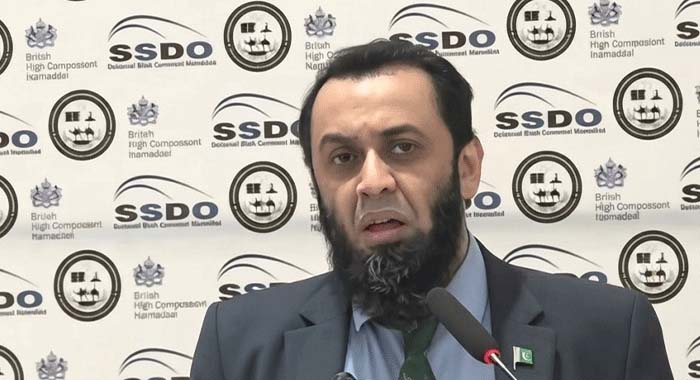
Federal Minister for Information and Broadcasting Atta Tarar has said that Pakistan’s National Action Plan (NAP) played a decisive role in containing terrorism and restoring peace across the country, stressing that the fight against terrorism requires sustained national unity, institutional coordination, effective legislation and a comprehensive response on both physical and digital fronts.
Addressing a workshop in Islamabad, the Federal Minister said that the National Action Plan was formulated in response to the growing threat of terrorism as a unanimous state decision, bringing the federal and provincial governments, Pakistan’s Armed Forces and other state institutions together under a coordinated national framework.
He highlighted the enormous sacrifices rendered by the Pakistani nation, Armed Forces, police and law-enforcement agencies in the fight against terrorism, stating that 90,000 lives had been sacrificed in the country’s counter-terrorism struggle.
Atta Tarar recalled that implementation of the National Action Plan resulted in significant counter-terrorism successes, particularly during the period following its adoption. He said that concerted action against terrorist networks from Swat to Balochistan and South Punjab produced substantial gains within approximately two-and-a-half to three years.
He said peace and stability were restored from Karachi to Khyber, creating a more conducive environment for economic activity and investment.
The Minister emphasized that the success demonstrated the effectiveness of a coordinated national approach in confronting terrorism and violent extremism. Federal and provincial institutions, the Armed Forces and law-enforcement agencies had worked collectively to dismantle terrorist networks and restore public confidence.
The Information Minister expressed concern that subsequent policies aimed at rehabilitating and negotiating with terrorists and their facilitators undermined the gains achieved through years of counter-terrorism efforts.
He described the return of terrorist elements as effectively a reversal of four years of counter-terrorism efforts, stressing that lessons from the past must inform future national security policy.
Atta Tarar emphasized that all political parties must be taken into confidence on the national policy against terrorism, noting that sustainable success in the fight against terrorism requires political consensus alongside operational and institutional measures.
He observed that terrorist organizations increasingly target soft and vulnerable targets rather than conventional military objectives, citing attacks against Imambargahs, schoolchildren and trains as examples of the evolving nature of the threat.
Referring to the Jaffar Express attack, the Federal Minister said that incidents of such complexity and scale are rare internationally and praised the security institutions for completing the ensuing operation with exceptional professionalism and skill.
He said the resurgence of terrorism was linked not only to policy reversals but also to external interference, maintaining that evidence exists regarding external support for terrorist activity against Pakistan.
Addressing the situation following the Pahalgam incident, Atta Tarar said that Pakistan was subjected to allegations almost immediately after the incident, but the state responded to the accusations with practical and reasoned arguments.
He questioned the circumstances surrounding the registration of an FIR within approximately half an hour of the incident, saying that the speed with which the process unfolded raised serious questions requiring credible answers.
The Minister recalled the Prime Minister’s offer of transparent international investigation, arguing that Pakistan’s willingness to support an impartial inquiry demonstrated confidence in the country’s position and challenged the credibility of attempts to prematurely establish a particular narrative.
Atta Tarar posed a fundamental question: How could a nation that has sacrificed 90,000 lives in the fight against terrorism support terrorism?
He said Pakistan possesses substantial facts, evidence and data to present its case before the international community and remains committed to exposing terrorism and its external dimensions through credible evidence.
The Information Minister referred to the arrest of Kulbhushan Jadhav in Balochistan as what he described as concrete evidence of Indian involvement in activities inside Pakistan.
He further noted that India itself has faced allegations concerning activities beyond its borders, contrasting this with Pakistan’s stated position that it has been engaged in an active and sustained struggle against terrorism.
Turning to the rapidly evolving digital environment, Atta Tarar said that contemporary security threats extend beyond physical acts of terrorism.
According to the Minister, external actors can seek to undermine Pakistan not only through acts of sabotage but also through psychological operations, disinformation, narrative manipulation and coordinated negative campaigns.
He warned that activity in the digital domain can have serious real-world consequences, observing that a single social media post can potentially place an individual’s life at risk.
The Minister therefore stressed the need for an effective legal and institutional framework to address cybercrime and emerging digital threats.
He pointed to challenges including terrorism in cyberspace, harassment of women and exploitation of children, emphasizing that counter-terrorism and cybersecurity capabilities must evolve alongside technology.
Atta Tarar noted that, as part of efforts to strengthen Pakistan’s response to digital threats, the former cybercrime wing has been transformed into the National Cyber Crime Investigation Agency (NCCIA).
He said Pakistan already possesses a legal and law-enforcement framework under the National Action Plan to combat terrorism, but emphasized that the system is continuously being strengthened to address emerging threats.
He called for further development of mechanisms capable of countering anti-state narratives and coordinated attempts at psychological manipulation, stressing that legislation and institutional capacity must evolve to protect both the state and society.
The Information Minister emphasized that narrative-building and law enforcement are central components of the National Action Plan and that countering anti-state narratives requires a whole-of-government approach.
He said the federal government and all provincial governments must work together to confront attempts to manipulate public opinion and conduct organized psychological operations through digital platforms.
Atta Tarar maintained that allegations concerning external involvement must be based on evidence and credible intelligence, reiterating that the state does not make such assertions without supporting information.
He also highlighted the role of provincial assemblies and governments in countering anti-state propaganda, noting that the Balochistan government has undertaken measures to address hostile narratives. The Federal Minister said the government is developing a more integrated communication structure to strengthen Pakistan’s presence in the digital domain. He disclosed that a dedicated digital communication division has been established to enhance the government’s ability to monitor, analyse and respond to developments in electronic and digital media.
Modern technologies, including artificial intelligence, are being employed to analyse electronic media content, with AI-based systems being used to automatically convert broadcast conversations into written text for more efficient analysis.
He added that provincial governments are being provided with the necessary technology and expertise to establish and strengthen their own digital communication capabilities.
According to the Minister, these initiatives are aimed at creating a coordinated and professional communication ecosystem capable of responding rapidly and effectively to emerging information challenges.
Atta Tarar stressed that strengthening Pakistan’s soft image and positive international identity remains a key priority of the government. He said digital platforms are being utilized to showcase Pakistan’s culture, heritage, achievements and positive identity to audiences around the world.
Efforts are also being made to enhance media access and coverage in different parts of the country, including Balochistan, so that the diversity, potential and achievements of Pakistan can be more effectively communicated domestically and internationally.
The Minister further highlighted Pakistan’s recent diplomatic achievements, saying that these successes have enhanced the country’s standing and contributed to greater international recognition. He emphasized the need to communicate Pakistan’s diplomatic achievements more effectively to the global audience and to employ the combined strength of strategic communication, narrative-building and soft power to project the country’s positive image.
Atta Tarar also announced that a special cell for countering violent extremism has been established within the Press Information Department (PID).
He said coordinated efforts by state institutions are continuing to address the root causes and manifestations of terrorism and violent extremism, while emphasizing the importance of preventing extremist narratives from gaining traction in society.
The Minister reiterated that terrorism has no colour, ethnicity or religion, describing it as an attempt to impose an ideology upon others through violence.
He underscored the importance of national cohesion, recalling the sacrifices and struggles of the nation’s forefathers that led to the creation of Pakistan.
Concluding his remarks, Atta Tarar stressed that Pakistan’s long-term security and stability depend upon national unity and collective resolve.
He said the country has endured immense sacrifices in its struggle against terrorism and that the state remains committed to protecting its people, strengthening its institutions and confronting both conventional and emerging security threats.
The Federal Minister emphasized that the fight against terrorism cannot be confined to military action alone. It requires political consensus, effective law enforcement, robust legislation, digital resilience, strategic communication, public awareness and a coordinated whole-of-government response.



