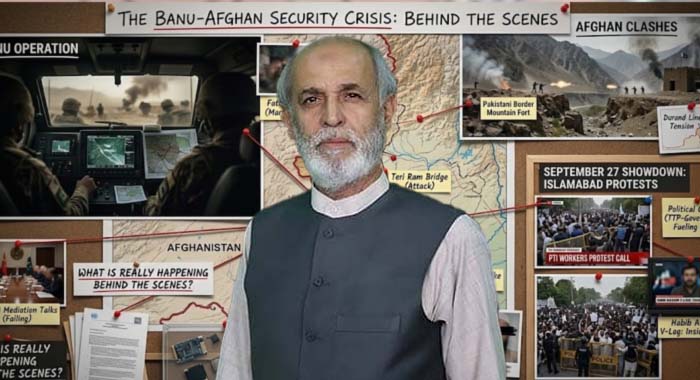
Pakistan’s security landscape is entering another difficult phase. From Bannu and other troubled districts of Khyber Pakhtunkhwa to the increasingly complicated situation across the Afghan border, and from Badakhshan and Kandahar to the unrest in Balochistan, the country is confronting a security challenge that can no longer be viewed through the narrow lens of military operations alone.
The recent operation in Bannu, in which security forces reportedly killed 10 militants described by authorities as “khawarij,” once again demonstrates the determination and operational capacity of Pakistan’s security institutions. At the same time, the deployment of modern equipment to the Khyber Pakhtunkhwa police including night-vision cameras, laser-equipped weapons, surveillance capabilities and other technology—shows that the police are becoming more proactive in confronting the evolving threat.
But the larger question is not simply whether Pakistan can eliminate militants in individual operations. The real question is whether the country can develop a comprehensive security and political strategy capable of preventing these threats from repeatedly returning. That is where the debate becomes much more complicated.
The operation in Bannu, according to the information discussed, resulted in the killing of 10 militants. Such operations are undoubtedly important. When armed groups establish a presence, threaten civilians or attack security personnel, the state has a responsibility to respond decisively.
Yet every successful operation should lead to a second question: what happens after the operation? Khyber Pakhtunkhwa has experienced years of militancy, and the geography of the province makes the security challenge particularly difficult. Districts such as Bannu, Tank, Lakki Marwat and Dera Ismail Khan have repeatedly faced serious security problems, while other parts of the province, including areas such as Swat and Bajaur, have also remained vulnerable to militant activity.
The reported activation of the provincial police is therefore an encouraging development. Inspector General of Police Khyber Pakhtunkhwa Zulfiqar Hameed has reportedly been visiting different areas and emphasizing the need to strengthen police capabilities. The provision of modern equipment—including APCs, night-vision cameras, laser guns and surveillance technology could significantly improve the ability of police personnel to operate in difficult terrain and during nighttime engagements.
Technology, however, is only one part of the equation. A night-vision camera can help a police officer see an approaching threat. Better weapons can increase the officer’s ability to respond. An APC can provide protection during an operation. But none of these tools can substitute for intelligence, coordination, training, policing networks and public cooperation.
This distinction is particularly important in districts such as Bannu and Tank, where militants can exploit difficult terrain and local vulnerabilities. There have reportedly been periods when security personnel in certain areas lacked adequate night-vision equipment. The experience of earlier operations suggested that when night-vision cameras and laser-equipped weapons were made available to police, attacks could be better countered. Expanding these capabilities to other vulnerable districts could therefore make a meaningful difference. But Pakistan should be careful not to mistake improved equipment for a complete security strategy.
Perhaps the most politically sensitive issue is the relationship between the security crisis and the priorities of the Khyber Pakhtunkhwa government. The argument presented in the discussion is that security remains a secondary priority for the provincial administration, while the release of Imran Khan and political pressure on the federal government occupy a more central position. Whether one agrees with this assessment or not, it raises an important question: can a province facing serious security threats afford to allow political confrontation to dominate its public agenda? The answer should be no. Political parties have every right to campaign, organize rallies and demand the release of their leaders through constitutional and legal means. Political mobilization is part of democratic politics. But governance does not stop when politics becomes intense.
The provincial government has to deal simultaneously with security, education, healthcare, infrastructure, economic development and political matters. None can simply be postponed. A rally was held in Peshawar on August 5, and Chief Minister Sohail Afridi has reportedly announced another major gathering or long march for September 27. Preparations for this political mobilization have already begun, with provincial ministers, lawmakers and party workers visiting different areas and engaging supporters. The real test will be whether this political activity can coexist with effective governance. A province cannot afford to treat security as an issue that can be addressed only when militants strike. Security policy must be continuous, institutional and above partisan politics.
Pakistan’s security situation cannot be separated from developments inside Afghanistan. Reports of clashes between the Taliban and local resistance elements in Badakhshan demonstrate the complexity of Afghanistan’s internal security environment. According to the information discussed, a clash took place in the Nesi area of Badakhshan involving forces associated with Jama Khan Fateh and the Taliban. Details about casualties were not immediately clear. The significance of these developments goes beyond a single clash.
Badakhshan has historically been strategically important. It is also rich in mineral resources, including lapis lazuli and other valuable stones and minerals. Control over mineral resources can become an important source of political and economic power in conflict zones. This is one reason why the current tensions should not be understood purely as an ideological confrontation. Afghanistan’s conflicts have repeatedly been shaped by geography, ethnicity, political authority, economic interests and control over resources. Badakhshan, with its strategic location and mineral wealth, has historically attracted competing political and military forces. The discussion also referred to the broader spread of clashes, including incidents around Faizabad and Zebak, suggesting that the confrontation is not confined to one isolated location. There have also been reports of fighting or resistance activity extending toward Kandahar. If these developments continue, they could create another layer of uncertainty for Pakistan.
The situation in Kandahar deserves particular attention. The National Resistance Front, associated with Ahmad Massoud, remains one of the prominent anti-Taliban resistance formations. Separately, the discussion referred to claims by former military figures that a group called “United Front” has been organized with the participation of former Afghan security and police personnel.
These developments illustrate a broader reality: Afghanistan’s political conflict did not disappear with the Taliban’s return to power. Instead, the nature of the conflict changed.
An open insurgency can evolve into decentralized resistance, underground networks, political opposition and localized armed activity. If competing groups acquire access to weapons, money and territorial bases, Afghanistan could face another cycle of fragmentation. That would be dangerous not only for Afghans but also for Pakistan. Pakistan has a direct interest in a stable Afghanistan. A fragmented Afghanistan can become a breeding ground for militant organizations, cross-border smuggling and regional competition. Refugee flows and border management can also become more difficult. This is why Islamabad needs a policy that is firm on security but equally serious about diplomacy.
One of the most important points raised in the discussion is the possibility of quiet or backchannel contacts between Pakistan and Afghanistan, reportedly with Chinese mediation. For several weeks, there may have been limited public signs of formal negotiations, but the possibility of behind-the-scenes engagement should not be dismissed.
China has strategic interests in both Pakistan and Afghanistan. It also has wider ambitions for connectivity with Central Asia and beyond. Stability in Afghanistan is therefore important for Beijing’s economic and regional objectives. China has previously played a role in Afghan diplomatic processes and has maintained relationships with multiple stakeholders in the region. Its interest in encouraging stability between Pakistan and Afghanistan is understandable.
For Pakistan, this presents an opportunity. Islamabad should not rely exclusively on military pressure or border restrictions. Diplomatic engagement must remain open, particularly on issues such as militant sanctuaries, border violations, trade, transit and security cooperation. There is no contradiction between maintaining national security and negotiating with a difficult neighbor. In fact, responsible diplomacy is often one of the tools through which national security is protected.
The Pakistan-Afghanistan border remains another major challenge. Border violations and security incidents are likely to continue unless both countries establish reliable mechanisms for communication and dispute resolution. At the same time, restrictions on cross-border movement and trade have imposed costs on communities on both sides.
The discussion also highlighted an important contradiction: if border fencing and security measures are designed to prevent unauthorized movement, then the state must also ensure that prohibited material cannot enter through alternative channels.
This becomes especially relevant in relation to reports concerning drones.
Reports have emerged that drones used in attacks in Khyber Pakhtunkhwa and Balochistan may have been manufactured in India and entered from Afghanistan, with claims that their components may have been transported separately and assembled later. These claims require careful investigation and should not be treated as established fact without independent evidence. But even as a security allegation, the issue raises a legitimate question: how can sophisticated equipment cross a heavily secured border?
If components are being transported in parts rather than as complete systems, traditional border-control mechanisms may struggle to detect them. That means Pakistan needs to think beyond the physical fence. Modern border security requires intelligence-led monitoring, customs intelligence, tracking of suspicious supply chains, surveillance technology and cooperation among intelligence, police, military and civilian agencies. If an object can be dismantled into several small components, simply strengthening the fence may not solve the problem. The state must understand the entire network from procurement and transportation to assembly and deployment.
The security crisis is not limited to Khyber Pakhtunkhwa or Afghanistan. Balochistan continues to face serious instability, including reported incidents in Panjgur and Mastung. Administrative decisions have also generated resentment in some communities. The reported raid and action at the residence of Sardar Akhtar Mengal further contributed to political anger among sections of Baloch society. This is precisely where Pakistan needs political wisdom. Security forces have a responsibility to protect lives and state institutions. But Balochistan’s problems also have political, economic and constitutional dimensions. When political grievances are left unresolved, they can create space for militant organizations to exploit public frustration.
The answer is therefore not to choose between security and political engagement. Pakistan needs both. There should be meaningful political mediation, dialogue with legitimate representatives, attention to local grievances and a serious effort to address governance and development concerns. Force may suppress an immediate threat, but only political legitimacy can produce durable stability.
This is perhaps the most consequential question. Pakistan has previously conducted strikes inside Afghanistan, and the discussion referred to seven such strikes since October. Yet the argument presented was that these strikes have not resolved the underlying problem and may have made the situation more complicated. That deserves serious consideration. Military action can sometimes be necessary when an imminent threat cannot be stopped by other means. But military action should not automatically become the default response to every security incident. If strikes do not eliminate militant networks, reduce cross-border attacks or create conditions for political engagement, then policymakers must reconsider the broader strategy. The objective should not be simply to punish an adversary. The objective should be to make Pakistan safer. That distinction is fundamental. A military strike can destroy a target. It cannot by itself create a functioning border-management system, produce political accommodation, improve intelligence cooperation or convince Afghanistan’s authorities to permanently change their policies. For that, diplomacy is indispensable.
Pakistan needs strong security forces, but it also needs strong institutions. It needs secure borders, but it also needs functional diplomatic channels. It needs counterterrorism operations, but it also needs political dialogue. It needs to confront militants, but it must also address the grievances that create fertile ground for instability.
The lesson from the region is clear: military power can buy time, but political strategy determines what a country does with that time.
For Khyber Pakhtunkhwa, the immediate priority should be protecting citizens and strengthening the police. For Afghanistan, Pakistan should pursue firm but sustained diplomacy. For Balochistan, political mediation must accompany security measures. And for the wider region, Islamabad should work with China and other stakeholders to create incentives for stability rather than allowing every dispute to become another security crisis.
Pakistan is standing at a crossroads. It can continue responding to each attack as an isolated incident, or it can recognize the larger pattern and build a comprehensive strategy. The second option is harder. But it is also the only one that offers the possibility of lasting peace.