
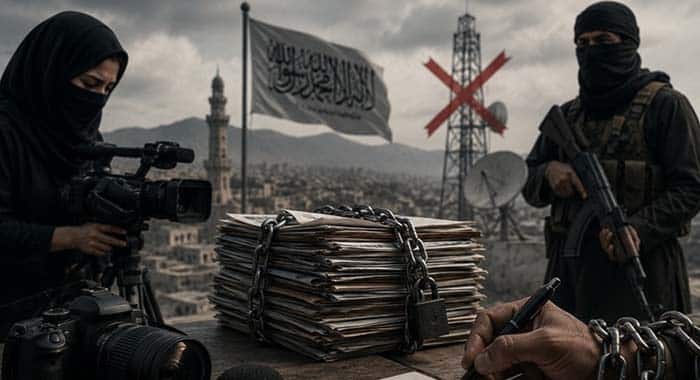
Five years after the Taliban returned to power in Afghanistan, Reporters Without Borders (RSF) has warned that the country’s independent media environment has been subjected to a systematic and increasingly institutionalized campaign of repression.
In a major review released on August 10, 2026, marking five years of Taliban rule, RSF reported that the de facto authorities have introduced more than 20 national directives, alongside a growing number of provincial orders, aimed at restricting journalism and dismantling press freedom. According to the organization, measures that initially appeared as administrative censorship have evolved into a broader system involving intimidation, restrictions on political debate, control over sources and interviews, exclusion of women from the media sector and increasingly severe legal consequences for criticism.
RSF has described Afghanistan as a “prison for information,” arguing that the country’s media environment has moved steadily away from independent scrutiny and toward a system in which journalists are expected to operate within boundaries defined by the Taliban authorities.
The organization’s assessment comes against the backdrop of an already deteriorated media environment. In its 2026 World Press Freedom Index, RSF ranks Afghanistan 175th out of 180 countries, with particularly severe scores in the legal, security and political dimensions of press freedom. RSF says the Taliban takeover “sounded the death knell” for press freedom and that repression of journalists has continued to intensify.
According to RSF, one of the earliest steps toward the current system came in September 2021, when Taliban authorities introduced 11 rules governing journalism. The rules gave authorities broad discretion over what journalists could publish and broadcast. RSF has previously documented how vaguely worded restrictions including requirements concerning the publication of information whose authenticity had not been approved by authorities created an environment in which journalists could face pressure or punishment based on broad interpretations of official rules.
The restrictions did not remain limited to individual news reports. Over time, they expanded into a comprehensive system governing what subjects journalists could cover, whom they could interview, how political discussions could be conducted and what criticism could be expressed publicly. RSF says that this progression has transformed journalism from an independent mechanism for scrutinizing those in power into an activity conducted under increasingly close governmental supervision.
One of the most consequential developments has been the restriction of political programming and criticism. RSF has documented a ban on interviewing dissidents or analysts critical of the Taliban dating from November 2021. The organization has also reported that political programmes were increasingly subjected to censorship, with authorities restricting the participation of guests and limiting discussion of Taliban policies and decisions. According to RSF, political programmes in Kabul television stations were completely prohibited from airing political discussions from February 2024, while later directives required political programmes to be recorded before broadcast so that criticism could be removed. Guests on political debates were reportedly required to come from government-approved lists.
The effect, RSF argues, has been to transform political journalism from a forum for competing views into a tightly controlled environment in which the range of permissible debate is determined by the authorities.
The restrictions have also extended to the fundamental journalistic practice of speaking with people who hold opposing or critical views. According to RSF, journalists have been prevented from interviewing analysts and individuals considered critical of the Taliban authorities. Later restrictions further limited the participation of guests in political programmes and prohibited challenges to Taliban laws, policies and decisions. Such measures have profound implications for independent journalism. A functioning press depends upon the ability of reporters to question officials, interview critics, examine competing claims and provide audiences with multiple perspectives. When authorities determine which voices can appear in the media, the resulting information environment inevitably becomes narrower.
RSF has warned that the cumulative effect of these restrictions is to eliminate criticism and enable the Taliban authorities to monopolize the media narrative.
The erosion of press freedom has also had a particularly severe impact on women working in Afghanistan’s media sector. According to RSF, restrictions introduced after the Taliban takeover required women television presenters to cover their faces. Women have subsequently faced increasingly severe limitations on their ability to work in public media, appear on television, interact professionally with male colleagues and participate in interviews. The restrictions have extended beyond appearance. RSF has documented provincial measures affecting women’s voices on radio, including a March 2025 directive in Kandahar that prohibited women’s voices from being broadcast. The organization has described such measures as part of a broader campaign to remove women from Afghanistan’s information space.
The consequences go beyond individual journalists. When women are prevented from working as presenters, reporters, producers or interview subjects, the public loses access to an important part of Afghan society and the media landscape becomes significantly less representative.
Another major development has been the restriction of images. RSF reports that the Taliban’s 2024 Law on the Promotion of Virtue and Prevention of Vice prohibited the broadcasting of images of living beings. The measure has subsequently been applied in multiple provinces and has affected television operations. The restriction represents a significant transformation of the media environment because visual journalism is central to television reporting, documentary production and the public documentation of events.
As the restrictions expanded geographically, media organizations faced increasing pressure to alter their programming or abandon certain forms of reporting altogether. The result, according to RSF, has been a steadily shrinking space for independent visual journalism.
The restrictions have not been limited to Afghan-owned media. RSF has documented restrictions on the rebroadcasting of programmes from international broadcasters, including Voice of America and the BBC, with a ban dating to March 2022. The organization has also documented measures targeting Afghan media operating in exile. Such restrictions reduce the ability of Afghan audiences to access independent reporting from outside the Taliban-controlled information environment. For journalists who have left Afghanistan, exile has not necessarily ended the pressure. RSF has reported that journalists working for exile media have faced obstacles and, in some cases, arrests after returning or while operating inside the country.
RSF has identified July 2022 as another important turning point, when Taliban Supreme Leader Hibatullah Akhundzada stated that criticism of Taliban government leaders was contrary to Islamic law. According to RSF, this position helped establish an environment in which criticism of the authorities could be treated not as a legitimate component of public debate, but as conduct contrary to the Taliban’s interpretation of Islamic law.
For journalists, the implications are profound. The ability to scrutinize political leaders is one of the central functions of a free press. Without that ability, investigative reporting, accountability journalism and public debate become increasingly difficult.
Another significant development came in April 2024, when the Taliban Ministry of Justice announced the repeal of Afghanistan’s 2015 press law. RSF’s Afghanistan profile states that although Taliban spokesperson Zabihullah Mujahid had said in 2022 that the earlier press law remained in force, the Ministry of Justice announced its repeal in 2024 as authorities sought to align the legal framework with their interpretation of Sharia. The removal of the previous legal framework, combined with the accumulation of new directives and restrictions, has further increased uncertainty for journalists and media organizations.
Rather than operating under clear protections governing journalism, reporters increasingly face a shifting set of rules and orders issued by different Taliban institutions and provincial authorities.
RSF’s assessment also points to a broader transformation in the nature of repression. The organization has documented arrests, arbitrary detention and intimidation of journalists, including cases in which journalists were accused of producing “anti-Taliban propaganda.” In one particularly striking case, Afghan News Agency journalist Mahdi Ansary was detained and later subjected to what RSF described as a forced confession that was broadcast online. RSF said the case illustrated an increasingly coercive strategy intended not only to punish journalists but also to publicly intimidate others and deter independent reporting. Ansary was eventually released in March 2026 after spending nearly 18 months in detention.
RSF has described such cases as evidence of a broader pattern in which journalists are increasingly treated as security threats rather than independent professionals.
The cumulative impact of these measures is greater than any individual ban. According to RSF, directives have been issued by multiple Taliban institutions and authorities, including the General Directorate of Intelligence, the Supreme Leader, the Ministry of Information and Culture, the Ministry for the Promotion of Virtue and Prevention of Vice, Taliban spokespersons and provincial authorities. The organization argues that these measures have accumulated over time to create an environment in which journalists operate under continuous pressure and uncertainty.
A journalist may face restrictions on what can be reported, whom they can interview, which images can be broadcast, how political programmes can be conducted and how the Taliban leadership can be discussed. The result is not merely censorship of individual stories. It is a system that can shape the entire process through which information is produced.
The consequences have extended beyond newsroom censorship. RSF reports that the Taliban takeover triggered a major exodus of Afghan journalists, while the country’s remaining journalists continue to face the risk of arrest and detention. The organization says journalists working for foreign or exile-based media are particularly vulnerable to accusations of espionage or portraying the Taliban negatively.
The loss of journalists has also weakened Afghanistan’s overall media ecosystem. When experienced reporters leave, newsrooms lose institutional knowledge, investigative capacity and professional networks. Communities lose local journalists who previously documented events and gave citizens a platform to express concerns. The result is a vacuum in which fewer independent voices remain to document what is happening inside the country.
The international assessment of Afghanistan’s media environment reflects these developments. RSF’s 2026 World Press Freedom Index places Afghanistan at 175th out of 180 countries, with the country recording particularly low scores in the legal and security dimensions of press freedom. The ranking underscores the scale of the deterioration and places Afghanistan among the countries where journalists face some of the world’s most difficult conditions. The country’s current media environment, according to RSF, is characterized by government-controlled information, reduced pluralism, diminished dissent and continuing pressure on journalists.
RSF’s five-year assessment presents a broader conclusion: the restrictions imposed since August 2021 should not be viewed as isolated or temporary measures. Instead, the organization argues that they form an expanding system. Rules introduced initially to regulate reporting have been followed by restrictions on interviews, political programmes, women journalists, international broadcasters, visual content and criticism of Taliban leaders. Meanwhile, arrests and intimidation have created an additional layer of fear.
Together, these measures have progressively narrowed the space in which independent journalism can survive. The central issue is therefore not simply whether a particular news report can be published. It is whether journalists can independently decide what deserves to be reported, investigate those in power, question official narratives and provide the public with information without fear of punishment.
The consequences of press restrictions extend far beyond journalists. A society without independent media has fewer mechanisms for exposing corruption, documenting abuses, challenging official claims and giving citizens access to competing perspectives. When political debate is restricted, the public loses the ability to assess competing ideas. When women are excluded from the media, an entire segment of society becomes less visible. When international broadcasters are blocked, access to alternative sources of information is reduced. And when journalists fear arrest or detention, stories that would otherwise be investigated may never be reported. Freedom of the press is therefore not simply a professional right belonging to journalists. It is a public right connected to access to information, accountability and informed decision-making.



