
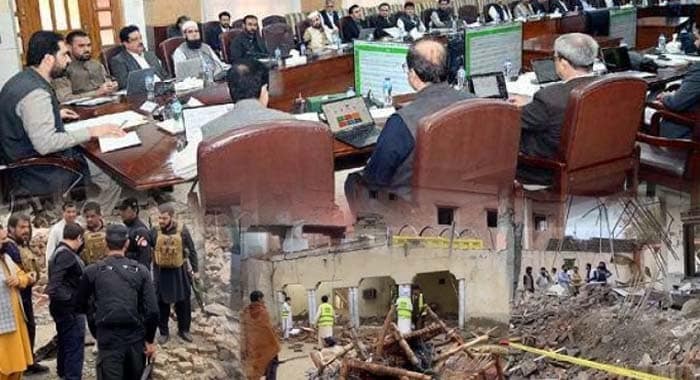
There are moments in politics when a single sentence becomes larger than the speaker intended. The exchange at KP House Islamabad was one of them. A journalist asked Chief Minister Sohail Afridi why the provincial leadership appeared more focused on protests and the health of Imran Khan than on the terrorism threatening Khyber Pakhtunkhwa.
The chief minister’s answer was short: “We are talking about Imran Khan’s health.”
That answer may have been politically convenient.
For the people of KP, however, it was deeply inconvenient.
Because the question was not really about Imran Khan’s health.
It was about the health of an entire province.
Khyber Pakhtunkhwa is not merely experiencing a political disagreement with Islamabad. It is confronting a security challenge that has repeatedly claimed the lives of security personnel and civilians, disrupted education, damaged businesses and kept entire communities under permanent psychological pressure.
The province’s security crisis demands political ownership.
That means a chief minister should be able to speak about counterterrorism with the same urgency with which he speaks about his party’s political battles.
Instead, the KP House exchange produced the opposite impression.
The provincial leadership’s immediate political priority appeared to be the incarcerated PTI founder.
That raises a basic question: what is the primary responsibility of a provincial government?
The answer is not complicated.
Govern.
Protect.
Deliver.
The chief minister of KP is not merely the political representative of PTI in the province. He is the chief executive of a province whose citizens include PTI supporters, PML-N supporters, PPP supporters, ANP supporters and millions who may support no political party whatsoever.
A terrorist does not check party membership before attacking a school.
A bomb does not ask which party a police officer votes for.
A bullet does not distinguish between a PTI supporter and someone who never attended a political rally.
Terrorism is therefore the one issue on which partisan calculations should have the least room.
Yet the problem becomes even more striking because the chief minister himself comes from Khyber, a district that knows the cost of insecurity intimately.
The people of Khyber do not need to be convinced that terrorism is real.
They have lived through it.
They have seen armed groups exploit difficult terrain, fragile governance and cross-border sanctuaries. They have watched the security forces conduct operations, lose personnel and gradually reclaim areas from terrorist networks.
That makes political ambiguity particularly costly.
The state cannot defeat terrorism through force alone. It needs political legitimacy, local cooperation, governance and public confidence.
The provincial government is therefore not a spectator in the counterterrorism campaign. It is one of its essential pillars.
This is also where PTI’s own record becomes relevant.
During Imran Khan’s tenure, his government pursued talks with the TTP through Afghan Taliban mediation. Khan subsequently acknowledged that his government had considered resettling thousands of TTP fighters and their families in Pakistan.
The argument at the time was that reintegration and negotiations could produce peace.
The outcome is now part of Pakistan’s difficult security history.
The TTP’s demands included issues that challenged the constitutional and administrative order in the former tribal areas, while Pakistani authorities maintained their own red lines, including disarmament and respect for the Constitution.
The lesson should have been unmistakable: peace without the dismantling of terrorist infrastructure is not peace.
It is an interval.
That lesson becomes even more important today, when terrorist violence continues to place pressure on KP.
Political leaders can disagree over operations.
They can demand negotiations.
They can challenge the federal government.
They can defend their party founder.
But they cannot allow the central issue of public security to disappear behind political theatre.
The latest Mall Road incident adds another uncomfortable dimension to the debate. A man identified by sources as Muhammad Hussain, a resident of Khyber, was neutralized after allegedly engaging in terrorist violence. Sources say weapons, ammunition, a party flag and documents were recovered from his possession, while investigators are examining his alleged political links and previous involvement in violent protests.
Those allegations must be investigated properly. If proven, the response should be based on law, not political affiliation.
That is precisely the point.
A political flag cannot provide a shield against terrorism.
Nor can a political grievance transform terrorism into legitimate activism.
And no provincial government should allow the pursuit of partisan objectives to obscure its constitutional responsibility towards citizens.
The people of KP have waited long enough for their leaders to treat terrorism as the emergency it is.
They do not need another political slogan.
They need a government that can look directly at the terrorist threat and say, without qualification, that defeating it is the first priority.
Because while Islamabad debates Imran Khan, Khyber Pakhtunkhwa is still waiting for someone to speak for Khyber.



