
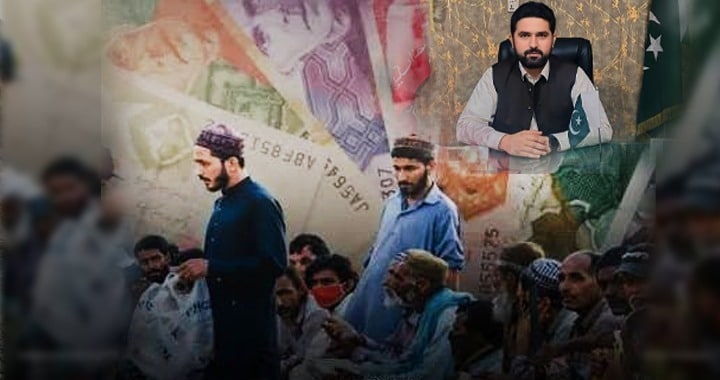
The Money Was Never His, and the Bill Is Never Theirs
“Kiya tere baap ka paisa hai?” (Is it your father’s money?)
The line became one of Imran Khan’s most memorable political outbursts, delivered in the charged atmosphere surrounding his journey towards the Prime Minister’s House. It was a rhetorical question about public money, accountability and the ownership of state resources.
Years later, the line deserves to be turned around.
Whose money is being spent when a provincial government brings its political battle to Islamabad?
And more importantly, who ultimately pays for it?
The recent gathering and press interaction at KP House Islamabad was not a private PTI event financed from the party’s organisational resources. It was a government setting involving the chief executive of Khyber Pakhtunkhwa and provincial official machinery.
That distinction matters.
A political party is free to hold a protest, press conference or political gathering. It can spend its own money doing so. But when the machinery, premises, personnel and logistical resources of a provincial government are involved, the cost ultimately moves towards the public purse.
And the public purse in KP is not overflowing.
This is a province battling terrorism, unemployment, underdevelopment, damaged infrastructure and enormous security expenditure. Its people are not sitting on piles of surplus cash waiting for politicians to spend it on political confrontation in Islamabad.
The poor farmer in Khyber, the shopkeeper in Bannu, the labourer in Peshawar, the student in Swat and the family living in South Waziristan do not care which political faction wins the next shouting match.
They care about whether their road is safe.
Whether their children can reach school.
Whether their shop can remain open.
Whether terrorists can be stopped.
Whether the police officer at the checkpoint comes home alive.
That is why the KP House episode deserves to be examined not merely as another political event, but as a question of fiscal and constitutional responsibility.
The provincial government exists to govern the province.
Its scarce resources are meant to serve its citizens.
When the province is facing a serious terrorism threat, every rupee spent by its government should be measured against the needs of those citizens.
This becomes even more difficult to justify when the political discussion taking place at the government facility revolves primarily around the health and release of PTI founder Imran Khan.
A journalist’s question at KP House exposed that contrast perfectly. Asked why the provincial leadership was not focusing more heavily on terrorism, the chief minister replied that they were discussing Imran Khan’s health.
There could hardly have been a clearer illustration of competing priorities.
The irony becomes heavier when viewed against Imran Khan’s own political rhetoric.
“Kiya tere baap ka paisa hai?” was powerful precisely because it suggested that those in power had no personal ownership over public resources.
Exactly.
They do not.
The money belongs to the people.
The offices belong to the people.
The provincial machinery belongs to the people.
And the responsibility belongs to those elected or appointed to serve them.
This is why the question should not be limited to PTI.
It should become a universal rule of governance: no political party should be allowed to convert public institutions into extensions of its partisan machinery.
There is another uncomfortable layer.
KP’s relationship with terrorism is not an abstract policy debate. The province has repeatedly suffered from attacks by the banned TTP and other terrorist organisations. PTI’s own previous government pursued negotiations with the TTP, including a plan that Imran Khan later described as involving the possible resettlement of thousands of fighters and their families.
Those decisions can be debated politically.
But the consequences cannot be wished away.
If terrorists return, ordinary citizens pay.
If police are deployed for political confrontations instead of security duties, ordinary citizens pay.
If government resources are diverted towards partisan activity, ordinary citizens pay.
If terrorism is allowed to become secondary to political survival, ordinary citizens pay again.
The burden always travels downward.
It reaches the poorest household first.
So perhaps the old question needs a sequel.
Not: “Whose father’s money is it?”
But: “Whose money are you spending, and whose security are you neglecting while spending it?”
The answer should be obvious.
It is the people’s money.
And it is the people of KP who are standing in the line of fire.



