
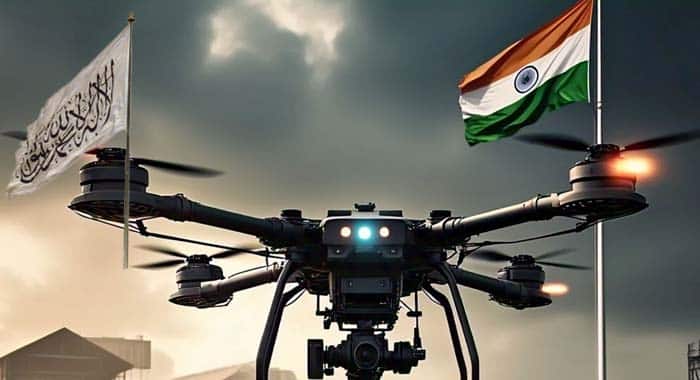
An investigative report has raised serious questions over the use of India-supplied unmanned aerial systems (UAS) in attacks against Pakistan from Afghan territory, while highlighting what it describes as India’s broader efforts to support the Taliban regime and armed groups operating from Afghanistan.
According to the report, drones used in attacks launched from Afghanistan into Khyber Pakhtunkhwa and Balochistan were not manufactured in Afghanistan, as may have been previously assumed, but were allegedly supplied by India for use against Pakistan.
The report further claims that the drones involved are technically limited systems, with relatively short operational ranges and restricted payload capacities. Despite their limitations, their reported deployment from Afghan territory represents an additional security challenge for Pakistan and underscores the evolving nature of cross-border threats involving unmanned technology.
According to the investigative findings, nine drone attacks were launched from Afghanistan into Khyber Pakhtunkhwa and Balochistan during June and July 2026. Recovered systems reportedly have operational ranges ranging from approximately 50 to 270 kilometres and are capable of carrying payloads of up to five kilograms.
The report characterizes the drones as technologically inferior and possessing limited capabilities compared with more sophisticated unmanned systems. Nevertheless, their potential use for surveillance, targeted attacks or delivery of small explosive payloads demonstrates how relatively inexpensive and technically basic platforms can create security challenges when employed across international borders. The findings have also raised questions regarding the supply chain through which such systems allegedly reached actors operating from Afghan territory.
A central finding highlighted in the report is that the UAS platforms recovered following attacks originating from Afghanistan were provided by India, rather than being locally manufactured in Afghanistan. The report argues that this finding undermines the narrative that Afghanistan itself is independently developing the systems used in these attacks and instead points towards an external supply dimension.
If independently substantiated, the transfer of such systems would represent a significant development in the regional security environment, particularly given Pakistan’s longstanding concerns regarding cross-border terrorism and the use of Afghan territory for attacks against Pakistan.
The allegations also come amid heightened tensions surrounding militant activity originating from Afghanistan and concerns over the ability of armed groups to acquire increasingly accessible unmanned technologies.
The investigative report further describes Afghanistan as having developed into a major operating environment for militant and terrorist organizations. According to the report, more than 20 terrorist organizations are currently active in Afghanistan or maintain a presence there. The report argues that the continued availability of permissive operating space for such groups provides opportunities for external actors to advance hostile agendas against neighbouring countries.
It specifically identifies the Tehreek-e-Taliban Pakistan (TTP) and the Balochistan Liberation Army (BLA) among organizations that, according to the report, have received financial support from India. These allegations remain serious and consequential and would require independent corroboration. However, the report presents them as part of a broader pattern in which Afghanistan’s security environment is allegedly being exploited to facilitate attacks against Pakistan.
The reported use of drones launched from Afghan territory adds another dimension to Pakistan’s security concerns. For Pakistan, the threat is not limited to conventional attacks or the movement of armed personnel across the border. The proliferation of unmanned systems allows relatively small groups to conduct surveillance or potentially carry out attacks without directly exposing their personnel to Pakistani security forces. The reported drone incidents in Khyber Pakhtunkhwa and Balochistan therefore underscore the growing importance of counter-UAS capabilities in Pakistan’s broader national security architecture. The development also highlights the potential consequences of advanced technologies becoming available to non-state actors operating in environments where effective controls over weapons and military equipment remain limited.
Despite the reported use of unmanned systems, the investigative report emphasizes that Pakistan possesses substantial capabilities to counter such threats. According to the findings, Pakistan has developed a combination of soft-kill and hard-kill counter-UAS capabilities, enabling security forces to detect, disrupt, disable or otherwise neutralize hostile drones. Soft-kill systems can interfere with a drone’s communications, navigation or control mechanisms, while hard-kill capabilities are designed to physically neutralize the platform.
The availability of both approaches provides Pakistan with a layered response to the growing use of unmanned systems by hostile actors. The report suggests that the relatively limited technical capabilities of the drones involved could further reduce their effectiveness against a well-developed counter-drone architecture.
The reported incidents nevertheless demonstrate that the strategic significance of a drone cannot be judged solely by its technological sophistication. Even relatively low-end systems can potentially be used for reconnaissance, surveillance or the delivery of small payloads. Their relatively low cost and ease of deployment can make them attractive to armed groups seeking capabilities that previously required significantly greater resources. The emergence of such threats therefore requires continuous improvement in detection, electronic warfare, air-defence and physical interception capabilities.
Pakistan’s reported ability to employ both soft-kill and hard-kill measures provides an important defensive advantage, but continued vigilance remains essential as unmanned technology evolves.
The allegations regarding Indian involvement add a wider geopolitical dimension to the issue. The report portrays the alleged provision of drones as part of a broader effort by India to exploit Afghanistan’s security environment against Pakistan. It further argues that the combination of alleged financial support to militant organizations and the reported transfer of unmanned systems could create an ecosystem in which armed groups operating from Afghan territory acquire additional means to threaten Pakistan.
Such allegations, if independently established, would raise significant questions regarding the proliferation of military technology to non-state actors and the responsibilities of states in preventing their territory or resources from being used to facilitate attacks against neighbouring countries.
The reported nine drone incidents during June and July 2026 demonstrate how rapidly the regional security environment is evolving. The combination of militant networks, cross-border attacks and unmanned technology presents a complex challenge that cannot be addressed through conventional border security measures alone. For Pakistan, the emerging threat requires a coordinated approach involving intelligence gathering, border surveillance, electronic countermeasures, air-defence systems and the rapid identification and neutralization of hostile unmanned platforms.
At the same time, the alleged external supply of drones highlights the importance of tracing the networks through which military equipment reaches armed groups operating in conflict zones.
The investigative report has brought renewed attention to the alleged use of India-supplied drones in attacks launched from Afghan territory against Pakistan, as well as the broader security challenges associated with Afghanistan’s militant landscape. The report claims that nine drone attacks were conducted against locations in Khyber Pakhtunkhwa and Balochistan during June and July 2026, involving systems with reported ranges of approximately 50–270 kilometres and payload capacities of up to five kilograms. While the drones are described as technically limited, their deployment demonstrates the growing accessibility of unmanned technology to non-state actors.
At the same time, Pakistan’s reported combination of soft-kill and hard-kill counter-UAS capabilities provides a significant defensive mechanism against such threats and enables hostile drones to be detected, disrupted or physically neutralized. The wider allegations concerning Indian support to armed groups and the alleged provision of drones, however, underscore a broader regional security challenge—one in which Afghanistan’s unstable security environment, militant networks and emerging technologies increasingly intersect.
As cross-border threats continue to evolve, the ability to identify the sources, supply chains and operational networks behind such attacks will remain critical to Pakistan’s national security and regional stability.



