
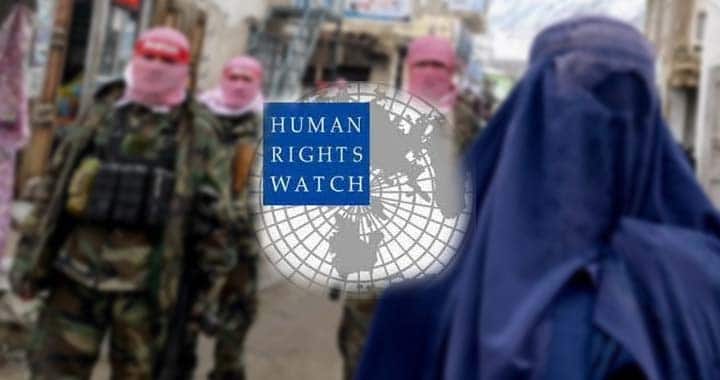
Marking the fifth anniversary of the Taliban’s return to power in Afghanistan, Human Rights Watch (HRW) has released a comprehensive report describing the country as the site of one of the world’s gravest and most prolonged human rights crises. The report presents a detailed assessment of developments since August 2021, documenting what it characterizes as widespread repression, systemic discrimination, shrinking civic space, and a deepening humanitarian emergency.
Alongside the report, HRW published a five-year timeline chronicling key events since the Taliban assumed control of Kabul on August 15, 2021. The organization states that Afghanistan has experienced an unprecedented erosion of fundamental freedoms, with women, girls, journalists, former government personnel, religious minorities, LGBTQ individuals, and civil society activists bearing the brunt of restrictive policies and alleged human rights violations.
According to HRW, the Taliban’s takeover fundamentally transformed Afghanistan’s political and social landscape. The organization recalls the mass exodus witnessed at Kabul International Airport in August 2021, where thousands of Afghans sought to flee amid fears of reprisals against former government officials, members of the Afghan National Security Forces (ANSF), journalists, human rights defenders, civil society representatives, and women employed in public institutions.
Although Taliban authorities announced a general amnesty following their return to power, HRW states that subsequent reports of house-to-house searches, arbitrary detentions, enforced disappearances, and revenge killings raised serious concerns regarding the implementation of those commitments.
The report details numerous alleged cases involving former Afghan security personnel. HRW states that between August 15 and October 31, 2021, it documented the killing or disappearance of 47 former members of the Afghan National Security Forces, including military personnel, police officers, intelligence officials, and local police members who had either surrendered or were detained following the Taliban takeover.
The organization further reports that credible information indicates more than 100 additional killings in the provinces of Ghazni, Helmand, Kandahar, and Kunduz, describing these incidents as inconsistent with earlier assurances of protection for former government employees and security officials.
Human Rights Watch also highlights the significant deterioration of media freedom in Afghanistan. According to the report, independent media organizations have faced extensive restrictions since the Taliban assumed power, resulting in the closure of hundreds of media outlets.
The organization reports that journalists have been subjected to arrests, physical assaults, intimidation, and threats, while many have either left the country or abandoned journalism altogether. Women journalists, HRW notes, have been particularly affected through employment restrictions and prohibitions on participation within various media organizations.
As civic space has continued to contract, the report concludes that conditions for independent journalism and public accountability have become increasingly constrained.
A central focus of the report is the continued prohibition on girls’ education beyond the sixth grade, introduced by Taliban authorities in March 2022.
Human Rights Watch states that Afghanistan remains the only country where girls are systematically prevented from pursuing education beyond primary school, describing the policy as one that deprives an entire generation of educational opportunities and future economic participation.
The report documents ongoing demonstrations organized by Afghan women in cities including Kabul, Herat, Bamiyan, and elsewhere, noting that participants have continued to advocate for their rights despite significant security pressures.
According to HRW, women protesters have allegedly faced arbitrary detention, violence, torture, threats, and forced confessions. The report notes that the slogan “Bread, Work, Freedom” has become a defining symbol of the movement demanding equal rights and opportunities.
Human Rights Watch concludes that Taliban authorities have implemented a broad range of laws, decrees, and administrative measures that systematically deprive women and girls of their fundamental rights solely on the basis of gender.
The organization argues that the cumulative impact of these policies amounts to crimes against humanity through gender persecution, citing restrictions on education, employment, freedom of movement, public participation, dress, and expression.
HRW states that the Taliban’s Law for the Propagation of Virtue and Prevention of Vice, enacted in August 2024, institutionalized additional restrictions affecting women’s mobility, employment opportunities, freedom of expression, and participation in public life.
The organization also expresses concern regarding provisions contained within the Taliban’s Code of Criminal Procedure, stating that the legislation has further reinforced discrimination and reduced legal protections available to women and other vulnerable communities.
According to the report, on July 8, 2025, the International Criminal Court (ICC) issued arrest warrants for two senior Taliban officials on allegations relating to crimes against humanity based on gender persecution.
Beyond civil liberties, Human Rights Watch describes Afghanistan’s humanitarian situation as increasingly severe.
The report attributes worsening living conditions to declining international financial assistance, prolonged economic deterioration, and restrictions imposed on female humanitarian workers, all of which have affected the delivery of humanitarian services across the country.
According to HRW, more than 17 million Afghans—nearly 40 percent of the population—currently face severe food insecurity, while United Nations humanitarian response programs continue to experience significant funding shortages.
The organization warns that restrictions preventing women from working within humanitarian organizations have substantially reduced access to assistance for women and girls throughout Afghanistan.
The report also identifies Afghanistan’s healthcare system as facing mounting challenges.
HRW states that reductions in international funding, shortages of medicines and medical equipment, and limitations placed upon female healthcare professionals have weakened essential medical services.
The organization further expresses concern that restrictions preventing women from pursuing education in medical institutions will likely worsen shortages of female healthcare workers in the years ahead, thereby limiting healthcare access for Afghan women who may only receive treatment from female medical staff.
The report states that members of Afghanistan’s LGBTQ community continue to face heightened risks of detention, violence, intimidation, and persecution under Taliban rule.
Human Rights Watch also raises concerns regarding increasing discrimination affecting religious minorities, particularly members of the Shia Muslim community.
According to the report, the Taliban’s revised Code of Criminal Procedure, issued in January 2026, recognizes only followers of the Hanafi school of Islamic jurisprudence as Muslims, a provision HRW argues limits legal protections available to other religious communities.
The organization also states that revisions within the legal framework have narrowed the legal definition of domestic violence and weakened protections available to women experiencing abuse.
Human Rights Watch further reports that individuals accused of maintaining links with ISIS have allegedly been subjected to detention, enforced disappearance, and extrajudicial execution without access to legal representation or family members.
The organization stresses the importance of adherence to internationally recognized standards of due process and judicial safeguards during counterterrorism operations.
The report also addresses the situation of Afghan migrants returning from neighboring and European countries.
Human Rights Watch criticizes policies adopted by Iran, Pakistan, Turkey, and certain European governments that have resulted in the forced return of Afghan nationals.
The organization warns that many returnees including women, journalists, former government officials, human rights defenders, members of religious minorities, and LGBTQ individuals may face serious risks of persecution, arbitrary detention, torture, or other human rights violations upon their return.
The report highlights recent actions undertaken by international institutions aimed at promoting accountability.
According to HRW, the International Criminal Court issued arrest warrants in July 2025 concerning allegations of crimes against humanity based on gender persecution.
Additionally, the United Nations Human Rights Council (UNHRC) established an independent investigative mechanism in October 2025 to examine alleged human rights violations committed in Afghanistan.
Commenting on the findings, Fereshta Abbasi, Afghanistan Researcher at Human Rights Watch, stated that the events of the past five years demonstrate how impunity has contributed to the escalation of human rights violations throughout Afghanistan.
She called upon the international community to move beyond expressions of concern by pursuing concrete measures to ensure accountability, prevent the forced return of vulnerable Afghan asylum seekers, support ongoing humanitarian operations, and uphold the fundamental rights and dignity of the Afghan people.
Human Rights Watch concludes that Afghanistan’s human rights situation remains among the most serious global challenges today, emphasizing that sustained international engagement, accountability mechanisms, humanitarian assistance, and protection of vulnerable populations will remain essential to addressing the country’s continuing crisis.



