
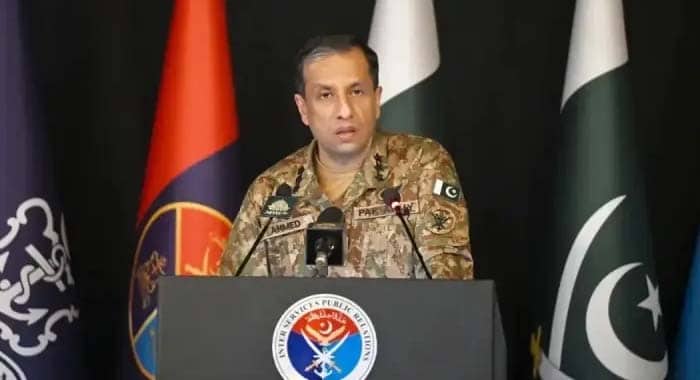
Pakistan’s military has underscored that sustainable peace and security in Balochistan cannot be achieved through kinetic operations alone, stressing that effective governance, public service delivery and direct engagement with the people are indispensable to addressing the province’s long-term challenges.
Speaking during a detailed press conference on the country’s counterterrorism strategy and the situation in Balochistan, Director General Inter Services Public Relations (ISPR), Lieutenant General Ahmed Sharif Chaudhry, said security institutions were fulfilling their constitutional responsibilities, but lasting stability required governance reforms that directly benefited the people.
He said the state must strengthen its relationship with citizens instead of relying on traditional power structures, emphasizing that the real stakeholders in Balochistan were its people rather than privileged intermediaries.
The military spokesperson said the Constitution clearly defines both the rights and responsibilities of citizens, adding that loyalty to the state and adherence to the Constitution formed the foundation of national stability. He stressed that rights and responsibilities should go hand in hand, arguing that greater public awareness of civic duties was essential for strengthening Pakistan’s democratic and constitutional order.
Referring to recent remarks by the Field Marshal, the DG ISPR said public discourse frequently focused on rights while paying comparatively little attention to constitutional responsibilities. He maintained that a balanced approach was necessary to reinforce national cohesion and improve governance across the country.
Turning specifically to Balochistan, Lieutenant General Ahmed Sharif said the province’s long-standing governance challenges could not be viewed solely through the lens of security. He argued that entrenched vested interests had historically sought to preserve the status quo instead of allowing ordinary citizens to benefit fully from education, economic opportunities and public resources.
According to the DG ISPR, the state’s objective was to ensure that development funds and government resources reached the people of Balochistan directly rather than serving the interests of a limited elite. He said the era of accommodating influential groups at the expense of public welfare had come to an end, adding that the government would continue strengthening direct engagement with local communities.
The military spokesperson also highlighted ongoing efforts to improve governance by expanding technical surveillance, strengthening policing capacity, enhancing cyber capabilities and establishing specialised training institutions for law enforcement agencies operating in the province.
He said nearly 11,000 young people in Balochistan were being provided information technology training every year, describing human resource development as the province’s greatest long-term asset. Empowering young people through education and professional skills, he said, was central to weakening extremist recruitment and building lasting peace.
Lieutenant General Ahmed Sharif rejected narratives suggesting that Balochistan’s development had been ignored, pointing to infrastructure projects, healthcare facilities, road networks and educational investments in cities including Gwadar and Turbat. He argued that terrorist groups deliberately targeted development projects to obstruct progress before exploiting resulting disruptions for propaganda purposes.
The DG ISPR said security forces, police and civil institutions would continue working together to improve conditions across the province, but stressed that effective governance remained equally important for defeating terrorism and strengthening public confidence in state institutions.
He concluded that Pakistan’s constitutional framework required all institutions and citizens alike to fulfil their respective responsibilities, maintaining that sustainable peace in Balochistan depended on a combination of robust security measures, accountable governance, development and closer engagement between the state and its people.



