
Pakistan has strongly rejected allegations made by the Indian representative at the United Nations Security Council, stating that India’s attempts to portray itself as a victim of terrorism cannot conceal what Pakistan describes as New Delhi’s role in supporting and sponsoring terrorist activities against Pakistan.
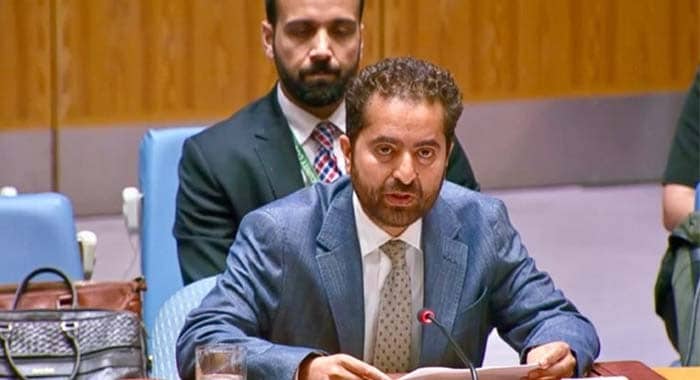
Addressing the Security Council, Pakistani diplomat Ansar Shah categorically dismissed the claims presented by the Indian delegation and said India was attempting to misrepresent facts while diverting international attention from its own actions and responsibilities under international law.
Shah stated that India’s portrayal of regional developments was inaccurate and misleading, emphasizing that unilateral actions concerning internationally recognized agreements cannot be justified under any circumstances.
Speaking on the Indus Waters Treaty, Pakistan reiterated that the agreement remains legally binding and cannot be suspended unilaterally by any party.
Ansar Shah informed the Security Council that the Court of Arbitration had reaffirmed in August 2025 that the Indus Waters Treaty remains valid and operational. He stressed that shared water resources cannot be used as a means of political pressure or strategic coercion.
He warned that attempts to manipulate shared resources for political objectives represent a serious violation of international commitments and could create broader risks for regional peace, stability, and international security.
Pakistan emphasized that international agreements form the foundation of global cooperation and must be respected by all parties regardless of political circumstances.
Rejecting India’s allegations related to terrorism, Shah stated that such claims were an attempt to divert attention from what Pakistan describes as India’s own involvement in supporting militant organizations operating against Pakistan.
He highlighted the activities of groups including Tehreek-e-Taliban Pakistan (TTP), Baloch Liberation Army (BLA), and Majeed Brigade, stating that these organizations have been responsible for numerous attacks inside Pakistan that have resulted in the loss of thousands of civilian lives and law enforcement personnel, including women and children.
The Pakistani representative stated that the international community must adopt an objective and balanced approach toward counterterrorism and examine all sources of support and financing for terrorist networks.
“India is not merely a country affected by terrorism; Pakistan maintains that India has also been involved in supporting and enabling terrorist activities against Pakistan,” Shah stated. The Pakistani diplomat further referred to allegations regarding India’s involvement in extrajudicial actions beyond its borders, stating that such incidents have raised serious international concerns.
He argued that a state cannot claim moral authority on counterterrorism while facing allegations of conducting operations outside its territory. Pakistan called for consistent application of international law and urged the international community to address all forms of terrorism without political selectivity.
During his address, Shah also raised concerns regarding India’s actions in Indian Illegally Occupied Jammu and Kashmir (IIOJK), stating that the Kashmiri people continue to be denied their right to self-determination despite relevant United Nations Security Council resolutions.
He emphasized that unilateral measures cannot alter the internationally recognized status of Jammu and Kashmir and that no state can change the legal and historical character of a disputed territory through administrative actions.
The Pakistani representative stated that India remains bound by the obligations outlined in the United Nations Charter, including Article 25, which requires member states to comply with Security Council decisions. “International law cannot be applied selectively. All member states must fulfill their responsibilities under the UN Charter and respect decisions adopted by the Security Council,” Shah said.
Pakistan urged India to fulfill its obligations under international law, the United Nations Charter, and relevant Security Council resolutions. Reaffirming its commitment to regional peace and stability, Pakistan called upon the international community to ensure that international agreements, human rights principles, and counterterrorism frameworks are upheld without discrimination or political bias.
Pakistan maintained that sustainable peace in South Asia requires respect for international commitments, accountability for those supporting terrorism, and resolution of outstanding disputes in accordance with international law.



