
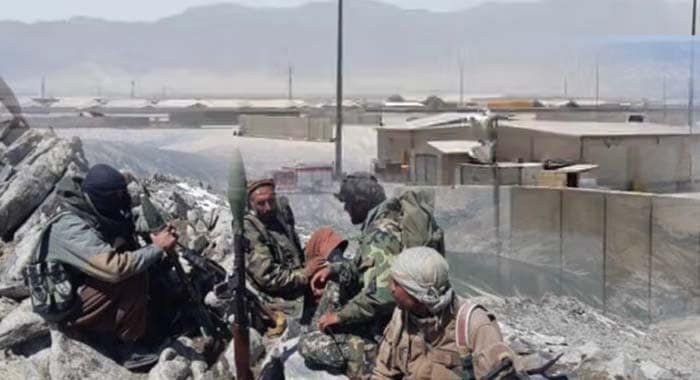
A series of attacks claimed by armed groups opposing Afghanistan’s Taliban authorities, culminating in a rocket strike on Bagram Airfield, has exposed persistent security challenges facing the regime, with the Afghanistan Freedom Front (AFF), National Resistance Front (NRF) and Afghanistan United Front claiming operations against Taliban personnel and installations across the country.
The AFF said its fighters launched a coordinated rocket attack on Taliban military facilities and training centres at Bagram Airfield in Parwan province on October 22. The group said the operation, based on intelligence gathered about the installation, killed or wounded more than 10 Taliban personnel and caused material damage.
The AFF also said its fighters withdrew safely after the attack. Taliban authorities had not publicly confirmed the claimed casualties at the time of publication.
Bagram, one of Afghanistan’s most strategically significant military installations, has become a symbol of the country’s turbulent security transition since the US withdrawal and the Taliban takeover in 2021. An attack on facilities used by the Taliban at the airfield raises fresh questions about the protection of key military installations.
At Least Nine Attacks Claimed in Recent Days
Between October 7 and October 22, anti-Taliban groups claimed a series of attacks across several Afghan provinces, targeting security checkpoints, intelligence personnel, commanders, patrols and military facilities.
The incidents include:
October 7, Faizabad, Badakhshan: The AFF claimed a targeted attack on a vehicle carrying Taliban personnel near the Taliban police headquarters. The group said four Taliban members, including a commander, were killed.
October 9, Injil district, Herat: The NRF claimed an attack on a Taliban military patrol, saying two personnel were killed and another wounded.
October 9, Baghlan: The NRF claimed an operation in Jalga district that killed one Taliban member and wounded another.
October 10, Panjshir: The NRF said its fighters attacked a Taliban checkpoint near Sheikhan village in Rokha district, killing one member and wounding two others.
October 11, Ghor: The Afghanistan United Front claimed an attack that killed one Taliban member and wounded another.
October 13, Arghandab, Kandahar: The Afghanistan United Front said its fighters killed Taliban commander Rahimullah Rohani and a police officer.
October 13, Logar: The AFF claimed an attack on Taliban intelligence personnel near the provincial police headquarters in Pul-e Alam, saying three were killed and two wounded.
October 14, Spin Boldak, Kandahar: The Afghanistan United Front claimed attacks on three Taliban checkpoints, saying three personnel were killed, three wounded and a vehicle destroyed.
October 20, Parwan: The AFF claimed an attack on a Taliban checkpoint near Pul-e Matak along the Kabul-North Highway, saying three Taliban personnel were killed and two wounded.
October 21, Takhar: The AFF claimed a targeted attack on Taliban intelligence personnel in Taloqan, saying one member was killed and three wounded.
October 22, Bagram Airfield, Parwan: The AFF claimed a rocket attack on Taliban military facilities and training centres, putting the number of Taliban personnel killed or wounded at more than 10.
The casualty figures above reflect claims made by the respective groups and have not been independently verified in every case. Nevertheless, the geographical spread and range of targets illustrate the continuing activity of armed opposition groups challenging Taliban rule.
Multiple Groups Target Taliban Security Structures
The AFF is not alone in its campaign against the Taliban. The NRF has claimed operations in northern and northeastern Afghanistan, while the Afghanistan United Front has targeted Taliban personnel in southern and western provinces. Afghan Green Trend has also claimed attacks on Taliban-linked security positions.
The operations have focused on different elements of the Taliban’s security structure, from checkpoints and mobile patrols to intelligence personnel, commanders and military facilities. This pattern creates pressure on local security arrangements and forces the authorities to protect a wide range of installations and officials.
The activity is not confined to one province or a single opposition organisation. The AFF’s claimed operations in Parwan, Logar, Badakhshan and Takhar, alongside NRF activity in Herat, Baghlan and Panjshir and Afghanistan United Front operations in Kandahar and Ghor, demonstrate the geographical reach of the groups’ campaigns.
However, the number of attacks alone does not establish that the opposition groups can seize or hold territory. Their long-term capacity, local support and ability to sustain operations remain important measures of whether the violence can develop into a broader challenge to Taliban control.
Faizabad Killing Adds to the Security Pressure
The killing of Taliban-appointed Faizabad mayor Abdul Rahman Mansour in an attack claimed by the NRF in August had already highlighted the vulnerability of Taliban officials. The subsequent attacks on personnel, vehicles and security positions have kept pressure on the administration’s local security apparatus.
Faizabad, the capital of Badakhshan, has also experienced several explosions targeting Taliban-linked personnel. The AFF, NRF and other opposition networks have claimed responsibility for attacks in the city, prompting Taliban security forces to conduct arrests and tighten security.
The incidents underscore the difficulties facing the Taliban authorities in protecting officials and maintaining security across a country where armed opposition groups continue to operate.
Security Claims Face a Continuing Test
The Taliban’s assertion that it has established security throughout Afghanistan faces a practical test whenever opposition groups strike military facilities, checkpoints or senior personnel. The Bagram attack claim is particularly significant because of the installation’s strategic importance.
If the AFF’s account is confirmed, the strike would demonstrate that the group could reach a high-profile military target. The extent of the damage and the claimed casualties, however, remain unconfirmed.
The wider pattern also requires careful assessment. Repeated attacks can strain security resources, undermine confidence among officials and force the deployment of additional personnel. But a sustained change in the balance of power would require evidence of broader operational gains, territorial control or an enduring ability to disrupt Taliban governance.
For Afghanistan’s population, the continuing violence carries its own risks. Attacks near security installations and populated areas can endanger civilians, making the protection of local communities an essential part of any assessment of the conflict.
The latest wave of attacks therefore presents a clear challenge to the Taliban’s security narrative, even as the full military impact remains uncertain. The AFF’s strike claim at Bagram, combined with operations claimed by the NRF and Afghanistan United Front in several provinces, shows that armed opposition to Taliban rule remains active.
The central question is no longer whether opposition groups are claiming attacks against the Taliban, but how effectively the authorities can protect their personnel and installations while preventing further violence across Afghanistan.



