
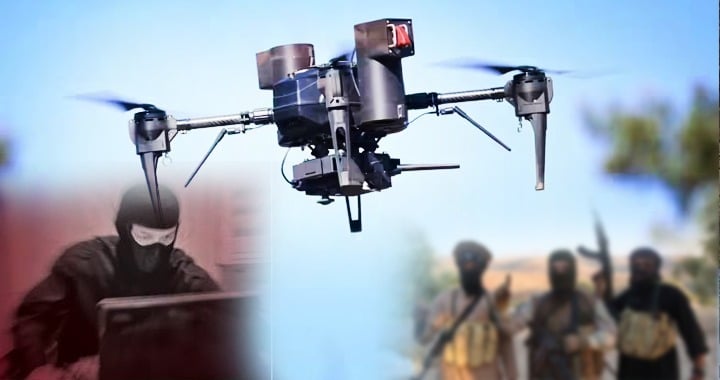
The quadcopter attack in Baka Khel’s Narmi Khel area of Bannu, which left three civilians injured, including a five-year-old child, is more than another isolated terrorist incident. It is another reminder that terrorist groups operating in Pakistan have continued to adapt their tactics while pursuing the same objective: weakening the state’s writ through violence, fear and psychological warfare.
The use of quadcopters has become one of the latest additions to the terrorist playbook. What was once a technology associated with photography, agriculture and commerce has increasingly been weaponized by terrorist organizations to carry out low-cost, high-impact attacks. The growing frequency of such incidents in Bannu, Tank, North Waziristan and South Waziristan reflects a tactical evolution rather than a strategic transformation. Terrorists have not changed their goals, only the tools with which they seek to achieve them. Recent months have seen repeated quadcopter attacks on police stations, security posts and even civilian neighborhoods, particularly in Bannu’s Miryan and adjoining areas, demonstrating that the tactic is no longer experimental but has become part of an established operational pattern.
Yet focusing solely on drones would amount to missing the larger picture.
The real challenge confronting Pakistan today is a hybrid terrorist campaign that combines conventional violence with modern technology, coordinated propaganda and psychological operations. Alongside quadcopters, terrorist organizations continue to rely on suicide bombings, improvised explosive devices, targeted assassinations, kidnappings, extortion networks and cross-border infiltration. These tactics are deliberately employed in combination to stretch security resources, create a constant atmosphere of uncertainty and undermine public confidence.
Southern Khyber Pakhtunkhwa has emerged as the principal arena of this campaign. Districts such as Bannu, North Waziristan, South Waziristan, Tank, Lakki Marwat and Dera Ismail Khan have repeatedly witnessed attacks on security personnel, police stations, check posts, tribal elders and civilians. Bannu, in particular, has become a recurring target because of its strategic location connecting settled districts with former tribal areas and its proximity to routes historically exploited by terrorist networks.
Equally important is the psychological dimension of these attacks. Terrorists understand that every explosion is accompanied by another battle, the battle over perception. Their objective extends beyond causing casualties. They seek to create panic, disrupt daily life, discourage investment, weaken public morale and generate an impression that the state has lost control. This information campaign often unfolds within minutes of an attack, as rumors, fabricated narratives and manipulated content circulate rapidly across social media platforms.
Security analysts have long argued that civilian casualties are exploited as propaganda tools. Terrorists attempt to shift blame onto Pakistan’s security forces, inflame anti-state sentiment and deepen mistrust between local communities and state institutions. The information domain has therefore become almost as important as the battlefield itself.
The security forces, however, have adapted as well. Intelligence-based operations have become increasingly precise, coordination among military, police and intelligence agencies has improved considerably, and terrorist hideouts continue to be dismantled through sustained counterterrorism operations. Numerous planned attacks have reportedly been foiled before execution, while hundreds of attempted drone strikes have been intercepted or disrupted through improved surveillance and intelligence capabilities.
Nevertheless, the persistence of attacks demonstrates that terrorism cannot be measured solely by the number of successful strikes. The continued ability of terrorist groups to recruit, procure equipment, exploit cross-border sanctuaries and finance their activities indicates that the challenge remains multidimensional.
This reality also explains why developments in Khyber Pakhtunkhwa cannot be viewed in isolation from Balochistan. Although the actors and local dynamics differ, both provinces are confronting organizations that increasingly combine armed violence with information warfare, recruitment campaigns and attempts to exploit local grievances. The objective remains consistent: erode state authority, discourage development and project instability beyond Pakistan’s borders.
The latest attack in Bannu should therefore be understood not merely as another security incident but as part of a broader contest over Pakistan’s internal stability. Winning that contest requires more than tactical victories on the battlefield. It demands continued intelligence-led operations, stronger policing, technological adaptation against emerging threats, closer cooperation between federal and provincial institutions, effective border management and, equally importantly, public resilience against terrorist propaganda.
Pakistan has confronted evolving terrorist threats before and has repeatedly demonstrated its capacity to adapt. The emergence of weaponized quadcopters represents another phase in that evolution, not the beginning of a new conflict. The country’s response will likewise have to continue evolving, combining military preparedness, technological innovation, effective governance and strategic communication to ensure that terrorist organizations are denied not only physical space, but also the narrative space they seek to occupy.



