
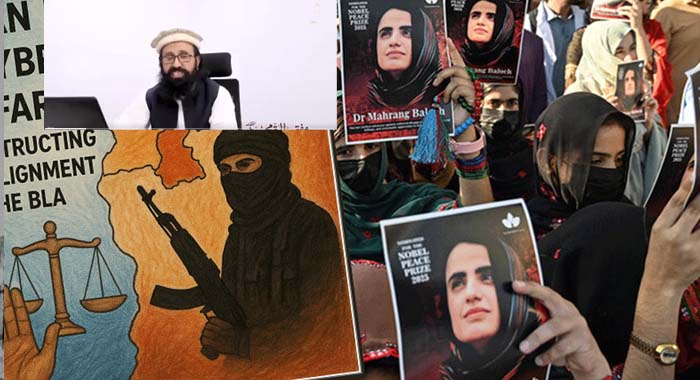
The proscribed organization known as the Tehreek-e-Taliban Pakistan (TTP) has reportedly released a video statement featuring Mufti Tariq Mehsud, in which the group presents its narrative regarding the arrest of Dr. Mahrang Baloch and the prevailing security situation in Balochistan.
According to officials, the release of this video is part of a broader effort by terrorist organizations to distort facts, misrepresent ongoing legal proceedings, and construct an anti-state narrative aimed at undermining Pakistan’s internal stability and institutional credibility.
In the video, the TTP attempts to comment on the circumstances surrounding the detention of Dr. Mahrang Baloch and presents its position on the broader security environment in Balochistan. Security observers note that such messaging is consistent with the group’s longstanding pattern of propaganda dissemination designed to exploit sensitive political and human rights issues for its own strategic objectives.
Authorities emphasized that terrorist groups such as the TTP have a long history of violence, bloodshed, and destabilization, and have repeatedly supported or aligned themselves with elements hostile to the state of Pakistan. Officials further stated that these groups routinely manipulate facts, distort incidents, and propagate baseless allegations against Pakistan in an attempt to justify their own activities and maintain relevance within extremist networks allegedly operating under external influence.
Officials added that the TTP has, in various instances, attempted to link unrelated global and domestic issues from international conflicts such as Gaza to internal legal proceedings in Pakistan—in order to construct misleading narratives against the state. According to the statement, such attempts are aimed at damaging Pakistan’s international image while simultaneously promoting internal discord.
In response to claims referenced in the video, officials reiterated that Pakistan is a responsible Islamic republic where the rule of law, constitutional governance, and protection of citizens’ rights remain fundamental pillars of the state. The government, they said, remains fully committed to addressing the concerns of all citizens through constitutional, legal, and democratic mechanisms while working to improve public welfare and social stability across all regions.
Authorities further stated that certain anti-state elements continue to exploit Pakistan’s democratic environment and institutional restraint in pursuit of external agendas that seek to undermine national cohesion and stability.
Regarding legal proceedings related to Dr. Mahrang Baloch, officials confirmed that she has been convicted following due legal process under Pakistan’s judicial system in cases related to terrorism and incitement to violence. Authorities stated that the proceedings established her involvement in activities that included alleged incitement during events in Gwadar, which resulted in violent unrest and the martyrdom of a member of Pakistan’s security forces.
Security officials further noted that the TTP remains responsible for the killing of more than 90,000 innocent Pakistanis, including civilians and security personnel, and continues to pose one of the most serious threats to peace and stability in the country.
The statement also highlighted that terrorist groups consistently attempt to manipulate public discourse by exploiting sensitive issues and supporting individuals or groups whose activities, according to officials, contribute to disorder and undermine state authority.
Authorities emphasized that the expression of sympathy or alignment by proscribed organizations such as the TTP toward individuals facing legal proceedings raises serious concerns regarding attempts to influence narratives aimed at destabilizing the state.
Reiterating Pakistan’s position, officials stated that proscribed terrorist organizations with a documented history of violence, mass killings, and attacks against civilians and security personnel have no moral or legal authority to comment on matters related to human rights or the rule of law within the country.
The government and security institutions reaffirmed their commitment to countering extremist propaganda, ensuring public order, and safeguarding national sovereignty against all forms of misinformation, incitement, and hybrid information warfare.



