
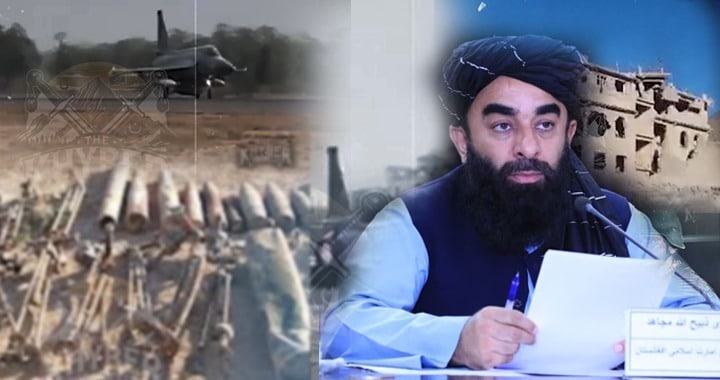
Pakistan’s latest cross-border operation has once again exposed the widening gap between Islamabad’s demands and the Afghan Taliban’s response.
Rather than announcing concrete measures against the Tehreek-e-Taliban Pakistan (TTP) and other terrorist groups that Pakistan says continue to operate from Afghan territory, senior Taliban officials have instead warned of retaliation.
Taliban spokesman Zabihullah Mujahid said the group does not seek war but claimed it would respond to Pakistan’s strikes “with restraint.” He added that if retaliation could not be carried out through the air, it could be undertaken “by land,” while asserting that the Taliban would eventually develop the capability to counter Pakistani military action.
In a separate statement, Taliban Deputy Minister of Information and Culture Hayatullah Muhajir Farahi declared that the Taliban would respond to Pakistan’s airstrikes “at the appropriate time,” describing the strikes as an attempt to challenge the Taliban administration.
Those statements, however, leave one fundamental question unanswered.
Why is the discussion centered on retaliation against Pakistan rather than on eliminating the terrorist infrastructure that triggered the operation in the first place?
Pakistan has consistently maintained that its strikes under Operation Ghazb Lil Haq were not directed at Afghanistan as a state or its civilian population. According to Islamabad, the operation targeted terrorist camps belonging to the banned TTP and Jamaat-ul-Ahrar after the failed terrorist attack on a Pakistan Rangers camp in Karachi and a series of other cross-border terrorist incidents.
Pakistan also says one of the terrorists captured after the Karachi attack is an Afghan national who confessed to receiving training, logistical support and operational direction from Afghanistan. The Taliban reject those assertions and continue to deny providing sanctuary to anti-Pakistan terrorist groups.
The central issue therefore remains unchanged.
For years, Pakistan has repeatedly urged the Afghan Taliban to prevent Afghan territory from being used for planning, facilitating and launching terrorist attacks against Pakistan. Islamabad says it has presented evidence on multiple occasions, yet terrorist attacks have continued.
Instead of demonstrating action against those groups, the Taliban leadership is now discussing how and when to respond to Pakistan’s retaliatory strikes.
That approach risks overlooking the very factor that produced the current crisis.
Every sovereign state possesses the inherent right to defend its citizens against armed attacks and to respond when terrorist organizations operating from across an international border repeatedly target its territory. Pakistan has consistently described its recent operations as retaliatory, undertaken only after terrorist attacks originating from infrastructure that it says exists inside Afghanistan.
The pattern is notable.
Pakistan has not announced military operations aimed at occupying territory, changing borders or confronting the Afghan Taliban government directly. Its publicly stated objective has remained focused on terrorist infrastructure allegedly used by groups responsible for attacks inside Pakistan.
If the Taliban genuinely seek stability, the most effective way to prevent further Pakistani strikes would not be through threats of revenge, but through credible action against terrorist safe havens operating within areas under their control.
Any move to escalate the situation militarily instead of addressing those sanctuaries would only deepen regional instability and increase the likelihood of further confrontation.
Pakistan has repeatedly signaled that every terrorist attack will invite a response, and that each response will be stronger than the last. Whether that cycle continues depends less on rhetoric and more on whether the terrorist networks that have fueled the crisis are finally dismantled.
The choice facing the Taliban is therefore straightforward.
They can eliminate the terrorist sanctuaries that Pakistan says are being used to launch attacks across the border, or they can continue issuing warnings of retaliation while leaving the underlying problem untouched.
If the latter course is chosen and further attacks against Pakistan originate from Afghan soil, Islamabad is likely to argue that it retains both the responsibility and the right to respond once again.



