
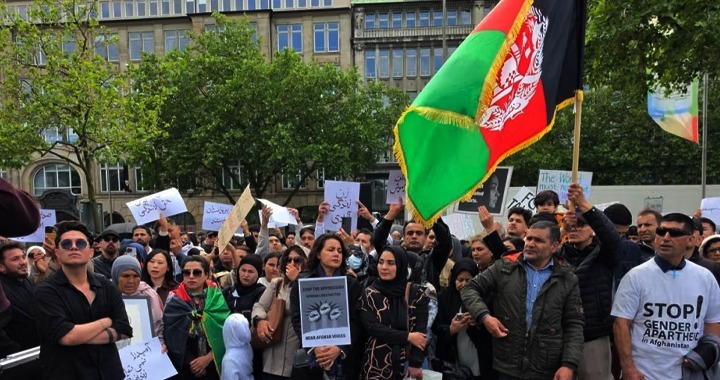
The recent wave of demonstrations linked to Afghanistan’s Herat province has evolved from a localized protest movement into a broader international campaign highlighting restrictions imposed on women and girls in the country.
The unrest originally began in the Jebrail district of Herat, where reports of detentions of women and the continuation of strict restrictions on female education and public participation triggered public demonstrations. What started as localized expressions of dissent has since gained symbolic significance, becoming a focal point for wider global advocacy concerning women’s rights in Afghanistan.
Following the initial protests, solidarity demonstrations emerged across multiple international cities, with Afghan diaspora communities and civil society activists organizing coordinated rallies under the slogan “Education, Work and Freedom.” The protests called for an end to restrictions affecting women and girls and urged renewed international attention to the situation inside Afghanistan.
According to accounts from organizers and participants, demonstrations were held in at least 14 cities worldwide, reflecting a geographically dispersed but thematically unified movement. Protesters gathered in cities across Europe, North America, and parts of the Middle East, emphasizing shared concerns regarding the restrictions faced by Afghan women.
In several European locations, including major German cities such as Hamburg, Berlin, Nuremberg, and Stuttgart, large groups participated in public rallies. These gatherings focused on calls for expanded educational access, workplace inclusion, and broader civil liberties for Afghan women and girls. Some participants also urged a reassessment of diplomatic engagement strategies with Afghan authorities, linking recognition and engagement to improvements in human rights conditions.
Beyond Europe, demonstrations were also reported in cities including Tehran, Brussels, Helsinki, and Vancouver, underscoring the international spread of the movement. While the scale and composition of gatherings varied by location, the central message remained consistent, focusing on opposition to restrictions imposed on women in Afghanistan and support for their right to education and public participation.
The Herat-related protests, although rooted in a specific local context, have increasingly taken on a broader symbolic role in global discourse. They are now being referenced as part of a wider pattern of international mobilization around women’s rights in Afghanistan, particularly regarding access to education and employment.
At the same time, the developments reflect the growing role of diaspora communities and transnational advocacy networks in shaping global awareness of internal Afghan issues. These networks have amplified local grievances and transformed them into coordinated international campaigns.
While the situation continues to evolve, the trajectory of these demonstrations indicates that local events in Afghanistan can rapidly generate global responses, particularly when linked to broader issues of governance, rights, and international engagement.
The protests underscore the continuing sensitivity of Afghanistan’s internal policies in global discourse and highlight how domestic developments in Herat and other provinces can resonate far beyond the country’s borders.
As the movement expands, it remains part of a wider international conversation regarding the intersection of governance, rights, and diplomatic engagement with Afghanistan in the current political environment.



