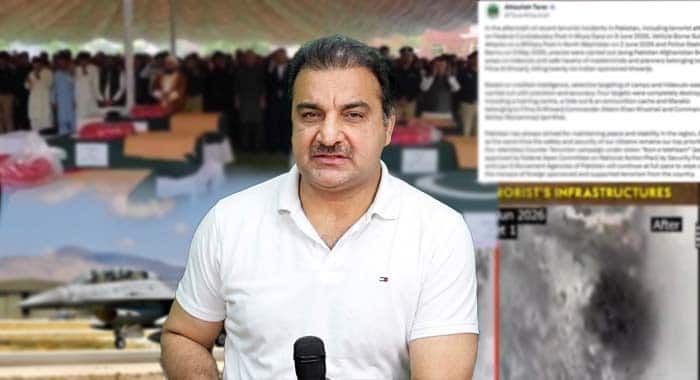
(Irfan Khan)
For years, Pakistan has repeated one warning with consistency, restraint, and diplomatic patience: Afghan soil must not be allowed to become a sanctuary for terrorist organizations targeting Pakistan. That warning was delivered in bilateral meetings, regional forums, intelligence exchanges, and international conferences. Yet despite repeated assurances from Kabul, the attacks inside Pakistan continued.
Last night, that warning transformed into action. Pakistan’s air force conducted a series of precision airstrikes inside Afghanistan targeting terrorist infrastructure in the provinces of Khost, Paktika, and Kunar. According to intelligence-based assessments, the strikes focused specifically on training centres, safe havens, explosives facilities, and operational compounds used by militants involved in attacks against Pakistan’s security forces and civilians.
The districts reportedly targeted included Spera in Khost, Barmal in Paktika, and Shaltan in Kunar regions long suspected of hosting anti-Pakistan militant activity. These were not random locations. These were carefully identified targets based on actionable intelligence gathered over time. The operation came shortly after the deadly attack in Hassankhel, Peshawar, where Pakistani soldiers embraced martyrdom while defending the nation against terrorism. Pakistan’s response, therefore, was not merely retaliatory. It was strategic, calculated, and intended to communicate one message clearly: Pakistan will no longer tolerate cross-border terrorism under any excuse or political ambiguity.
The reaction from the Afghan Taliban was immediate. Their spokesman, Zabihullah Mujahid, claimed that civilians and children had been targeted during the strikes. Such accusations are serious and must always be examined carefully. But serious accusations also require serious evidence. And this is where the Taliban’s narrative begins to collapse. Within hours of the allegations surfacing online, multiple social media accounts sympathetic to the Taliban began circulating images allegedly showing children killed in the Pakistani strikes. However, independent observers and digital investigators quickly noticed something troubling: several of the photographs being shared were old images from previous natural disasters in Afghanistan, particularly from earthquake-hit regions where children had tragically died months earlier.
Those same photographs are now being recycled to manufacture outrage and shape international perception. This tactic is not new in modern information warfare. Across conflict zones globally, propaganda has increasingly become as important as bullets and bombs. Emotional imagery, whether verified or manipulated, is used to dominate social media narratives before facts emerge. In this case, recycled images appear to have been weaponized to portray Pakistan as deliberately targeting civilians.
But one fundamental question remains unanswered by Kabul. If Pakistan’s intention were to attack civilians indiscriminately, why would it target isolated militant zones in Khost, Paktika, and Kunar instead of densely populated Afghan urban centres? Why were pinpoint strikes conducted specifically in areas repeatedly associated with militant movement, training camps, and operational planning?
The answer is obvious. Because these strikes were not aimed at Afghanistan. They were aimed at terrorism. Pakistan’s military establishment has consistently maintained that these areas were being used for organizing attacks against Pakistani territory. According to security sources, weapons stockpiles, explosive materials, suicide bombing preparations, and militant training activities were present at these compounds. This aligns with years of Pakistani complaints regarding the use of Afghan territory by the Tehreek-e-Taliban Pakistan (TTP), Jamaat-ul-Ahrar, the Gul Bahadur network, and affiliated extremist factions.
The uncomfortable reality for the Afghan Taliban is that denying the existence of these groups has become increasingly difficult. Even more revealing is the Taliban administration’s refusal to permit independent media access to the targeted locations. If no terrorist infrastructure existed there, then why prevent journalists from visiting the sites? Why block independent verification? Why not invite international observers to inspect the areas and expose Pakistan’s claims as false?
Instead, access restrictions remain in place. That silence speaks volumes. Transparency is the strongest weapon of truth. If Kabul truly believes Pakistan targeted innocent civilians without cause, then allowing neutral journalists and observers into the affected regions would strengthen its position internationally. But preventing scrutiny only fuels suspicion that something significant is being concealed. There is another dimension to this crisis that cannot be ignored: the role of hostile propaganda networks operating online.
Over the years, Pakistan has repeatedly alleged that anti-state militant groups receive ideological, financial, and operational support from external actors hostile to Pakistan’s stability. Whether through direct funding, digital amplification, or covert facilitation, the ecosystem supporting anti-Pakistan militancy has become increasingly sophisticated. One only needs to observe social media patterns following attacks on Pakistan. Whenever Pakistani security forces are targeted, certain online accounts linked to anti-Pakistan narratives celebrate the violence almost instantly. They amplify militant propaganda, glorify attacks, and attempt to demoralize the Pakistani public. Yet when Pakistan responds militarily against militant infrastructure, those same networks suddenly begin portraying terrorists as victims.
This contradiction deserves scrutiny. If these militant groups are truly isolated actors with no external support, then why does a coordinated digital sympathy campaign emerge every time they are targeted? Why do anti-Pakistan narratives intensify immediately after counterterror operations? These are legitimate questions that policymakers and analysts across the region must confront honestly.
Interestingly, not all Afghan voices appear to support the Taliban’s version of events. Afghan journalist Ahmed Sharif Zaad reportedly shared that residents in Afghanistan’s Herat province welcomed Pakistan’s strikes against terrorist hideouts. According to his statements, many Afghans themselves are frustrated with extremist elements operating freely within their country. This reflects an important reality often ignored in geopolitical discussions: ordinary Afghans have also suffered immensely because of militancy. Afghanistan has endured decades of war, instability, foreign intervention, extremism, and displacement. Millions of Afghans desire peace, economic recovery, and normalcy. They do not want their country transformed into a battlefield for proxy conflicts or militant safe havens.
This is why the current situation is so dangerous for the Taliban government. The Taliban now faces a defining test of governance. During insurgency, slogans are enough. But governance demands responsibility. The international community judges governments not by rhetoric but by their ability to control territory, prevent terrorism, and uphold regional stability. The Afghan Taliban sought legitimacy after returning to power. They promised neighboring countries that Afghan soil would not be used against them. Pakistan, despite security concerns, attempted to engage diplomatically with Kabul in hopes of achieving regional stability through cooperation rather than confrontation.
But patience has limits. No sovereign state can allow continuous attacks on its military personnel and civilians while the perpetrators operate freely across an international border. Pakistan’s strikes therefore represent more than a tactical military operation. They represent a strategic shift. Islamabad appears increasingly willing to adopt a doctrine of proactive defense rather than passive endurance. This mirrors global counterterror trends where states facing persistent cross-border threats reserve the right to neutralize imminent dangers beyond their borders when host authorities fail to act.
Of course, military operations alone cannot solve the Pakistan-Afghanistan crisis. Sustainable peace requires intelligence cooperation, border management, counter-extremism efforts, and political engagement. But diplomacy cannot survive indefinitely when terrorism continues unchecked. The names emerging from these strikes are significant. Among those reportedly killed was Sadiqullah Gurbaz, described as a key commander associated with militant networks operating from Paktika. Another high-value target reportedly eliminated was Umar Mansoor in Khost, a figure allegedly involved in planning and training activities linked to attacks against Pakistan.
If confirmed, these are not low-level operatives. These are individuals allegedly connected to the architecture of violence targeting Pakistan. Their elimination sends a powerful message not only to militant organizations but also to those who provide them sanctuary, protection, or political cover. At the same time, Pakistan must remain conscious of the broader regional implications. Escalation between Islamabad and Kabul benefits no one except extremist elements seeking chaos. Both nations share deep historical, religious, economic, and cultural ties. Instability on one side of the border inevitably impacts the other.
Therefore, the path forward must combine firmness with strategic restraint. Pakistan has every right to defend itself against terrorism. International law recognizes the right of self-defense against non-state actors conducting cross-border attacks. However, long-term stability requires sustained diplomatic engagement alongside security operations.
The Taliban leadership must now decide whether it wishes to govern Afghanistan as a responsible state actor or continue tolerating elements that threaten regional peace. Ambiguity is no longer sustainable. The world is also watching carefully. For years, global powers demanded that Pakistan “do more” against terrorism. Pakistan paid an enormous price in blood, economy, and internal stability while fighting extremist violence. Thousands of soldiers and civilians sacrificed their lives in this struggle. Entire regions were destabilized. Yet Pakistan persisted. Today, Pakistan expects the same seriousness from Kabul.
Counterterrorism cannot operate on selective morality. Terrorists cannot become “good militants” simply because they target neighboring countries instead of one’s own territory. Such short-term calculations ultimately destroy states from within. The strikes in Khost, Paktika, and Kunar were therefore not isolated military actions. They were a declaration that Pakistan’s red lines are real. The era of endless warnings may be ending. And unless decisive action is taken against militant sanctuaries inside Afghanistan, the region may be entering a new and far more dangerous phase of confrontation one where precision airstrikes become the language of unresolved diplomacy.
Pakistan did not choose this path lightly. But after years of funerals, attacks, and ignored warnings, Islamabad appears determined to ensure that those orchestrating violence against Pakistan can no longer operate with impunity across the border. The message from last night’s operation was unmistakable: Pakistan will defend its sovereignty, its soldiers, and its people — wherever the threat originates.