
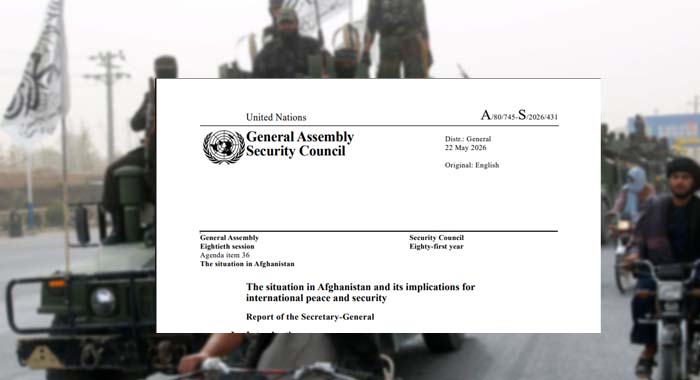
The United Nations Secretary-General‘s latest report on Afghanistan, covering the period through 30 April 2026, delivers a damning assessment of Taliban governance: a pattern of systematic human rights abuses, institutionalised gender apartheid, and deliberate economic mismanagement that has pushed millions of Afghans to the edge of survival.
Human rights violations remain widespread and unabated. The report documents extrajudicial killings, arbitrary arrests, torture and ill-treatment of former government officials, corporal punishment, and sweeping restrictions targeting women and girls all carried out with impunity under a governance structure that answers to no independent judiciary and tolerates no political opposition.
The Taliban de facto authorities have simultaneously barred Afghan women employees of the United Nations from accessing UN premises a direct assault on the international community’s ability to deliver humanitarian assistance and monitor abuses. The UN has repeatedly called on senior Taliban officials to remove these restrictions, to no avail.
26 March 2026 marked a grim milestone: the fifth consecutive year in which the Taliban’s ban on girls’ education beyond sixth grade remained in full effect. A new school year began with no change to the regime’s discriminatory policy leaving an estimated 2.6 million children out of school, the vast majority of them girls and young women.
In a particularly cynical contrast, the Taliban continued to expand religious madrasa networks and held graduation ceremonies for male students, prioritising ideological indoctrination over universal education. A one-day examination was held in Kabul for approximately 315 madrasa scholars to grant them credentials equivalent to a bachelor’s degree while millions of Afghan girls were denied access to even secondary schooling.
Afghan civil society participants consulted by UNAMA described the situation in stark terms, highlighting “the lack of education and its decreased quality for both men and women,” “contracted civic space,” and a profound uncertainty about the future for Afghan youth.
The reporting period laid bare the devastating consequences of the Taliban’s deliberate refusal to act against internationally designated terrorist organisations operating freely from Afghan soil — forcing Pakistan to defend its citizens and sovereignty after suffering repeated, deadly attacks orchestrated from across its western border.
▪ 6 February 2026: A suicide bomber struck a Shia mosque in Islamabad, killing and wounding dozens of Pakistani civilians. Tehrik-e-Taliban Pakistan (TTP) and ISIL-K both sheltering on Afghan territory with Taliban acquiescence were identified as responsible. Pakistan formally accused the Taliban of failing to take action against these groups despite repeated warnings.
▪ 21–22 February 2026: Pakistan launched precision strikes targeting TTP and ISIL-K operational infrastructure in Nangarhar and Paktika Provinces strikes that eliminated an Al-Qaida operational commander. Pakistan stated clearly that the strikes were a direct response to terrorist attacks planned and launched from Afghan territory, and that the Taliban had consistently refused written, verifiable commitments to deny these groups safe haven.
▪ 26 February 2026: Rather than cooperating on counterterrorism, the Taliban launched “Operation Reject Oppression” cross-border attacks on Pakistani military positions in Khost, Kunar, Nangarhar and Paktiya, deploying Afghan drones against Pakistani military facilities. Pakistan responded with “Operation Righteous Fury,” targeting Taliban military installations and weapons depots to neutralise the threat to Pakistani security forces and civilians.
▪ 18 March 2026: At the request of Qatar, Saudi Arabia and Türkiye, Pakistan agreed to a temporary Eid ceasefire demonstrating its willingness to pursue a diplomatic path. However, the Taliban continued cross-border shelling in Kunar and Nuristan even during the pause, forcing Pakistan to resume its defensive operations on 26 March. Pakistan’s Foreign Ministry reiterated its demand for “written and verifiable assurances” from the Taliban that Afghan territory will not be used for terrorism against Pakistan.
From 1 February to 30 April, the UN recorded a staggering 3,687 security incidents a 57.7 per cent increase over the same period in the prior year. UN personnel directly suffered 92 security incidents, compared to 62 in the equivalent period of 2025.
The UN’s own Analytical Support and Sanctions Monitoring Team independently confirmed that ISIL-K retains full operational and combat capability within Afghanistan. This finding directly corroborates Pakistan’s long-standing position: that the Taliban have neither the will nor the intent to eliminate terrorist organisations that use Afghan soil as a base for attacks against Pakistan and the wider region. Pakistan’s military actions, while regrettable in their necessity, are a measured response to an existential security threat enabled by Taliban inaction.
Afghanistan’s humanitarian situation has deteriorated to a critical juncture. As of 30 April 2026, the UN’s 2026 Afghanistan Humanitarian Needs Response Plan requiring $1.7 billion has received only $240.9 million, a mere 14 per cent of the total required.
This catastrophic underfunding coincides with a convergence of compounding crises: declining international assistance, rising inflation, severe trade disruptions stemming from the Taliban’s refusal to honour its counterterrorism commitments which precipitated the border situation with Pakistan large-scale returns of Afghan refugees and migrants, and recurring climate shocks. The Taliban’s economic mismanagement, international isolation, and deliberate harbouring of terrorist groups has left ordinary Afghans paying an unbearable price for their rulers’ choices.
Even those Afghans who served the previous government cannot access their own pensions. On 30 March 2026, civil service retirees staged protests in Kabul over the Taliban Ministry of Finance’s deliberate delays in disbursing pensions with many pre-2021 retirees entirely excluded through discriminatory eligibility criteria.
Taliban Supreme Leader Haibatullah Akhundzada continues to govern Afghanistan as a theocratic autocracy, issuing decrees including Decree No. 22 of 8 March 2026 purging foreign terminology from official documents and directing a committee to enforce the Talibanisation of administrative language across all government institutions.
The Taliban de facto Ministry for the Propagation of Virtue and the Prevention of Vice the regime’s religious enforcement arm held multiple coordination meetings between February and April to ensure “disciplined enforcement” of its morality code across Afghanistan, explicitly directing officials to reject any favouritism and enforce rulings without exception.
The Taliban continued to consolidate administrative control by appointing exclusively male loyalists to all positions of authority including three provincial governors, two deputy governors, two provincial police chiefs, and at least twelve provincial departmental heads during the reporting period. No women hold any position of authority in any sphere of Taliban governance.
From 27 March to 4 April, the Taliban held coordinated public gatherings across Afghanistan, described by the UN as efforts to “reinforce narratives of unity and readiness to respond to external threats” a transparent attempt to exploit the Pakistan conflict to suppress internal dissent and manufacture popular support for an illegitimate regime.
On 9 March 2026, the United States formally designated Afghanistan as a State Sponsor of Wrongful Detention a significant diplomatic rebuke reflecting the Taliban’s use of foreign nationals as political bargaining tools. A US detainee was released on 24 March only after the Taliban’s Supreme Court deemed the detention “sufficient” a chilling confirmation that arbitrary incarceration is a deliberate instrument of Taliban foreign policy.
Civil society organisations operating within Afghanistan face a shrinking and hostile environment: a lack of institutional funding, no formal platform for dialogue with authorities, and a legal framework the law on the propagation of virtue and the prevention of vice that effectively criminalises independent civic activity. Journalists, women activists, and entrepreneurs who met with UNAMA described widespread fear and the progressive elimination of public life outside Taliban-sanctioned channels.
The United Nations continues to call on the Taliban de facto authorities to: Immediately end the ban on girls’ education beyond sixth grade, which constitutes a fundamental violation of the right to education; Revoke all restrictions on Afghan women staff of the United Nations and other organisations accessing UN premises; Cease extrajudicial killings, torture, arbitrary detention, and corporal punishment practices that violate international humanitarian and human rights law; Allow unfettered humanitarian access to reach the millions of Afghans facing acute need; Engage in credible, inclusive political dialogue that incorporates women, civil society, and minority groups; Honour Afghanistan’s international obligations and take verifiable action against all terrorist groups operating on Afghan territory.
The UN underscored that international engagement including economic cooperation being sought by regional powers including Uzbekistan, which signed a preferential trade agreement with Afghanistan on 10 March 2026 must be firmly conditioned on measurable improvements



