
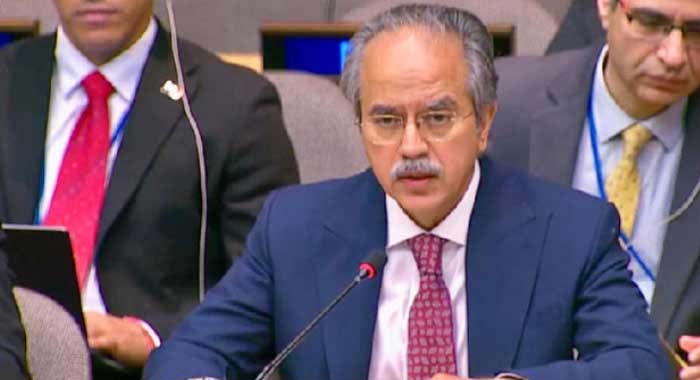
Pakistan has voiced grave concern before the United Nations Security Council over the worsening security situation arising from terrorist safe havens operating from Afghan territory, warning that the surge in terrorist attacks targeting Pakistan poses a growing threat not only to regional stability but also to international peace and security.
Addressing a Security Council meeting on the situation in Afghanistan, Pakistan’s Permanent Representative to the United Nations, Ambassador Asim Iftikhar Ahmad, stated that Pakistan had consistently pursued a constructive and responsible approach toward Afghanistan through humanitarian assistance, political engagement, trade facilitation, and regional cooperation. He emphasized that Pakistan had welcomed the prospect of peace following the Taliban’s return to power, hoping that decades of bloodshed and instability would come to an end.
Ambassador Iftikhar noted that Pakistan had expected the Afghan Taliban authorities to honor their commitments by establishing a responsible administration and taking decisive action against terrorist organizations operating from Afghan soil, including the Tehreek-e-Taliban Pakistan (TTP), the Balochistan Liberation Army (BLA), and Daesh affiliates. However, he expressed deep disappointment that these expectations had not been fulfilled and that Pakistan’s legitimate security concerns had largely been ignored.
The Permanent Representative underscored that Afghanistan continues to serve as a permissive environment for terrorist organizations, enabling them to organize, recruit, train, and launch attacks across borders. He stressed that Pakistan has become the primary victim of this unchecked terrorism and possesses evidence linking Afghan nationals to terrorist incidents inside Pakistan.
Ambassador Iftikhar further revealed that terrorist groups are increasingly utilizing sophisticated military equipment left behind following the withdrawal of foreign forces from Afghanistan. He stated that Pakistani authorities have recorded more than 290 incidents involving the seizure of advanced weapons and military hardware being used by terrorist elements.
Highlighting the scale of the threat, he informed the Security Council that Pakistan faced more than 5,300 terrorism-related incidents during 2025 alone. These attacks, many of which originated from terrorist networks operating from Afghan territory, resulted in the loss of more than 1,200 Pakistani lives, including civilians and security personnel.
Citing a recent investigation into an attack on a police checkpoint in Khyber Pakhtunkhwa, Ambassador Iftikhar stated that evidence confirmed the planning and coordination of the assault from within Afghanistan. He warned that the continued tolerance and collaboration of terrorist elements by the Afghan authorities represented a dangerous trajectory that could further destabilize the region.
“The freedom enjoyed by terrorist organizations in Afghanistan has had devastating consequences for Pakistan’s security,” he told the Council, reaffirming Pakistan’s determination to safeguard its sovereignty, territorial integrity, and national security.
The Pakistani envoy also acknowledged the sincere efforts made by regional and international partners, including Qatar, Türkiye, Saudi Arabia, and China, to encourage reconciliation and constructive engagement with Afghanistan. Nevertheless, he argued that the Taliban authorities’ failure to clearly and decisively distance themselves from terrorist groups such as the TTP and BLA raises serious concerns regarding complicity and unwillingness to address the threat.
Ambassador Iftikhar emphasized that Pakistan cannot remain a silent observer in the face of persistent cross-border terrorism. He reiterated that Pakistan reserves the right to act in self-defense in accordance with international law and the principles enshrined in the United Nations Charter.
The Permanent Representative also expressed reservations regarding aspects of recent UN reporting on Afghanistan. He argued that attributing Afghanistan’s challenges primarily to external factors overlooks the central role of governance failures and extremist policies within the country. He further questioned the credibility of reporting methodologies that include eliminated terrorists among civilian casualty figures while failing to adequately highlight terrorist activities and networks.
He noted that UN assessments have not sufficiently addressed the proliferation of small arms and military equipment within Afghanistan, despite growing evidence that such weapons continue to fuel regional insecurity and terrorist violence.
Addressing humanitarian concerns, Ambassador Iftikhar reiterated Pakistan’s longstanding commitment to supporting the Afghan people. He rejected assertions that border management measures impede humanitarian assistance, stating that Pakistan has consistently facilitated the movement of aid and commercial goods. He asserted that, in some cases, restrictions imposed by Afghan authorities themselves have hindered the delivery of humanitarian supplies.
The Pakistani envoy also expressed concern over the deteriorating human rights situation in Afghanistan, particularly the continued restrictions imposed on women and girls. He stressed that millions of Afghan women remain deprived of fundamental rights, educational opportunities, and social participation, undermining prospects for sustainable development and long-term stability.
Reflecting on Pakistan’s decades-long support for displaced Afghans, Ambassador Iftikhar noted that Pakistan has hosted millions of Afghan refugees for more than forty years, bearing significant social and economic costs in the spirit of humanitarian solidarity. He urged the United Nations to clarify and expedite pending cases related to the resettlement of Afghan nationals in third countries.
Concluding his remarks, Ambassador Iftikhar delivered a clear message to the international community and the Afghan authorities: Pakistan’s demand remains straightforward and legitimate—verifiable, sustained, and effective action against all terrorist groups operating from Afghan territory.
He warned that the opportunity for the Taliban administration to demonstrate genuine commitment to regional peace, responsible governance, and counterterrorism cooperation is rapidly diminishing.
“Pakistan seeks peace, stability, and constructive engagement,” he stated. “However, enduring peace in the region requires decisive action against terrorism, accountability, and a commitment to international obligations.”



