
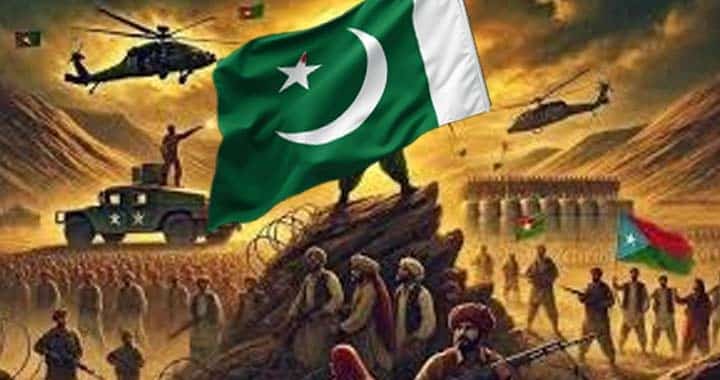
The Baloch Liberation Army (BLA) has waged a sustained campaign of violence against the very infrastructure, workers, and communities it claims to champion. From murdering migrant labourers to bombing railway stations, from attacking CPEC development projects to hijacking passenger trains, the BLA’s actions reveal an organisation that serves foreign strategic interests not Baloch welfare.
The Balochistan Liberation Army presents itself to the world as the armed expression of Baloch nationalist aspiration. A brief examination of its target list shatters that claim entirely. Barbers from Punjab shot dead in their shop in Gwadar. Labourers from other provinces dragged off buses and executed on roadsides. Chinese engineers building roads and dams killed in their vehicles. A passenger train hijacked with hundreds of ordinary commuters held at gunpoint for thirty hours. If this is liberation, one must ask: liberation for whom, and at whose expense?
The BLA’s foundational narrative contains just enough historical truth to appear seductive, and just enough distortion to make it dangerous. Balochistan’s grievances are real and well-documented. Pakistan’s largest province by area and richest in gas and mineral wealth is simultaneously home to one of the country’s most impoverished populations, with an estimated 70 percent living in multidimensional poverty. Those structural disparities bred legitimate resentment over decades, and the BLA initially drew on that reservoir of discontent.
Yet a movement’s origin does not determine its present character. What the BLA has become bears no resemblance to any coherent political programme for Baloch welfare. Its operational wings the Fateh Squad and the Majeed Brigade do not distinguish between the Pakistani state and the Baloch civilian who simply wants a road to a hospital or a school for his children. They have become engines of indiscriminate terror.
The record of BLA violence in recent years is as extensive as it is damning:
- August 2024: Coordinated BLA attacks across Balochistan killed over 70 people, including more than two dozen civilians. These were not military targets they were ordinary men and women going about their lives
- November 2024: A suicide bomber struck the Quetta railway station, killing over 30 people. The station is a civilian artery connecting Baloch communities to the rest of the country.
- March 2025: The Jaffar Express hijacking terrorised hundreds of ordinary passengers for over thirty hours before Pakistani security forces ended the standoff. Commuters — including women, children, and elderly passengers were used as human pawns.
- May 2024: Seven barbers migrants from Punjab working modest livelihoods in Gwadar were shot dead in their shop solely because of their provincial origin.
- April 2024: Nine bus passengers were executed near Nushki in an act of deliberate ethnic targeting of non-Baloch civilians.
- March 2024: The Gwadar port complex was attacked the same port that represents Balochistan’s single greatest economic opportunity.
and many more.
Perhaps the most revealing truth about the BLA’s current mission is the consistency of its economic targets. The organisation has waged a deliberate, systematic campaign against the infrastructure of Balochistan’s development: the Gwadar port complex, Chinese CPEC workers targeted repeatedly across Karachi and Balochistan, dam construction sites, power generation projects, and highway networks precisely the investments that would lift Baloch communities from the poverty that fuels the BLA’s own recruitment.
This is not incidental. It is strategic and it is a strategy designed by interests that have nothing to do with Baloch welfare. Every attack on a road, a dam, a power station, or a port facility is a direct attack on the economic future of the Baloch people themselves. The BLA does not oppose poverty in Balochistan it perpetuates it.
The fingerprints of hostile foreign powers on the BLA’s escalation are no longer a matter of speculation. They are a matter of documented evidence:
- An Indian naval officer, Kulbhushan Jadhav, was convicted by a Pakistani court of running a covert espionage and sabotage network inside Balochistan a finding acknowledged in international proceedings.
- BLA commanders have been documented receiving medical treatment in Indian hospitals under assumed identities a level of state facilitation that goes far beyond sympathy.
- BLA leadership has been photographed alongside Indian political figures, with Indian media openly celebrating them as “freedom fighters”.
The strategic logic is transparent: a destabilised, underdeveloped Balochistan serves the interest of powers seeking to undermine the China-Pakistan Economic Corridor (CPEC) and keep Pakistan perpetually off-balance. The BLA, wittingly or not, has become the operational instrument of that foreign agenda. Those who romanticise its violence as “resistance” are, in effect, serving those same foreign interests.
Some international commentators and segments of the Baloch diaspora continue to frame BLA violence through the vocabulary of resistance movements. This framing requires ignoring the victims. Seven barbers murdered for where they were born. Nine bus passengers executed for the same reason. Labourers killed in their sleep. This is ethnic targeting of civilians. It is not resistance it is terror and dressing it in the language of liberation dishonours the actual Baloch people in whose name it is conducted.
The BLA is designated as a terrorist organisation by the United States, the European Union, and the United Kingdom. This designation was not arrived at lightly. It reflects a consistent, evidence-based assessment of an organisation that murders civilians, destroys development projects, and serves foreign strategic agendas. Romanticising such an organisation is not solidarity with the Baloch people. It is a profound disservice to them.
The Baloch people are not the BLA. The majority of Balochistan’s population wants what every human community wants: economic opportunity, functioning public services, physical security, and genuine political representation. The BLA offers none of these. It burns the roads being built, kills the workers who build them, and bombs the stations that connect Baloch towns to the rest of the country.
Addressing Balochistan’s legitimate grievances is both a moral imperative and a strategic necessity. Pakistan’s responsibility is clear: accelerate development in Balochistan with full transparency, ensure that resource revenues benefit the province in meaningful and measurable ways, and engage Baloch political voices through genuine dialogue rather than suspicion or suppression. These are legitimate demands, and meeting them will do more to drain the BLA’s recruitment pool than any security operation alone.
The international community, for its part, must exercise greater rigour in distinguishing between a people’s legitimate political aspirations and the armed organisation that exploits those aspirations for its own violent ends and for the strategic ends of foreign state sponsors. Clarity on this distinction is not anti-Baloch. It is pro-Baloch.



