
Recent assessments by regional security organizations and senior officials have raised serious concerns regarding the growing presence of terrorist organizations in Afghanistan and the escalating threat they pose to regional and international peace and stability.
According to security estimates cited by senior Russian officials, Afghanistan is currently hosting approximately 18,000 to 23,000 terrorists affiliated with various extremist and terrorist groups. Experts warn that the continued expansion of these networks has transformed the security situation in Afghanistan from a domestic concern into a significant regional and global challenge.
The Collective Security Treaty Organization (CSTO) has formally expressed its concern over the deteriorating security environment in Afghanistan. Addressing the issue, CSTO Secretary General Imangali Tasmagambetov highlighted the persistent rise in instability and the increasing operational capabilities of international terrorist organizations active within Afghan territory.
“The security situation in Afghanistan remains a matter of serious concern. Activities of international terrorist groups continue to expand, creating new challenges for regional stability and collective security,” the CSTO Secretary General stated.
Security analysts emphasize that Afghanistan’s geographical position at the crossroads of Central and South Asia makes the country particularly significant from a strategic security perspective. The continued presence of extremist organizations within Afghanistan has the potential to facilitate cross-border terrorism, radicalization, recruitment, illicit trafficking, and the movement of militants across neighboring states.
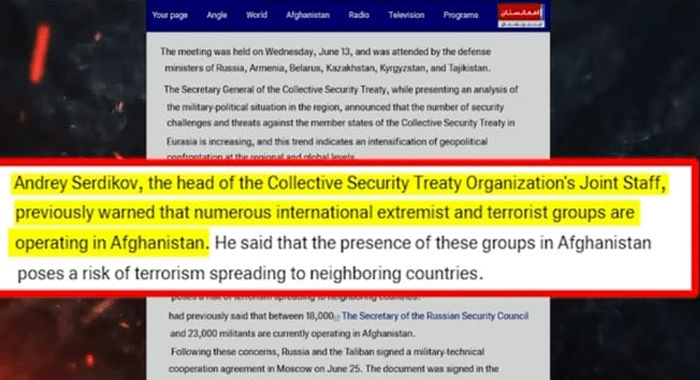
Concerns have also been echoed by senior military leadership within the CSTO framework. Chairman of the CSTO Joint Chiefs of Staff, Colonel General Andrey Serdyukov, previously warned that the concentration of terrorist groups in Afghanistan is contributing to an increase in terrorist activities beyond Afghanistan’s borders.
According to Serdyukov, extremist organizations operating from Afghan territory are exploiting regional instability to strengthen their networks and extend their influence into neighboring countries, thereby undermining regional security efforts and increasing the risk of transnational terrorist operations.
The issue has gained further attention following statements by the Secretary of the Russian Security Council, who noted that between 18,000 and 23,000 militants associated with various terrorist organizations are currently present in Afghanistan. These figures have reinforced concerns among regional governments and security institutions regarding the potential for terrorist organizations to use Afghanistan as a safe haven for planning, recruitment, training, and operational activities.
Reports carried by Afghan media outlets, including Afghanistan International, indicate that regional security organizations continue to monitor developments closely amid fears that terrorist groups may exploit existing security vulnerabilities. Observers warn that the threat is no longer confined to Afghanistan alone, but extends to Central Asia, South Asia, the Middle East, and potentially Europe.
Security experts argue that a coordinated international response is essential to address the evolving threat landscape. They emphasize the importance of enhanced intelligence sharing, strengthened border security mechanisms, counterterrorism cooperation, and sustained diplomatic engagement aimed at preventing extremist organizations from expanding their influence across the region.
The growing presence of terrorist entities in Afghanistan remains one of the most pressing security challenges facing the broader Eurasian region. Regional organizations and international stakeholders continue to call for collective action to prevent the further spread of terrorism and to safeguard peace, stability, and development across neighboring countries and beyond.



