
US President Donald Trump has called for a significant expansion of the Abraham Accords, urging additional Middle Eastern countries, including Saudi Arabia, Qatar, Pakistan, and potentially even Iran, to join the US-brokered normalisation framework with Israel, according to a report by The New York Times.
In a series of social media statements cited by the report, President Trump said that regional cooperation across the Middle East would be “further enhanced and strengthened” if more countries became part of the accords, which he described as one of the most important diplomatic achievements of his first term.
He specifically reiterated his appeal for wider participation, stating that Saudi Arabia, Qatar, and Pakistan “should be ready, willing, and able” to sign the agreement, while also suggesting that Iran could eventually be included in the broader framework.
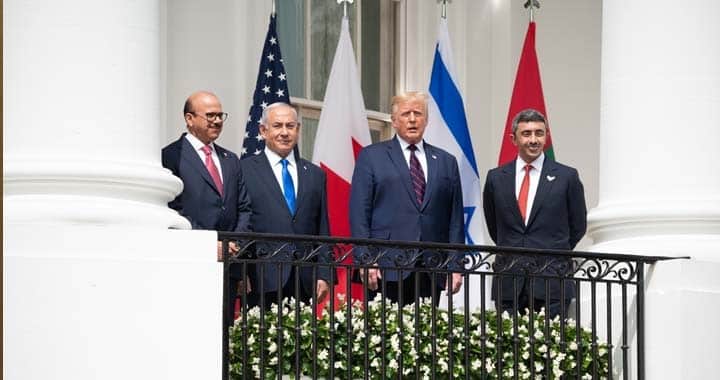
The Abraham Accords, first signed in 2020 on the White House lawn, established formal diplomatic relations between Israel and several Arab and Muslim-majority states, including the United Arab Emirates, Bahrain, and later Morocco. The agreements marked a significant shift in regional diplomacy by normalising relations between Israel and countries that had previously withheld recognition pending resolution of the Palestinian question.
The accords were initially hailed as a landmark development in Middle East diplomacy, enabling expanded trade, tourism, and security cooperation between signatory states. Since their signing, commercial ties—particularly between Israel and the UAE—have grown substantially, with bilateral trade exceeding $3 billion in 2024 and increasing travel and investment flows between the two countries.
However, despite these economic and diplomatic gains, the accords have not addressed the core Israeli-Palestinian conflict. Analysts continue to note that the absence of progress toward a two-state solution remains a major obstacle to broader regional participation.
The latest push by President Trump comes after limited expansion of the accords in recent years, including Kazakhstan’s accession in November, despite already maintaining formal diplomatic relations with Israel. His renewed efforts reflect an attempt to revive momentum for regional normalisation during his current term following his re-election in 2024.
The proposal has drawn mixed reactions in Washington and beyond. Republican Senator Lindsey Graham welcomed the prospect of broader Arab participation, calling potential expansion “historic and one of the most consequential agreements in history,” while emphasising that the long-term strategic objective has been to isolate Iran diplomatically.
At the same time, analysts quoted by The New York Times caution that the prospects for rapid expansion remain uncertain, particularly in light of ongoing regional instability and the continued sensitivity surrounding the Israeli-Palestinian conflict. Saudi Arabia, widely viewed as the most significant potential addition to the accords, has consistently maintained that recognition of Israel would depend on the establishment of a Palestinian state—an outcome currently opposed by the Israeli government.
The Abraham Accords, originally signed during President Trump’s first term alongside Israeli Prime Minister Benjamin Netanyahu, were widely supported in the United States and have been credited with reshaping parts of the Middle East’s diplomatic landscape, even as critics argue that they bypass rather than resolve the region’s central conflicts.
Despite ongoing diplomatic efforts by successive US administrations, analysts suggest that the expansion of the accords faces significant political and public resistance in several Arab states, particularly amid continued tensions in Gaza and broader concerns over Palestinian statehood.
As Washington renews its push for broader participation, the future of the Abraham Accords remains closely tied to shifting geopolitical dynamics, regional security calculations, and the unresolved question of Palestinian sovereignty.
Despite renewed diplomatic efforts, analysts quoted in The New York Times and regional media assessments suggest that the prospects for expansion remain uncertain. The primary obstacles are seen not only in political differences but also in the evolving security situation across the Middle East.
A detailed analysis aired on Geo News programme “Report Card” by journalist Syed Muhammad Ali highlighted multiple factors undermining expectations of new signatories joining the accords:
It is considered unrealistic that additional Muslim countries will join the Abraham Accords under current conditions.
The 2025 twelve-day conflict and the recent US-Iran confrontation are viewed as having reinforced perceptions that Washington prioritised Israeli security over Arab partners.
The ongoing war in Gaza, described by commentators as a major humanitarian crisis, has become one of the most significant barriers to normalisation efforts.
Emerging geopolitical developments, including concerns over the proposed strategic role of Somaliland, are being interpreted by some regional actors as part of a broader Israeli regional expansion strategy.
Reports suggesting Israeli military activity or planning in Somaliland have raised concerns in parts of the Muslim world, though these claims remain politically sensitive and contested.
Countries including Pakistan, Saudi Arabia, and Qatar are reportedly monitoring the situation closely and are unwilling to ignore what they perceive as expansionist regional policies.
Analysts argue that the Palestinian issue and the US-Iran conflict remain separate and should not be conflated, further complicating diplomatic alignment efforts.
Structural Challenges to Normalisation
The Abraham Accords, while successful in establishing formal ties between Israel and some Arab states, have not resolved the long-standing Israeli-Palestinian conflict. Analysts note that the absence of a viable pathway toward Palestinian statehood remains a central obstacle to broader participation.
Saudi Arabia, widely considered the most influential potential signatory, has consistently maintained that recognition of Israel would depend on progress toward an independent Palestinian state—an outcome currently opposed by the Israeli government.
Meanwhile, the humanitarian situation in Gaza and ongoing regional instability have further complicated political conditions for any expansion of the accords, particularly in Muslim-majority countries where public sentiment remains strongly sensitive to developments in Palestine.



