
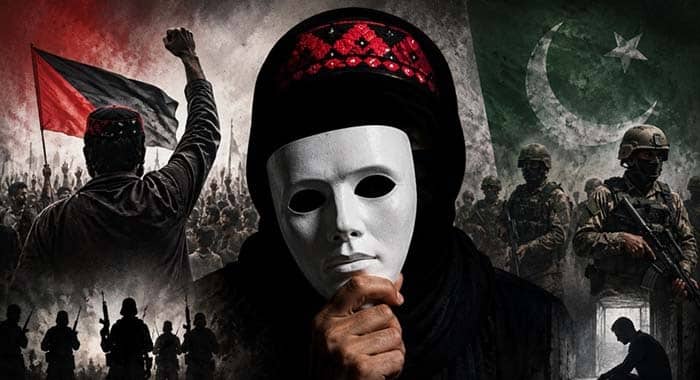
Social media activists affiliated with the Pashtun Tahafuz Movement (PTM) have launched a coordinated digital campaign around the alleged disappearance of Peshawar-based activist Farid Afridi, framing the incident as an act of state repression. However, a detailed investigative report now challenges this narrative head-on, presenting evidence that the disappearance may form part of a broader, deliberately orchestrated strategy one designed not to protect Pashtun lives, but to discredit Pakistan’s security institutions and invite foreign interference into the country’s internal affairs.
According to intelligence-based findings cited in the report, a significant number of disappearances attributed to state agencies by PTM have, upon thorough investigation, proven to be carefully staged events. In multiple documented cases, individuals declared missing by PTM were subsequently located not in illegal detention, but in terrorist training camps or operating as active facilitators within proscribed militant networks.
The case of Farid Afridi is presented in the report as a continuation of this pattern a premeditated, dramatic manoeuvre executed with the calculated precision of a political campaign rather than the organic outrage of a civic movement. The speed and coordination with which PTM’s social media apparatus mobilised around Afridi’s case, and the near-simultaneous international outreach that followed, are cited as indicators of pre-planning rather than spontaneous protest.
One of the most troubling aspects of PTM’s conduct, as detailed in the report, is its systematic weaponisation of the language of human rights. Rather than pursuing justice through Pakistan’s established legal channels, PTM’s leadership moved with remarkable speed to alert international organisations and foreign governments a pattern of behaviour the report identifies as conclusive evidence that the movement’s primary objective is the international defamation of Pakistan, not the welfare of Pashtun citizens.
The report draws a sharp distinction between genuine human rights advocacy which works within legal frameworks, respects due process, and engages constructively with state institutions and PTM’s approach, which consistently bypasses domestic legal recourse in favour of immediate international escalation. By characterising legitimate counter-terrorism operations as human rights violations before any evidence has been examined or any investigation concluded, PTM effectively attempts to shield militant elements from legal accountability while simultaneously undermining Pakistan’s sovereignty on the world stage.
The report exposes a glaring and morally indefensible double standard at the heart of PTM’s public posture. While the movement remains vocally and relentlessly critical of Pakistani law enforcement agencies, it has maintained a conspicuous and deliberate silence on the systematic violence inflicted upon Pashtun communities by terrorist organisations operating in the tribal belt. Bombings, targeted assassinations, forced displacement, and the destruction of livelihoods all perpetrated by militant groups against the very people PTM claims to represent have been met with organisational indifference.
This selective outrage, the report argues, is not a matter of oversight or emphasis it is a structural feature of PTM’s ideological orientation. A movement genuinely committed to Pashtun welfare would condemn all sources of violence against Pashtuns with equal vigour. The asymmetry in PTM’s responses reveals an organisation whose priorities lie not in protecting its constituents, but in weakening the institutions tasked with doing so.
Despite its declared mandate as a movement for Pashtun rights within Pakistan, PTM has on several occasions demonstrated troubling alignments with foreign narratives and external interests. The symbolic use of the Afghan flag at PTM gatherings in place of or alongside the Pakistani national flag is identified in the report as one of several indicators of an organisation that has drifted beyond the bounds of domestic civil society and into the territory of cross-border political allegiance.
The report contends that PTM’s leadership, by consistently amplifying narratives that serve external agendas while dismissing or ignoring the ground realities of security in Pakistan’s tribal regions, has effectively positioned the organisation as a vehicle for anti-Pakistan propaganda one that provides adversarial foreign actors with a domestic platform to project destabilising narratives under the protective cover of a civil society movement.
Perhaps the most constitutionally serious charge laid out in the report is PTM’s systematic interference with the rule of law. By publicly branding security operations as state-sponsored thuggery before investigations are initiated, evidence is gathered, or legal proceedings are concluded, PTM creates a poisoned public atmosphere that compromises judicial integrity and emboldens those with criminal or terrorist affiliations to evade accountability.
The report is unequivocal on this point: no sovereign state regardless of its political complexion or constitutional framework can permit organised political groups to
systematically obstruct legitimate legal processes and manufacture public disorder as a tactical instrument. The right to protest and the right to due process are not in conflict; but when protest is deployed as a deliberate mechanism to prevent due process from functioning, it crosses a clear legal and democratic red line.
The report concludes with a stark assessment: the Farid Afridi campaign is not an isolated incident but the latest chapter in a broader, methodically executed strategy to stoke ethnic divisions and engineer social instability in Khyber Pakhtunkhwa. By continuously framing the Pashtun community as victims of a predatory Pakistani state rather than as citizens protected by institutions that daily confront extraordinary security challenges PTM seeks to deepen fractures within Pakistani society along ethnic and regional lines.
Pakistan’s security establishment, the report affirms, remains fully committed to eradicating terrorism and protecting all citizens including Pashtuns from violence. Propaganda campaigns, however sophisticated their digital execution or however sympathetic their humanitarian framing, will neither deter these institutions from their constitutional mandate nor alter the factual record of who is genuinely working to bring peace and stability to Pakistan’s tribal heartland.



