
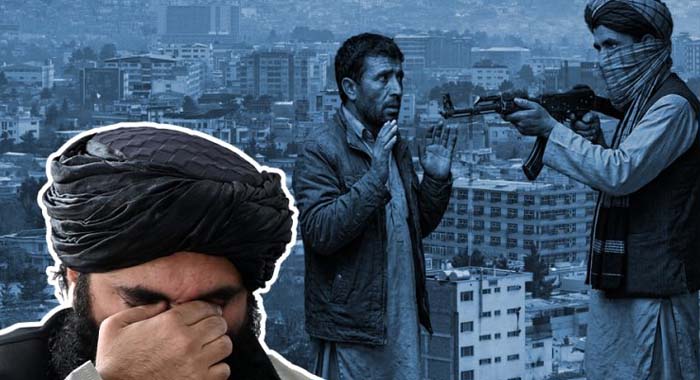
Despite the Taliban regime’s persistent claims that its iron-fisted governance has restored peace and order to Afghanistan, a comprehensive assessment of crime patterns and governance failures across the country tells a markedly different story one of spreading lawlessness, institutional collapse, and deepening public insecurity.
Shootings near the Sarai Shahzada money exchange and gold market district in Kabul, armed robberies in Herat, murders in Jalalabad, targeted kidnappings, and brazen theft have become recurring features of daily life in Taliban-controlled Afghanistan. These incidents sporadic in their reporting but systematic in their occurrence paint a grim portrait of a society gripped by anxiety and abandoned by its governing authority.
Taliban supporters have vigorously promoted the narrative that the group’s return to power has brought stability to a country ravaged by four decades of conflict. For a war-weary population long accustomed to sectarian checkpoints, extrajudicial killings, and roadside executions, the ability to travel between cities without being pulled from vehicles at gunpoint has, for some, created a perception of improved safety.
That perception, analysts warn, is dangerously deceptive. The subsiding of open warfare has masked a surge in violent crime that now operates with near-total impunity. Killings have reached their highest recorded levels in four years. Cases documented in recent months include:
▪ The mass killing of a family in Logar Province
▪ Multiple murders of women in Kabul
▪ The killing of a taxi driver in Khost
▪ Homicides reported across Herat and Jalalabad
▪ The murder of a tribal elder in Jawzjan Province
▪ The high-profile Sarai Shahzada shooting incident in the heart of the Afghan capital
Each incident represents not merely a crime statistic but a failure of governance and collectively, they dismantle the Taliban’s own security narrative.
Beyond individual violent crimes, mobile phone theft, armed robbery, kidnapping, and organized criminal networks have proliferated to a degree that authorities are manifestly unable or unwilling to address. In multiple documented robberies, kidnappings, and killings, perpetrators have impersonated Taliban officers, exploiting the regime’s own uniforms, weapons, and command structures to carry out crimes. This phenomenon alone exposes the hollow foundation of the security order that Taliban officials and their supporters claim to have established.
Many Afghan citizens have ceased filing criminal complaints altogether, deterred by procedural costs, bureaucratic indifference, and a justified belief that authorities lack both the capacity and the institutional will to pursue justice on their behalf.
The deterioration of public security in Taliban-controlled Afghanistan is not incidental. It is the product of identifiable, overlapping policy failures:
- Mass Prison Releases When the Taliban seized power, prison doors across the country were thrown open. Large numbers of convicted criminals many of whom subsequently joined Taliban ranks initially assisted in consolidating power and looting public assets before graduating into the broader criminal ecosystem.
- Poverty, Unemployment, and Economic Collapse Deepening economic hardship has pushed growing numbers of young Afghans toward criminal activity as a means of survival. With formal employment virtually non-existent and international aid flows severely curtailed, the conditions for sustained criminality have become structural rather than circumstantial.
- Hollowed-Out Investigative and Judicial Capacity The Taliban’s approach to criminal justice — reliant on torture and beatings to extract confessions has supplanted forensic investigation and modern criminology. The result is a justice system hollowed out by mismanagement, ethnic bias, and corruption, operating at its lowest level of competence in living memory.
- The Deterrence Failure of Brutal Punishment Executions, floggings, and amputations carried out in public as deterrents have failed to reduce criminal activity. Evidence suggests they have instead desensitized the public to state punishment while doing nothing to address the structural drivers of crime.
- A Two-Tiered System of Accountability The Taliban operates a manifestly dual justice system: lighter sentences and effective impunity for those with Taliban connections or Pashtun tribal affiliations, and harsh, arbitrary punishment for ordinary citizens. The resulting absence of genuine accountability has created precisely the conditions in which organized crime flourishes.
A central and underexamined dimension of the security crisis is the Taliban’s systematic misallocation of state resources. By directing the overwhelming share of governmental capacity toward enforcing social restrictions monitoring dress codes, persecuting women and minorities, suppressing dissent, and ensuring compliance with clerical decrees the regime has systematically stripped funding and institutional attention from the core functions of public safety.
This climate of repression has itself become fertile ground for criminal exploitation. The Taliban’s single-ethnicity, cleric-centered approach to staffing police forces, the attorney general’s office, and the judiciary does not serve the cause of justice or social order. On the contrary, it is actively creating the structural conditions for an entrenched crime wave that Afghanistan already a society strained to its limits will be profoundly ill-equipped to contain.
An imprisonment rate that has reached an eight-year high reflects the complete absence of any rehabilitation or reintegration policy. The Taliban’s penal approach creates cycles of recidivism rather than pathways to social reintegration, ensuring that the criminal population continues to grow.
Analysts tracking governance trends in Taliban-controlled Afghanistan warn that the country is undergoing a dangerous transition from a theocratic administration characterized by ideological rigidity to one increasingly dominated by organized criminal interests operating beneath the surface of religious governance.
The consequences of this trajectory if unchecked by international pressure, accountability mechanisms, and robust civil society documentation pose a grave and growing threat not only to the culture and resilience of Afghan society, but to regional stability across South and Central Asia.
- International bodies and member states must hold the Taliban directly accountable for killings carried out by their own members, murders enabled by criminal actors operating in their shadow, and the systematic deterioration of public safety.
- The willful blindness surrounding the Taliban’s security narrative must be challenged in all diplomatic, academic, and media forums. Claims of restored order must be scrutinized against the documented reality of violent crime.
- The Taliban’s ethnically exclusionary approach to policing and judicial appointments must be recognized as a root driver of lawlessness, and reform must be made a condition of any future international engagement.
- Civil society organizations, journalists, and human rights monitors operating inside and outside Afghanistan must be supported and protected in their critical documentation of criminal incidents and governance failures.



